Pilgrimage: Icons Pt. 1

Outside of the deliberate misrepresentation that traditional faiths worship saints, the largest misconception about traditional faith is that we worship icons. And, yes, I do consider it a deliberate and willful misrepresentation of truth, faith, and more. It is a heresy and the last gasp of iconoclasm in the service of the evil one. Too strong for you? Hang on, I will do my best to explain a book’s worth of theology in a single blog post. Can’t be done, but I will at least give you some broad strokes and the grounds for future discussions and explorations.

Fact is, icons have been a part of Christianity. From. The. Start. Just like the veneration of relics, a topic for another day (or year as that too is multiple books). Part comes from the fact that early Christianity (up until well past middle age even) (well, what did you expect, I am a PUNdit after all) was an oral tradition, not a written. As I have discussed before, the early Church (and even unto the 1700s) was based on oral tradition and not literary/written.

Per some previous discussions, go read Matthew, and then read Luke. Two things jump out. First, Matthew was written for an oral tradition including things done to enhance memorization. Luke, in addition to clearly having talked with the Theotokos (Mary, the mother of God), was a literate man who wrote a literary work. It clearly reads as such, and he was one of the few if not the only Apostle who was literate in that he could both read and write. Look at the Epistles and note that in many cases they list who wrote down the words and that they would be sent WITH THE LETTER to verify and explain as needed.

The other thing a lot of other people don’t know or don’t get is that Luke was one of the first (if not the first) iconographers. In fact, of the several with which he is credited, at least four are believed to survive to this day. One of those icons is said to have been painted upon wood from the table where the Holy Family ate. Yes, he is credited with taking the supper table of Christ as a youth and using the wood from it for an icon.

There is a lot that could be said about the seventy or so icons he is said to have created. However, I will simply note that one of the most famous, The Directress, has spawned thousands of copies. It simply depicts Christ the babe in the lap of Mary, with her pointing at him with emphasis indicating HE is the way, the truth and the light. That was the role the Theotokos chose in life, to point to him, to guide people to him. In many respects, it is still her role.

I will again point out an interesting thing I noted a while back. Of the icons attributed to Luke, the Theotokos is almost identical in each, while the figure of Christ can change rather dramatically. To me, it strongly indicates that he did indeed meet and talk with the Theotokos, and that — per scripture — he never met Christ in the flesh. Think about that for a bit, and consider that his icons were accepted not only by the Theotokos, but the fathers of the Church as well. Do you really think that if they were a blasphemy or wrong that no one would have spoken out? Just a thought to consider.

Let’s set aside such things for a moment, and discuss: what is an icon? In the broadest strokes, an icon is a depiction of a person that captures the totality of their work or life and provides a means of two-way communication between the person venerating and the person or persons depicted within the icon. Icons have been described as “windows into Heaven” in that the person or persons being depicted are the only people we know for sure are in Heaven, and the icon offers a path for mutual communication with them.

Now, I’m not saying that the icon comes to life and actually talks with you. It has happened, and I just had the chance to venerate one such icon while in Greece. That icon of the Theotokos (the Virgin Mary) spoke three times to the nuns of a monastery warning them to take everything they could and flee. The third time it spoke they listened, gathered up what they could, and fled. A few hours later a guerilla force sacked the monastery.

Yet another was at the Vatopedi monastery on Mount Athos, and I also had the chance to venerate, study, and pray before it. That icon spoke to warn the abbot not to open the gate one day, as pirates lay in wait for them to do so, so they could sack the monastery. In fact, that icon did in effect come to life, with the infant Jesus trying to stop her from talking, saying the monks deserved what was to come because they were not honoring their vows. She pulled down his hand and repeated the warning, which was heeded. Turns out, when they cautiously checked, the pirates were seen and had large rocks dropped on them, and surprisingly they ran away rather than pressing the sack as was normal. In the aftermath, the icon returned to something close to its original form, save that the infant Jesus’s hand was still in the process of being pulled down and he has a rather angry look on his face. The original fresco was very carefully removed and preserved with those changes; and, a new fresco was put up restoring the happy smiling infant Jesus with his hands where they were originally. The miracle icon is now in a special chapel above the main church, and I found it to be incredibly powerful.

This also brings up the matter of materials. The fact is, there is no limit. Many are painted (written) on wood. Others are done with mosaics, while yet others are done as plaster frescoes. Some more modern ones are copies printed and mounted on wood. I’m looking at one right now that is technically a photograph, but is accepted as an icon. We just had a very interesting discussion in the recent theology class that even something done by AI using prompts from an iconographer who did the prayers and other preparations could be an icon.

Again, the materials don’t matter. According to the seventh ecumenical council (which ended iconoclasm), what matters is: it has to depict a person and not an object; it has to be historical, and not of a dream, legend, etc.; it has to show the totality of a life or event in a life; and, it has to provide two-way communications. There is more, and I’m skipping a lot to keep this a reasonable length, but one final thing is that it has to be able to be venerated by people.

When you go into any number of Greek or Eastern Orthodox churches, you will find saints at ground/eye level, often grouped together by various criteria. The idea is that those icons not only tell the story of the saint(s) in question, but are where the laity can access them. Above them you often find religious art (not icons) depicting the life of Christ. Above that you may have one (or more, Russian Orthodox churches often have five levels I’m told) levels depicting individuals, events, etc. None of the higher levels are considered icons as no one can reach them to venerate them.

A quick aside in regards a lot of the artwork and illustrations seen in traditional churches. As I mentioned above, the early Church was based on an oral tradition not a literary one as few were literate. Instead, the laity and what became the clergy memorized scripture and the books of the Old Testament. The artwork was a memory prompt, as it immediately brought up the scripture associated with the event depicted. When someone wanted to know how many times or in how many places something was discussed, they didn’t have the internet and such. What they did have were people who had memorized content and could think about and then tell you the answer and provide you with the citations as they went.

Now, a couple of other things to share about icons. First up, they have to provide the whole picture as it were. One of the most famous icons, Christ Pantocrator, really threw me the first time I saw it as Christ has two different eyes in historically accurate versions. One eye reflects his divine nature while the other reflects his human nature (two natures separate but united). For those interested, a little tidbit from the recent class. That icon was originally on the walls at a gate into Constantinople and was copied onto the ceiling of a monastery in the Holy Lands. After Constantinople fell, the one in the monastery was copied and spread as the original was lost.

You are going to find a lot of things like that in icons, particularly Byzantine icons. It has to represent the whole, not a snapshot of one brief moment in time. How that was accomplished varied, and for those interested it grew out of the synthesis of Semitic and Hellenistic art in iconography and religious art. Hellenistic artwork tended to be heavily realistic and striving for beauty, while the Semitic was focused less on beauty and more on message. Those “models” if you will, and the synthesis of same, defined much of the iconography and religious art of the early Church.

One other thing you are likely to notice is that perspective is off. Part of that comes from trying to depict the whole rather than a moment; and, part comes from the fact that it is not your viewpoint that drives things, but God’s. The perspective is different because it puts you into the icon as a participant and not a viewer. The world isn’t centered and doesn’t revolve around you, you are a part of the events not separate from them.

Another neat little fact is that indoor scenes always show as outdoor or without a roof/ceiling/etc. This is because nothing is hidden from God. Roof, tent, etc., God sees you as if they are not there. So, they are not present in the icon. Also, the gold background on classical Byzantine icons is intended to represent infinity. It is only in later Byzantine iconography that dark or shaded backgrounds came about, possibly reflecting the darkness as the empire fell.

Now, for the above two paragraphs, you can see what I’m talking about in Byzantine icons of the Annunciation. Though inside, no roof. Perspective on most puts you in the picture and not as a viewer of it. It’s not one brief moment shown; rather, the complete story is depicted using a variety of techniques.

By the way, neither icons or religious art are supposed to depict the Father as a bearded old man, or the Holy Spirit as a dove and the Lord as a lamb. On the former, based on all the Greek Orthodox churches I went into, that has to be the most cheerfully violated bit of canon law out there. On the latter, I can’t count how often that pops up in Protestant art in particular.

There is a lot more that I could say, and I’ve probably not done the best job on what I have said. All errors are mine and mine alone. But, it is a start and hopefully there is fuller discussion of individual points to come. There have literally been books written on these subjects: just the difference in how Orthodoxy depicts the Crucifixion versus the Roman Catholic Church is easily a few thousand words.

Hopefully, however, this gives you a start on understanding icons and iconography. I want to emphasize that per more than one ecumenical council they are not idolatry (and I haven’t yet touched the paganism behind iconoclasm). Rather, they are windows and appeals into heaven which, even unto this day, bring about miracles. There is hopefully a lot more to come on this topic.

If you would like to help me with this trip, seminary courses, and more, feel free to hit the fundraiser at A New Life on GiveSendGo, use the options in the Tip Jar in the upper right, or drop me a line to discuss other methods. I’ve added Cash App ($CliffPow7) and Venmo (@Clifford-Powers-5). There is also the Amazon Wish List in the Bard’s Jar. Getting hit by lightning is not fun! It is thanks to your gifts and prayers that I am still going. Thank you.

Pilgrimage: St. Gregory Palamas

Back in this post, I mentioned getting to meet St. Gregory Palamas and alluded to a story behind wanting to meet him. Thought today would be a good time to do so, and to set the stage for a long-promised discussion on icons, specifically Byzantine icons, and the difference between such and religious art.

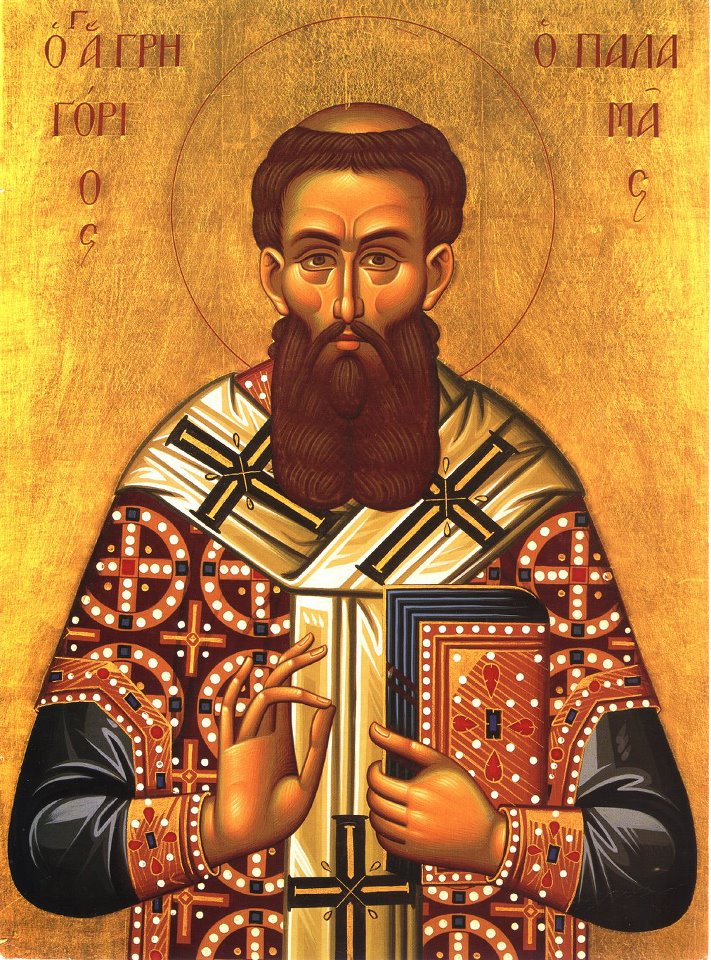
This image of St. Gregory Palamas (borrowed from the OCA website) is fairly typical of those I saw in Thessaloniki. Almost all depict him in a similar manner, with a reddish-brown beard and a fairly full head of hair. For the record, I figure the locals (as it were) might know a bit more about what he looked like in real life.

I want to note, however, that icons are not intended to be snapshots. Indeed, the purpose of an icon is to present the whole story and not just a snapshot of one part of it. Hence he is shown as a doctor of the Church but with elements that are intended to show the entire picture of monk-theologian-archbishop. The eyes here are intended to show intelligence, while many of the others I saw tended to show more thoughtfulness.

Which is a bit different from the icon of him in my church back in Indianapolis. The image there shows him with a somewhat longer face, black hair, and if I remember correctly not a full head of hair. Or as bushy a beard. The eyes of that icon are also very different. To put it bluntly, if you are anywhere other than directly in front of him (and sometimes even then) it looks like he’s giving you the side-eye. A very judgemental side-eye. Particularly as you venerate another saint nearby.

A friend of mine and I have talked and laughed about it, but I admit it is a little unsettling as one of the points/criteria for something to be an icon is that there is two-way communication. It is not just a painted piece of wood, but something where communication can and does flow both ways. Which makes the apparent side-eye a bit uncomfortable.

Now, my solution was to start talking to him. Note, yet again, we do not pray to the saints; rather, we talk to them and ask them to pray and intercede for us since they are the only people we know are truly in heaven. In my case, I started with just a simple request to pray and intercede for me. Then I started taking the recent theology course and asked for his guidance, prayers, and intercession with it and any other course I took, and with conveying accurately and properly what I learned to others. I pointed out that I was never going to be the theologian he was, which means I need all the help I can get with the courses and with sharing. As plans for the pilgrimage progressed, I also asked him (among others) to pray and intercede so I got the most out of it.

When plans not only came together, but I knew I was going to get the chance to visit Thessaloniki for a couple of days, I resolved to visit where he was interred and to venerate his relics if possible. He was one of two saints who I feel stepped up (unexpectedly in my view) and helped ensure that I truly did get the most out of this pilgrimage, and I wanted to say thank you in person as it were.

So, when I got to Thessaloniki and I knew I had about six hours to explore, his church was the first one I visited. Yes, I did thank him and have asked him to keep guiding me on matters theological, with courses, and with sharing what I’ve learned with others.

If you want to know a bit more about him, this is a good place to start. Personally, I think there is more to him than just hesychasm though it is a large part of his story. His teachings are a fundamental part of current Orthodox beliefs and teachings, and I will note that he served as Archbishop of Thessaloniki for roughly nine years. I’m glad I got to meet him, and wanted to share a bit of the story behind that with you.

If you would like to help me with this trip, seminary courses, and more, feel free to hit the fundraiser at A New Life on GiveSendGo, use the options in the Tip Jar in the upper right, or drop me a line to discuss other methods. I’ve added Cash App ($CliffPow7) and Venmo (@Clifford-Powers-5). There is also the Amazon Wish List in the Bard’s Jar. Getting hit by lightning is not fun! It is thanks to your gifts and prayers that I am still going. Thank you.

Pilgrimage: Agia Sophia

No, not the Hagia Sophia in Istanbul, but the smaller one in Thessaloniki. The city is filled with churches, some of which are the oldest such outside of the Holy Lands. I’m going to cover the Hagia Sophia in another post, but it set the bar for basilicas around the world. This church, built on the ruins of a previous basilica, was the cathedral in Thessaloniki for many years.

The church is known for it’s mosaics and it is indeed well worth the view. It is also home to the holy relics of St. Basil the Confessor, and a recent addition: relics of Saints Sophia, Faith, Love, and Hope. Sadly, the photo I took of those relics appears not to have turned out (could have sworn it had). Over the last couple of years, these saints have turned up in my life. Their story is one I will share with you, in a somewhat abbreviated form.

Sophia was a Christian widow who was openly Christian in a time when it was illegal. Her daughters — Faith (12), Hope (10), and Love (9) — were also strongly and openly faithful. A (minor) official,quite possibly spurned by Sophia, denounced them to the Emperor so they would be taken to Rome and forced to recant their faith. This did not work out.

The emperor, Hadrian, first tried to get each daughter to renounce their faith and each, in a private meeting with the emperor, refused to do so. So did Sophia. Hadrian then ordered them to be tortured until they renounced their faith, and in a twist of cruelty ordered that the young girls be tortured and Sophia forced to watch. The idea being that either one of the children would break, causing the others to do so as well; or, that Sophia would break and renounce her faith in order to save her daughters.

The tortures were standard for the time and rather hideous, and I will skip over them here. If you don’t know about wheels, grates, and the like, do yourself a favor and don’t look them up. What matters is that when it became clear that none of them would renounce Christ, the girls were beheaded and are reported to have willingly offered their necks to the sword. As a final act of cruelty, Hadrian purportedly let Sophia have the bodies and take them from the city. She did so, and buried them on a hillside away from Rome. She then sat down by the graves until she too passed three days later. Other Christians buried her beside her daughters, and in the 700s the remains were transferred to a church.

I’ve had the thought that I would like to visit the church where the relics reside, but apparently portions of them were shared with the Agia Sophia. It was a moving moment for me as while I don’t understand their connection with me, I am glad that I did get this opportunity to venerate them.

If you would like to help me with this trip, seminary courses, and more, feel free to hit the fundraiser at A New Life on GiveSendGo, use the options in the Tip Jar in the upper right, or drop me a line to discuss other methods. I’ve added Cash App ($CliffPow7) and Venmo (@Clifford-Powers-5). There is also the Amazon Wish List in the Bard’s Jar. Getting hit by lightning is not fun! It is thanks to your gifts and prayers that I am still going. Thank you.

Pilgrimage: In The Footsteps Of Paul

Thessaloniki is an ancient city. Founded in 315 BC, it has been a center of trade, learning, and more over the centuries. Looking at modern, crowded Thessaloniki, it can be hard to grasp how old it is, even with elements of that age staring you in the face at the oddest times. Ancient walls still stand and Roman baths have outlasted many other structures.

One of the subway entrances has this interesting timeline that also shows the depth where you find different ruins. In fact, the subway was years in the making because they were almost continually hitting archaeological sites that had to be surveyed, removed, etc.

It was also the site of early Christian evangelism, with the Apostle Paul spending time there preaching, and he later wrote two epistles to the church there (1 & 2 Thessalonians). The church there was important in spreading early Christianity to the world, and had a role in the ultimate legalization of Christianity. Some would rate Thessaloniki as the second most important city of what became the Byzantine empire, and it also filled a similar role for the early church.

The picture at the very top is of a small room, now chapel, surrounded by a newer (relatively) and larger church. It is widely believed that this room was in fact one of the earliest churches in Thessaloniki if not the first. It is also believed that it was here that Paul preached and/or talked with small groups of faithful and those interested in Christianity. Many of the decorations you see are ancient, but came later. Originally it was probably quite plain. Most early church services were in people’s homes, with altar cloths and other items being removed afterwards to help protect people. A common type of early church was a house-church, where the church was a house converted into a church, again so it didn’t stand out for the Romans and others to notice.

It is a bit awe-inspiring, and humbling, to stand where he stood. Where he preached knowing that doing so marked him for death — and doing it anyway. And, yes, Paul did preach or discuss in the open. More on that in another post, as this was not my only brush with Paul on this trip.

If you would like to help me with this trip, seminary courses, and more, feel free to hit the fundraiser at A New Life on GiveSendGo, use the options in the Tip Jar in the upper right, or drop me a line to discuss other methods. I’ve added Cash App ($CliffPow7) and Venmo (@Clifford-Powers-5). There is also the Amazon Wish List in the Bard’s Jar. Getting hit by lightning is not fun! It is thanks to your gifts and prayers that I am still going. Thank you.

Pilgrimage: Back In Sofia

I’ve got a lot to share with you. First, however, I need to rest up a bit and do laundry and I really wish that was the order of things. Sadly, laundry comes first even though I am of somewhat mixed emotions about washing the dirt/dust from various holy caves and such out of one particular pair of pants. I’ve also got to download the boatload of photos and such from the phone. Tomorrow, I will be spending the day with my friends at the German Monastery of St. John of Rila. Start looking for new content on Monday and don’t be surprised if things jump around a bit despite my desire to take things in order. More soon my friends!

Pilgrimage: Veria (Veroia)

Yesterday, we left Thessaloniki and headed towards Veria (Veroia in Greek). On the way, we stopped and spent the morning at a monastery where I was given the chance to venerate three different relics and a miraculous icon. Then, we sat under what I think may be a local oak tree and had a good conversation with one of the nuns there.

Then, we went and checked into our hotel, is within the ancient Jewish quarter (up until WWII) . Next door to the hotel is a museum that was the synagogue. Current building is less than a thousand years old, but it was built on the site of the original, which is one of the spots where the Apostle Paul preached when he was here.

Then we went to visit another monastery that is in the process of being rebuilt. Long story for later, but had an amazing visit which ended not only that I was welcome anytime, but that the abbot suggested I should look at coming back for an extended stay. Lots to process but thinking that is a very good idea. Also, was allowed to venerate a relic of the Apostle Paul while there.

More soon once I have WiFi again.

Pilgrimage: Thessaloniki Day 2

There will be a much longer post at some point, but getting this up while I have WiFi. Leave this morning for a visit a friend recommended, the same friend who arranged the guide/mentor I’m now enjoying. He took me to some amazing places yesterday, several monasteries and churches I would not have found without him. We did not walk the entire perimeter of the ancient walls, but we hit major points on each.

The very first place we went was on one of the highest points in the city. The church in the monastery there has what is now a chapel, but is believed to be one of the earliest churches in Thessaloniki. One where the Apostle Paul preached. And that was just the start of the day. More to come.

Pilgrimage: Arrived Thessaloniki

I arrived yesterday about one in the afternoon via bus. The difference between bus travel in the US and here is amazing. Even with a child getting motion sickness behind me, a much better experience. Slight delay at the border, but wasn’t because of me so it will wait for the full report.

The Greeks don’t seem to mind if you photograph, so have a couple to share. As it happened, the prime Church on my list was just a mile from the hotel, so walked there and got to “meet” St. Gregory Palamas. At another Church got to “meet” St. Basil the Confessor; and the Saints Sophia, Faith, Hope, and Love — who have become a large part of this trip.

more soon. Lots more photos and tales to share in the days ahead.

Pilgrimage: Rila

Late last week, I wasn’t nudged or guided nearly as much as I was told that I needed to go to Rila and the Monastery of St. John of Rila (St. Ivan Rilski) on Saturday. In fact, it was rather emphatic. So, I found a tour that would take me there that offered two things I needed: to do my own thing for an extended time at the monastery, and to visit the cave where St. John lived and died.

A bit of background for you. St. John was a hermit who for a time lived outside of modern Sofia in a hut, said hut being in the area referred to as the mini-holy mountain. In what I suspect was his dismay, his piety and prayers became highly regarded and people began seeking him out. This eventually included people like the Tsar, who wanted to meet him. Agents of any crown are not necessarily noted for subtlety or taking no for an answer, so he literally had to evade them. In turn, this fueled his decision to flee to the area outside of Rila, where he hoped to regain his solitude. Eventually, those who wanted to be his students found him, built a small church in front of his cave, and shielded him from most visitors. Eventually, a full monastery was established nearby. There’s a lot more and it is worth your time to read up on him as this really doesn’t do him or his story justice.

The entrance to the monastery in Rila

Now, St. John of Rila has an icon in our Church, but it is in some ways secondary to some other saints. He is also not one of those saints who speaks to me, at least not in a way I recognize as such. That said, I did ask him more than once to guide me on this pilgrimage, particularly on my journey to his monastery and to visit him. I do think I got what I asked for.

The view after you enter

After a stop at a museum here in Sofia, we started the hour-plus (two hour?) journey to Rila. I was prepared, but I will say that when the tour guide emphasizes several times that bathrooms will be limited on a trip you should pay attention.

When you first leave the valley and start into the foothills, some of the terrain reminds me very much of NE Georgia. So much so it actually makes me a bit homesick for it. Then you get just a bit further, and I am far more reminded of the Rockies. From what (little) I have seen of it so far, Bulgaria is a beautiful country and I would love to explore it further.

Now, I have heard it said that the insides of Orthodox churches are effectively graphic novels of the life of Christ. In this case, these photos are all of the exterior of the church at the center of the complex. The fresco’s are amazing, and you get not only the life of Christ, but also a bit of the Old Testament precursor stories. You can spend an hour or two just looking at these details.

I want to share these with you because I did not take photos inside the church. They ask you not to, but even though you can get some of the gorgeous interior from outside, it just isn’t right to share such in my opinion. Especially given what was to come.

Inside, I did my usual of lighting candles, as I pray for several members of our Church everywhere I go. I also pray for guidance for me on this pilgrimage and my spiritual journey. On this trip, some additional things happened that I did not plan or anticipate.

I won’t go into all the details, but I was given the opportunity to venerate relics of St. John of Rila directly. They are kept in a small casket that was opened by a priest so a few of us could venerate them.

After that, I was blessed by the priest and had the opportunity to take a cotton applicator that had been blessed while on the relics. This will go home to my priest so it can be used to anoint members of my Church.

A few minutes after that, I was anointed by that same priest. None of this was planned. It was not something expected or that I had asked to have happen. However, even as dense as I am, I figured out this was part of the reason I had been told to get there. Some more time was spent in prayer, then it was time to return to the bus so that those of us who had opted to go up to the cave could do so.

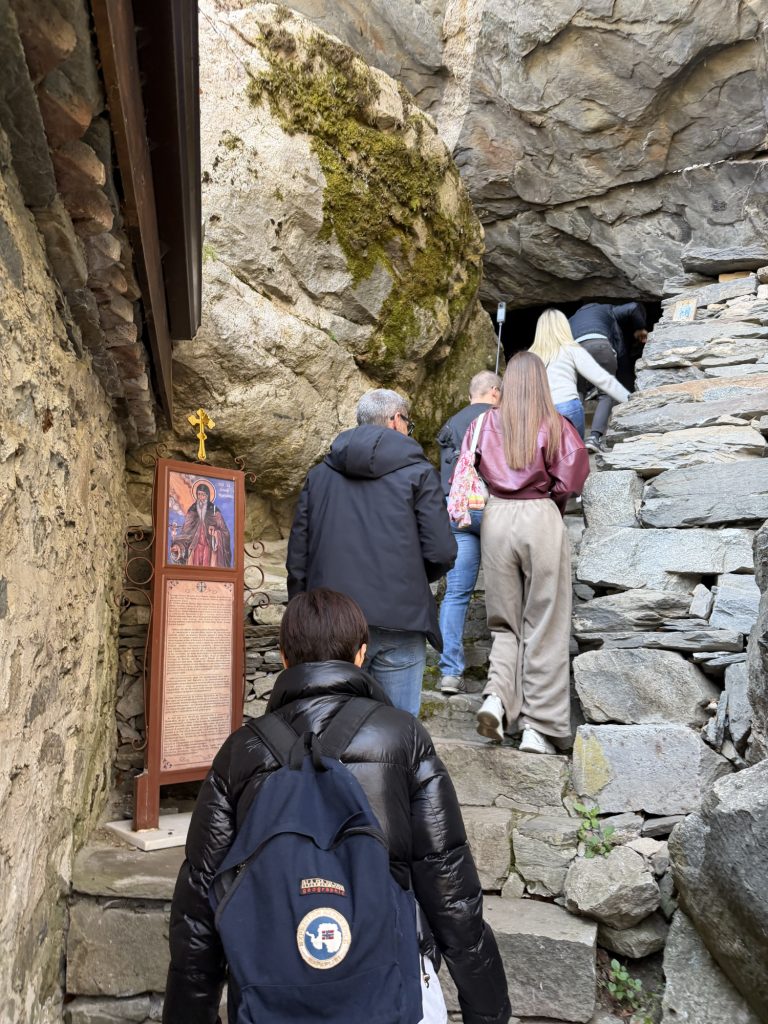
Now, the photo above does not give you a good idea of how steep, long, and narrow (and rough) the path up to the cave is. In fact, it makes it look rather sedate and easy, with the shadows suggesting steps that are not there. Of course, just after our guide told us to be careful and I passed that sign, I managed to fall flat on my face.

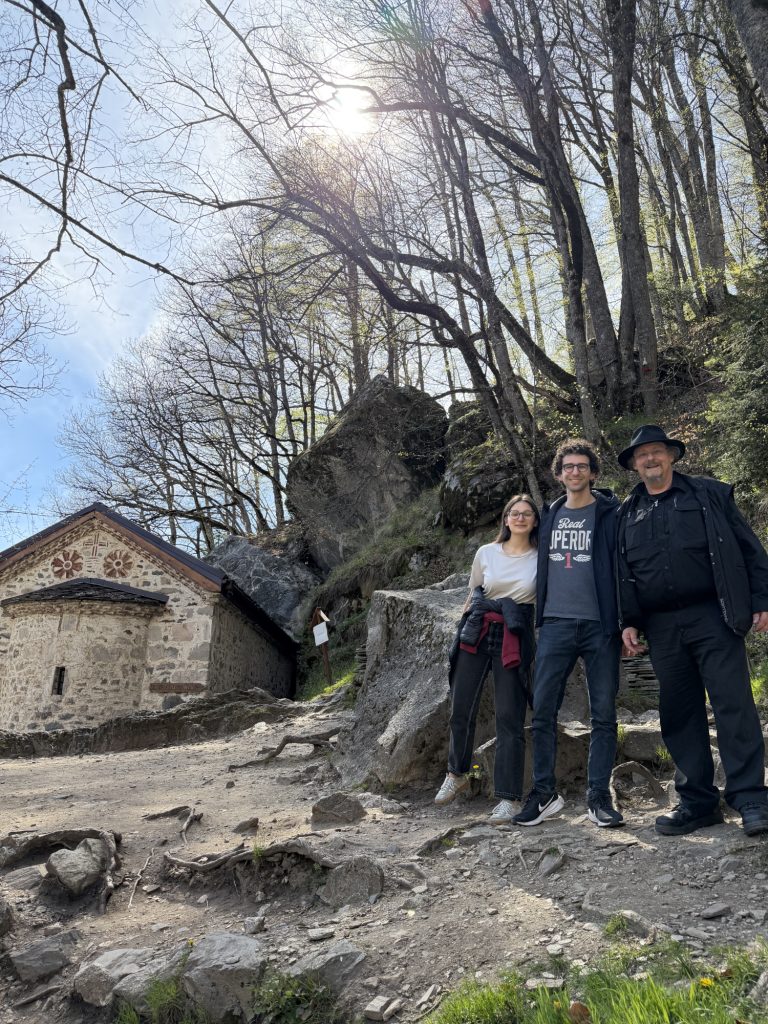
The nice young Italian couple that made sure I didn’t take the fast way down, with us standing near the church built at the entrance to
St. John’s cave.

This is something the physical therapist worked with me on last summer, when I finally got the physical therapy I should have had four years earlier. A lot of what is going on is reminding the brain that it has done this before, and can do it again. I used to run up and down hills that were as steep or steeper for years. The more I did, the more the brain began to remember. It was not pleasant in some respects, as my balance is no where near what it used to be. I also thought I was going to get in trouble, as it was up the trail a ways that I admitted to the guide that I had been hit by lightning. Some people apparently seem to think you should mention that when the tour booking and then the tour guide ask about medical conditions. Huh. Go figure.

Not sure if she was resigned about things at that point, or just a good sport, but I wasn’t in trouble. I did, however, have a nice young Italian couple from the tour stay with me and make sure I got up and down the hill without falling off. That, too, seems to becoming a theme for this trip, nice young couples being very nice to the old man. I am not old, I am still a teenager (in my mind).. Quit laughing. The tour guide got this shot of me coming out the upper exit of the cave, called the narrow way. Supposedly, only the pure may pass through and/or all sins are scraped off. It is interesting, as at one point your legs are sorta hanging out in space inside the cave while you pull yourself through a very tight opening.

The actual entrance to the cave

For me, the problem wasn’t my gut, but my shoulders. The only way to get out was to put one arm and shoulder out, while reaching for my toes with the other arm. Once I got far enough, a partial roll and a twist let me work the other shoulder then arm out. The photo earlier was taken just after I had gotten my feet under me. And, yes, I did wear my fedora through the cave along with my Scott-E-Vest. And, yes, you also have to do some ducking, twisting, and almost crawling getting in as well.

As I said earlier, still processing what happened in the monastery church. This trip has brought several such moments already, but that one really hit home for me. In some ways I’ve got even more questions than before; but, I am also more sure I will be guided to that which is right.

Onwards.

If you would like to help me with this trip, seminary courses, and more, feel free to hit the fundraiser at A New Life on GiveSendGo, use the options in the Tip Jar in the upper right, or drop me a line to discuss other methods. I’ve added Cash App ($CliffPow7) and Venmo (@Clifford-Powers-5). There is also the Amazon Wish List in the Bard’s Jar. Getting hit by lightning is not fun! It is thanks to your gifts and prayers that I am still going. Thank you.