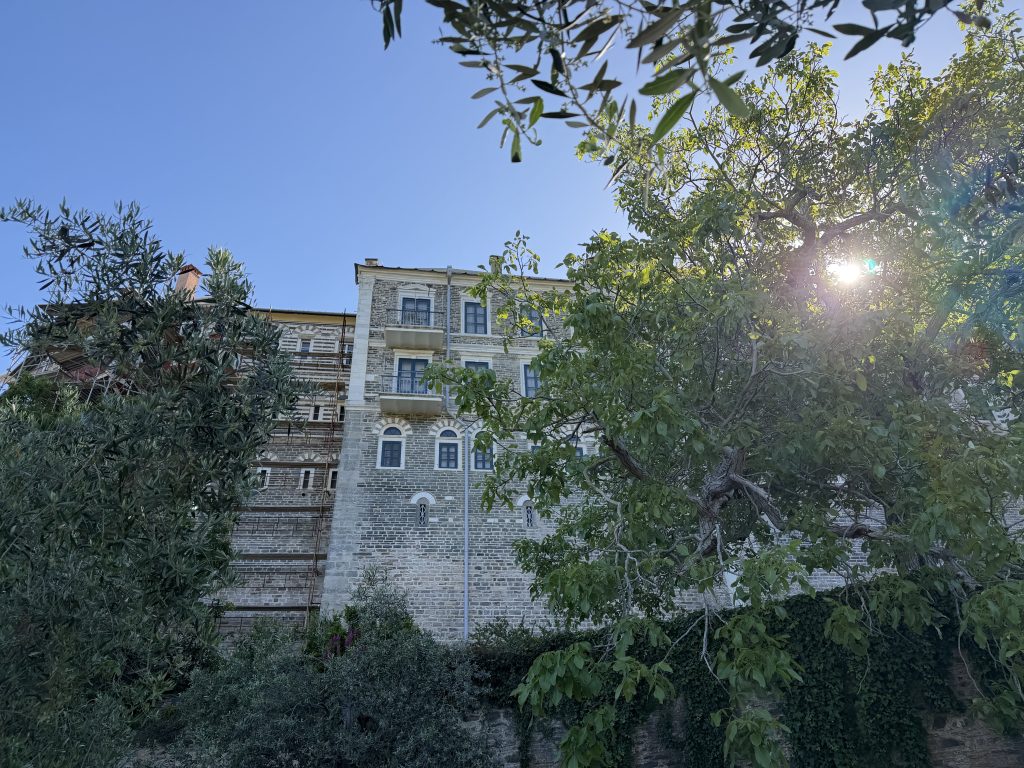
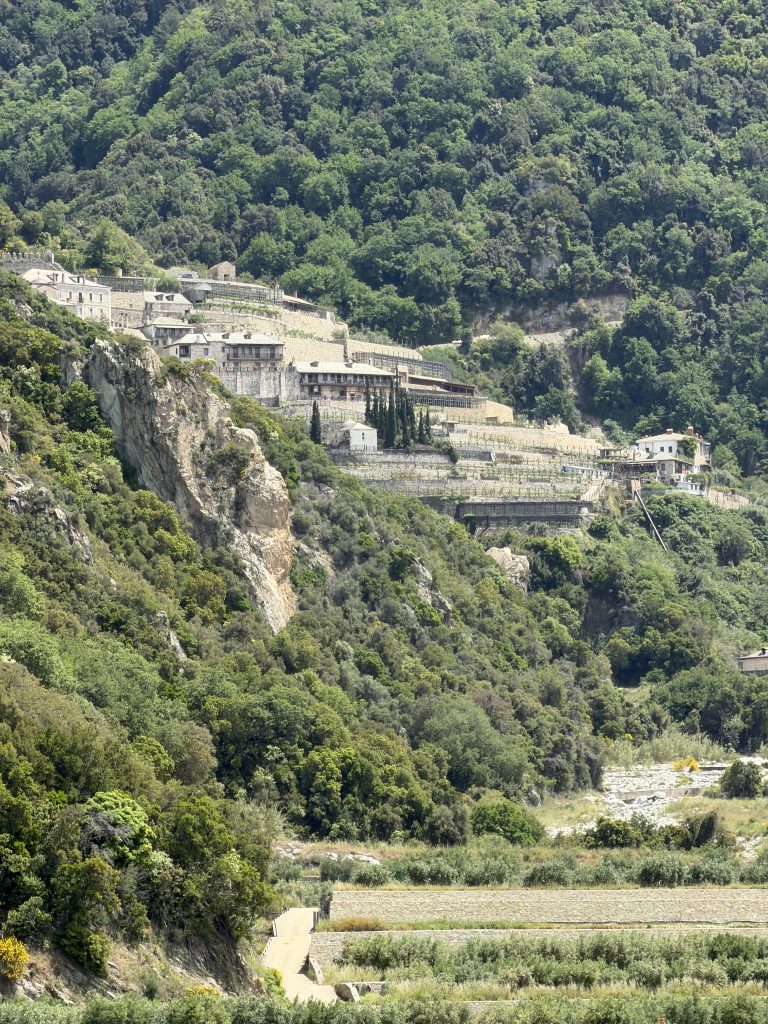
I’ve put this one off for several reasons, mostly to do with all the amazing things that happened there. Of the three monasteries I visited on Mount Athos, this was the most profound experience. Extremely positive, but it has given me a LOT to think about and work through. Some of the things I experienced I still can’t put into words, some is not for public consumption, and some I will share a bit of with you.
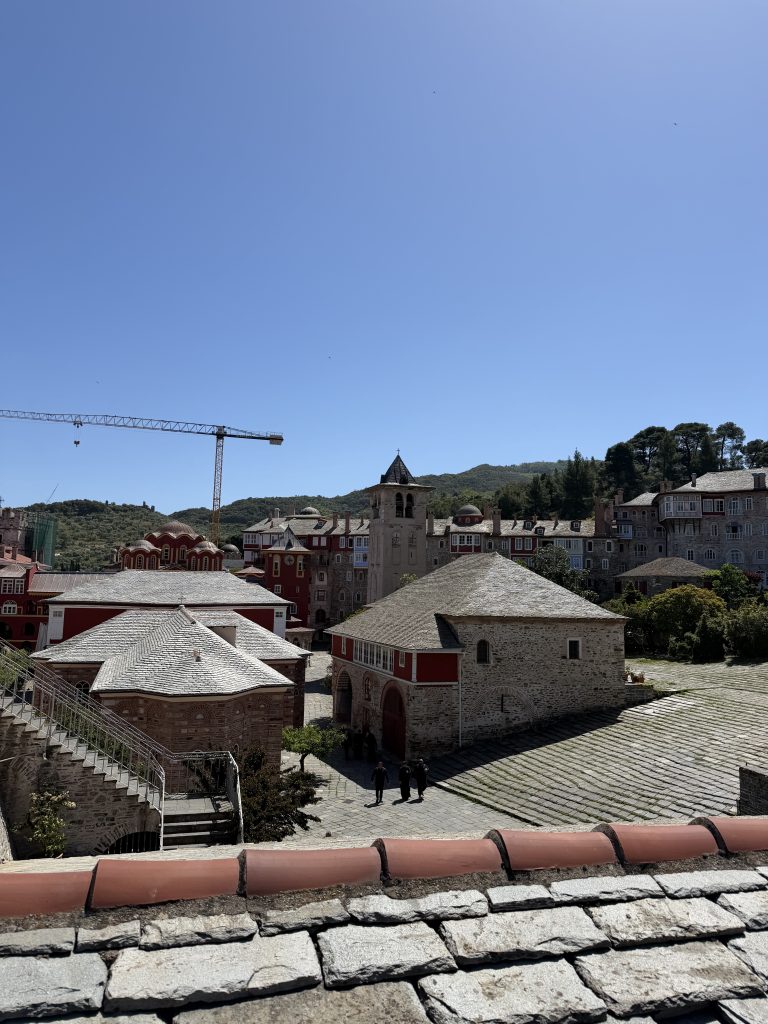
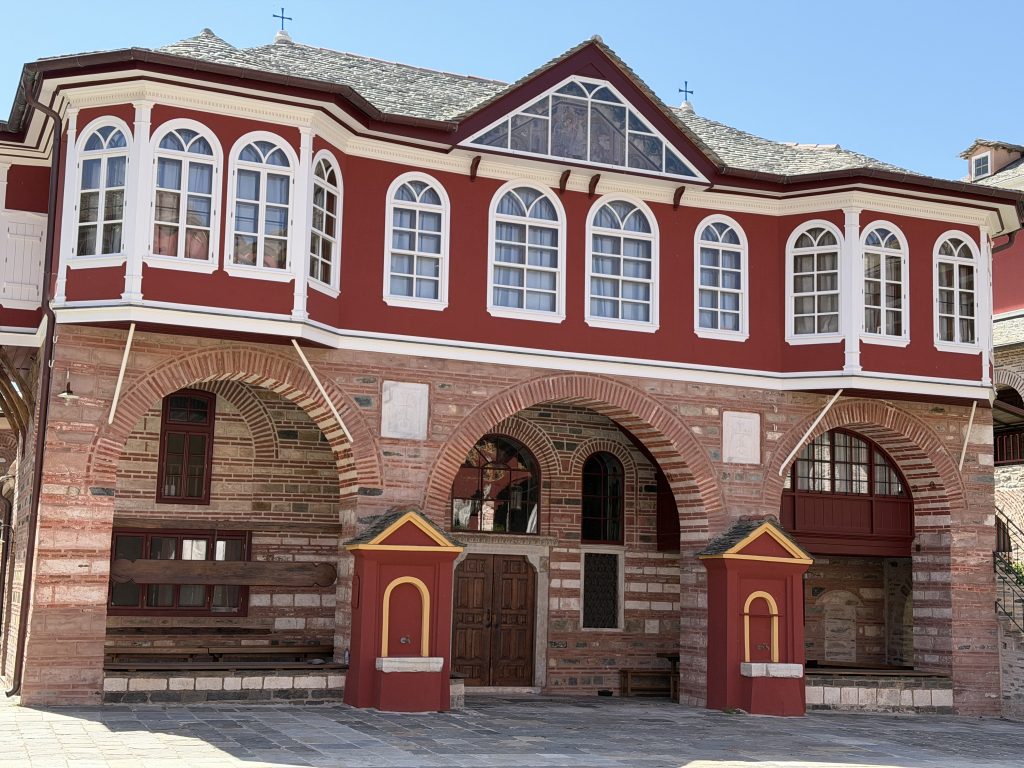
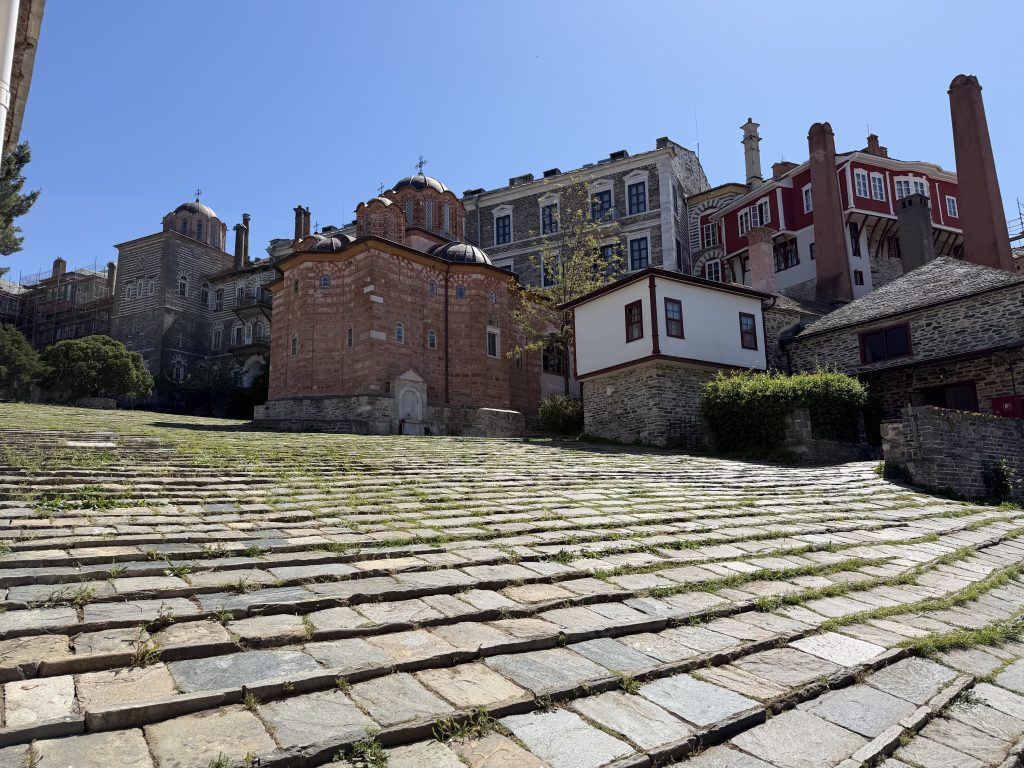
A view over the large interior courtyard
As I mentioned earlier, I didn’t get nearly as many pictures here as I did of the others, primarily because so much was happening. Have you ever walked into a place and just instinctively known that this was a place things would happen? If so, that’s pretty much what I felt. I also felt oddly at home, safe isn’t quite the right word, but it’s close enough for now.
Part of the interior courtyard
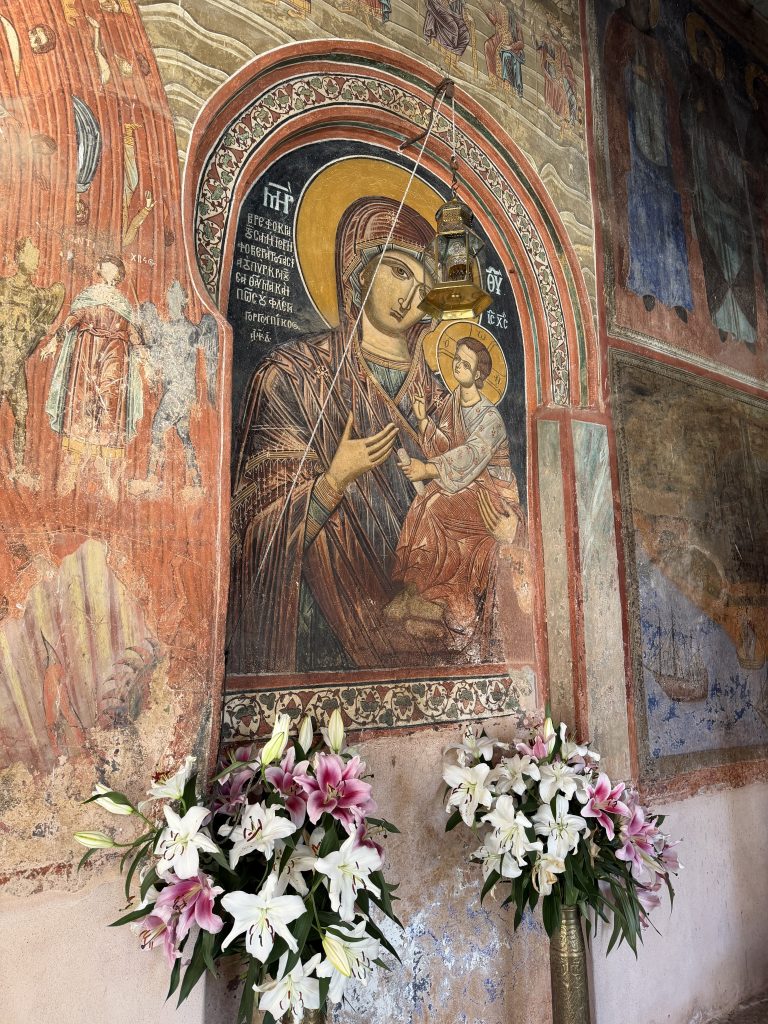
Vatopedi was founded in the 10th century, and has an extremely rich history. This gives a little bit of it, and it is well worth reading more. There are several miraculous icons and some awe-inspiring relics (and, yes, I was given the opportunity to venerate almost all of them). I want to avoid some of what Sarah A. Hoyt calls the “woo woo” but do need to share this. Not long after we arrived, I went to look around and do some prayers. Along the way, I chanced on the icon seen below, and then went up some stairs to a chapel above the main church where I venerated an icon you could feel the power rolling off. I spent twenty or so minutes in there praying for various people and things. I did not know the story of that icon at the time, but learned it later. The story of that icon is here, and I hope I never see that look on the Lord’s face directed at me. The icon below was put where the miraculous icon formerly resided.
The original was moved upstairs, read the story
I’m going to skip some of the amazing things that happened after that, but will share a small bit. I had wanted to partake of the Eucharist while there, and as such wanted to do confession. It worked out that to do so, I got up at 0300 and joined the monks as they entered the church to start morning prayers. I followed their lead, and was told that one of the monks would take me to confession in a bit.
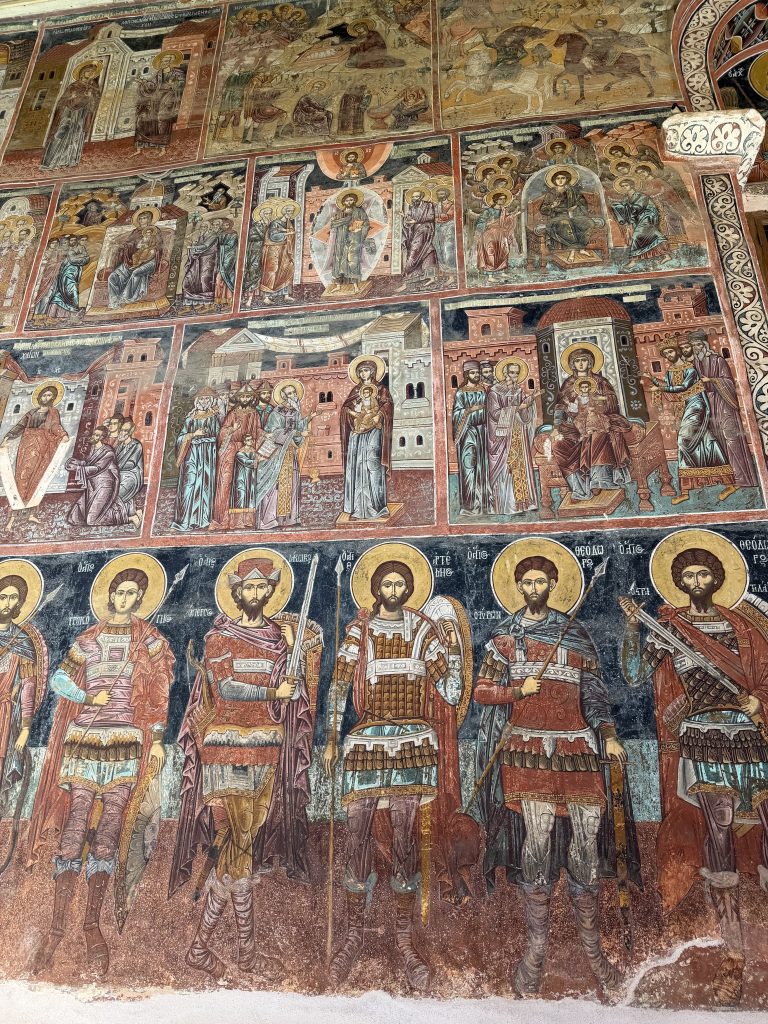
Some of the artwork outside the church
This did happen, and what I will share is that the priest knew more about me than I had shared with him. It was one of the best confessions I’ve had in any church with no disappointment, guilting, and such that can happen (and has happened with both Catholic and at least one Orthodox priest). Instead, it was thorough, supportive, encouraging, and remarkably positive. My regular confessor is good, but this priest gave a master-class on how to do a good confession. Yes, I made mental notes. I also hope he is right on a couple of things he told me.
The main dining hall
Afterwards, I went back to the church and re-joined the morning prayers. I wish there was some way to share what it was like as the sun came up and light began to fill the huge church dimly lit with candles and lamps. The beauty of it is not something you can easily catch with a camera, as rays from the rising sun begin to bounce off the brass and gold and stream down upon those within filling the church with a golden glow.
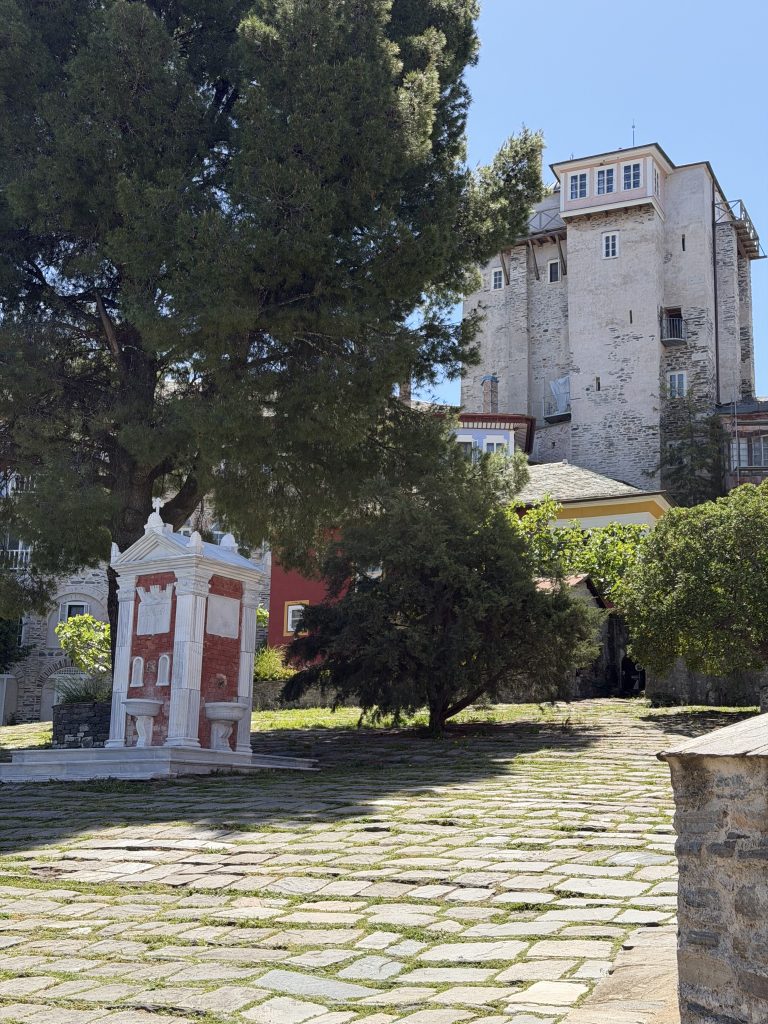
Another part of the interior courtyard
At a certain point, the crowd being so large, we broke up into groups and went to smaller churches located around the monastery. There, we finished the service and partook of the Eucharist. Then, we went to breakfast. Sadly, not long after that, it was time to leave. If I could go back right now, I would. I do hope that I can go back soon. More on this in a future post, as I have invitations to return to two monasteries for more extended stays.
If you would like to help me with this trip, seminary courses, and more, feel free to hit the fundraiser at A New Life on GiveSendGo, use the options in the Tip Jar in the upper right, or drop me a line to discuss other methods. I’ve added Cash App ($CliffPow7) and Venmo (@Clifford-Powers-5). There is also the Amazon Wish List in the Bard’s Jar. Getting hit by lightning is not fun!It is thanks to your gifts and prayers that I am still going. Thank you.
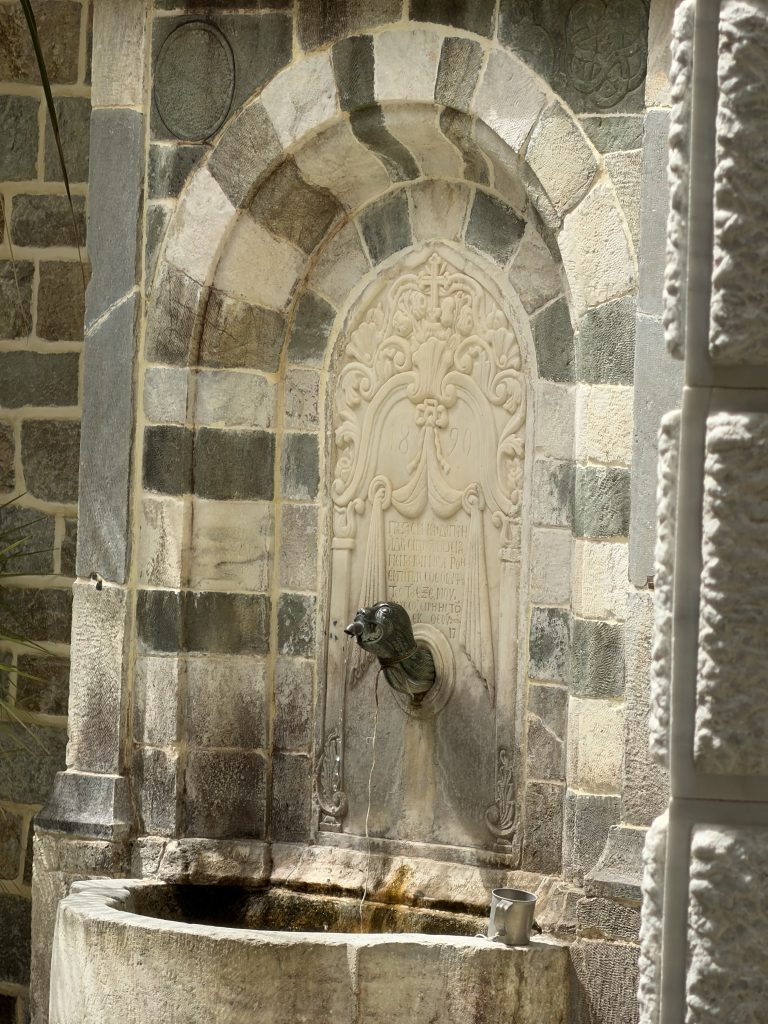
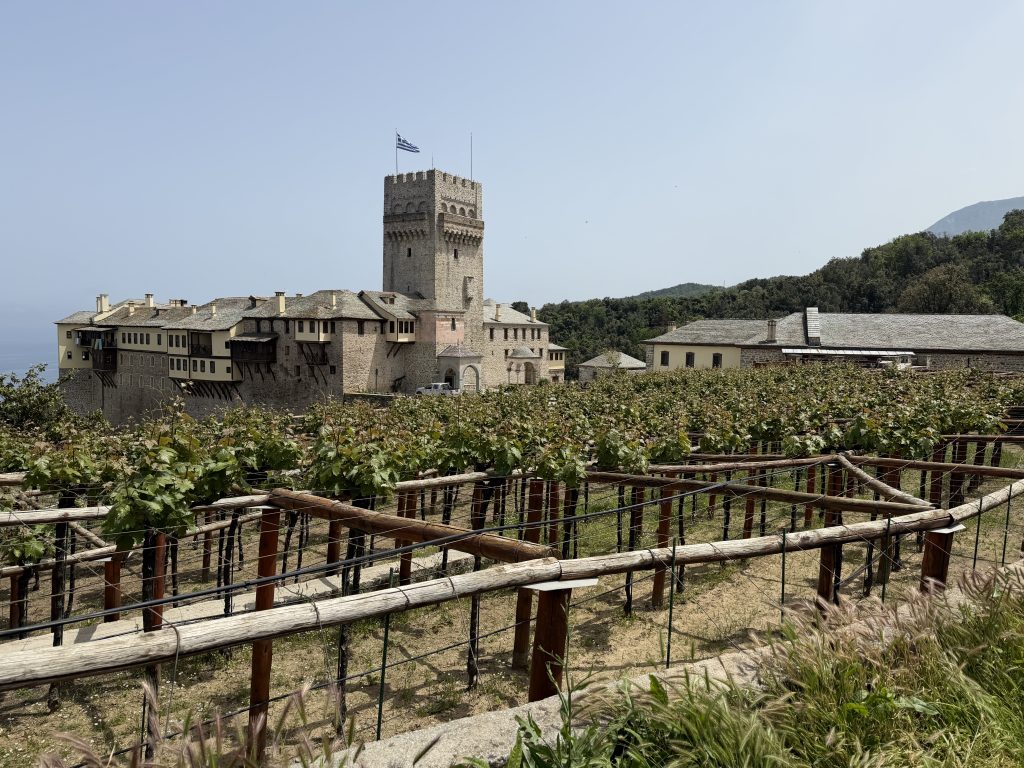
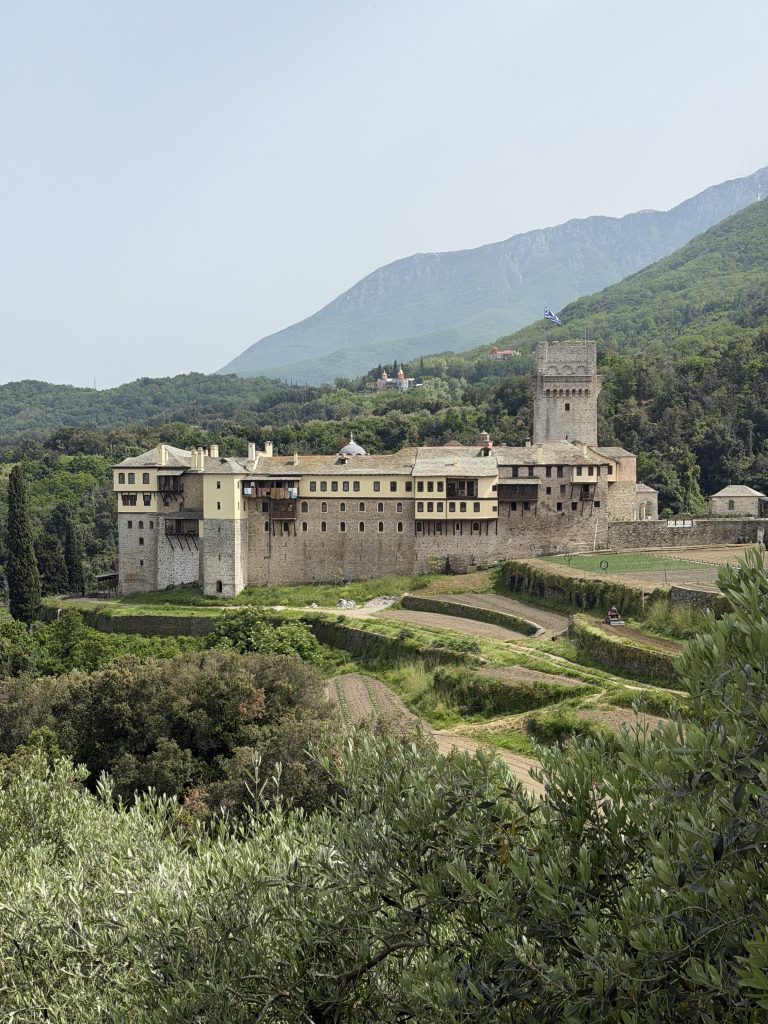
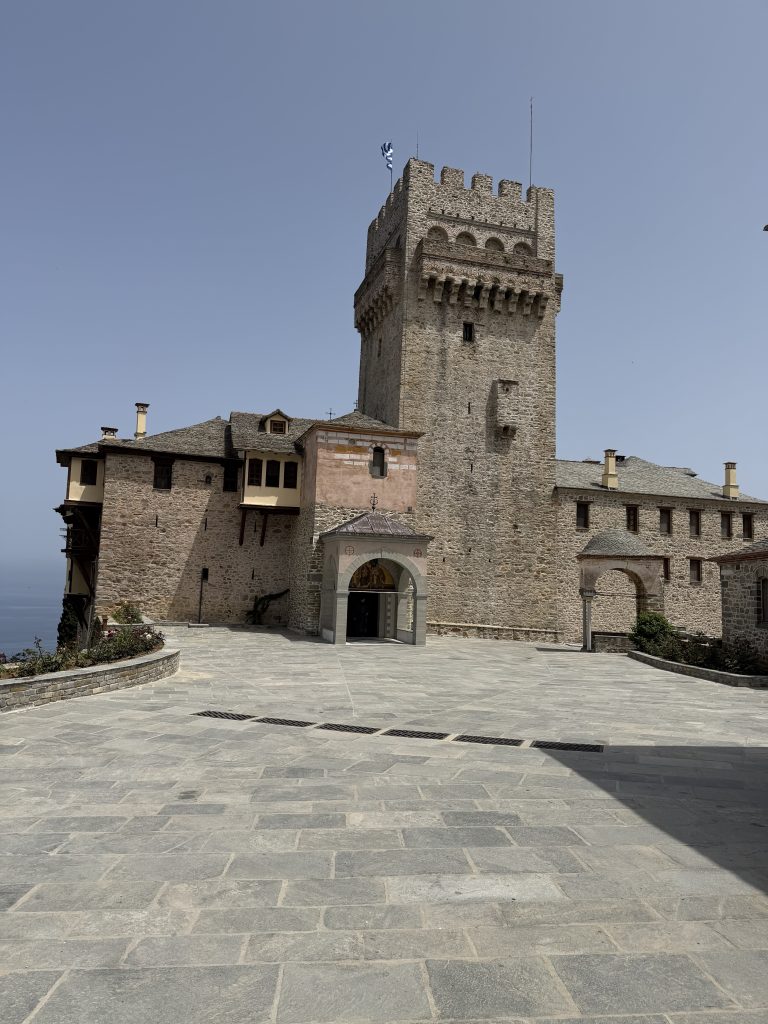
The Pavlou Monastery was a great place to end my time on Mount Athos. After all that went on at Vatopedi monastery (some of which I will share soon), I needed some quiet time for thought and contemplation. Pavlou was the perfect location for such.
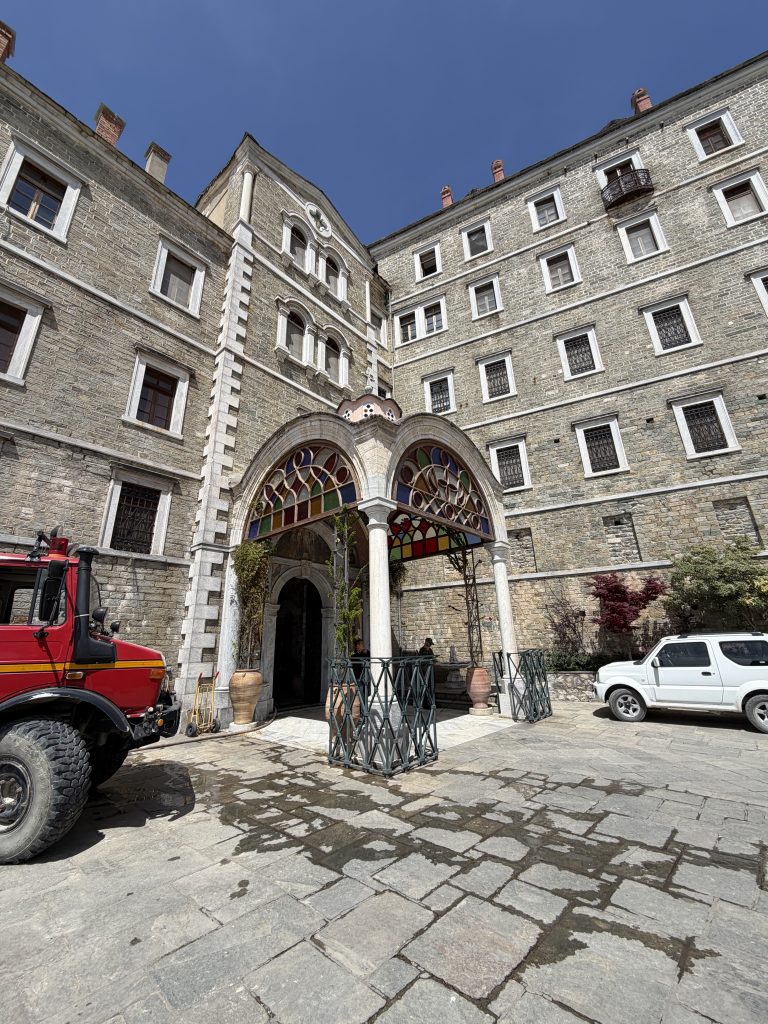
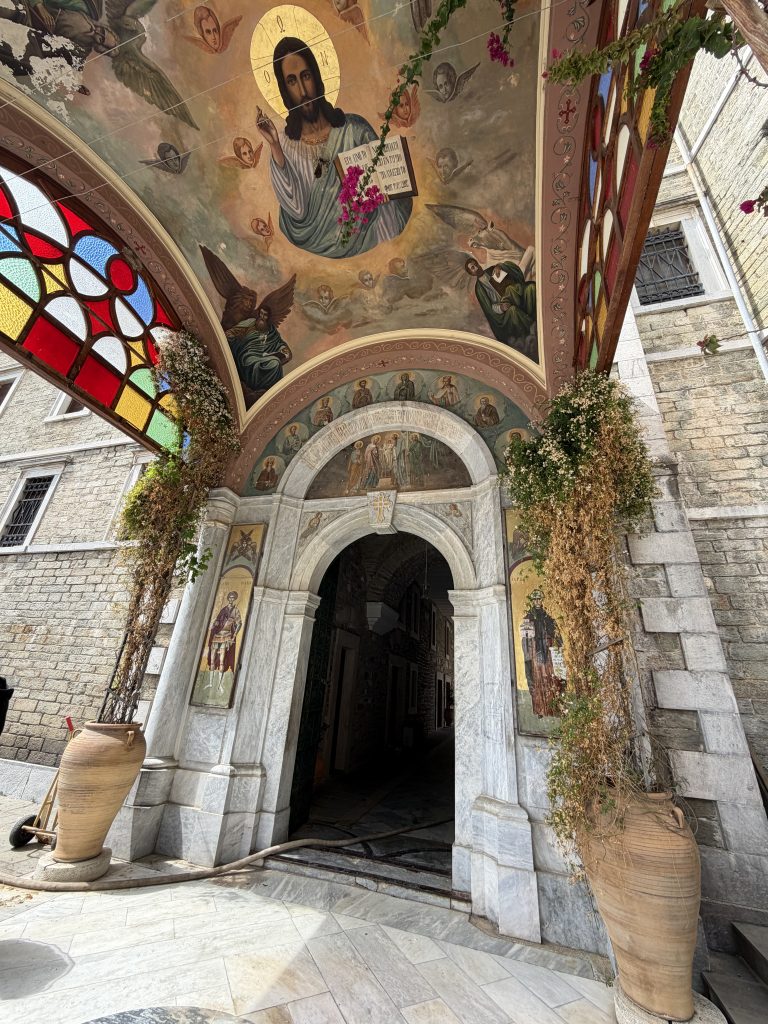
The main entrance
It is not far from the base of Mount Athos, and my hat’s off to those who climb that snow-capped mountain. I actually felt very sorry for the group(s) doing so that day, for reasons that will be clear in a moment. It is up the side of the “hill” and I was glad for the ride up to the monastery from the port. Lots of work going on there to secure things and deal with occasional floods coming down the mountain.
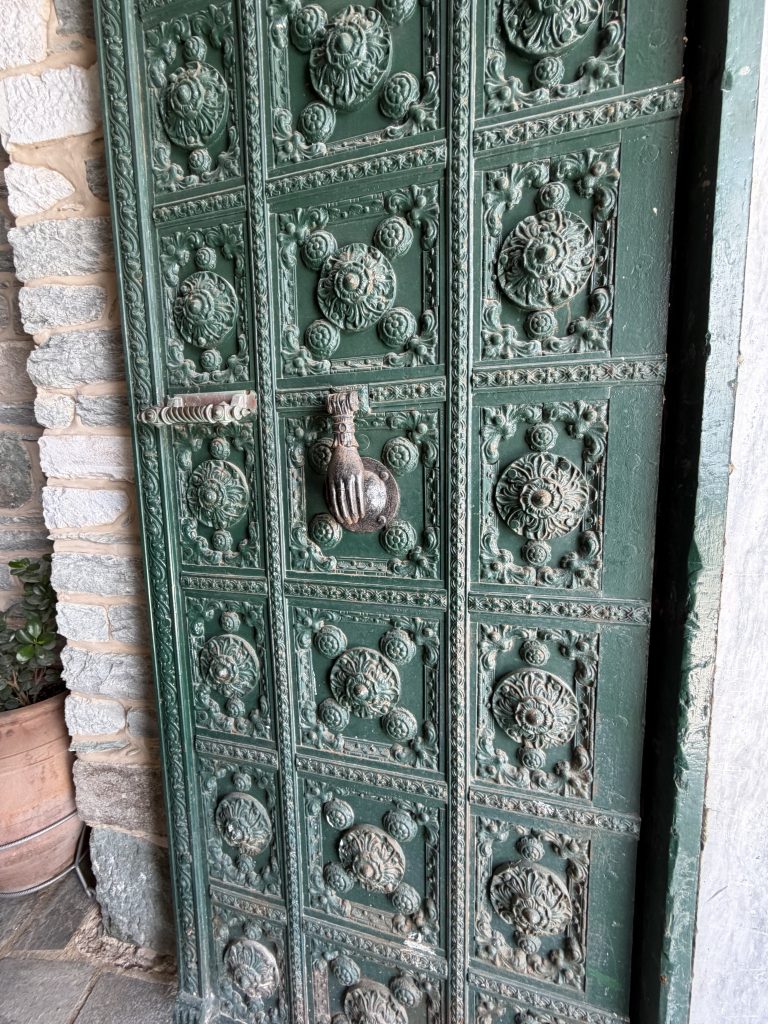
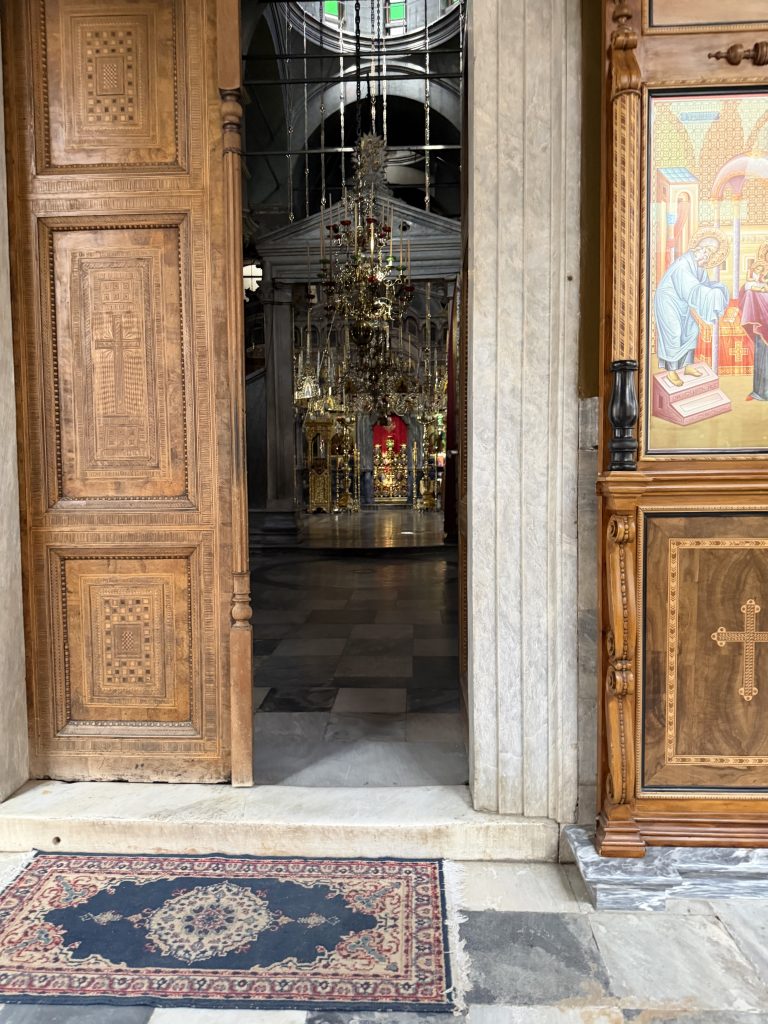
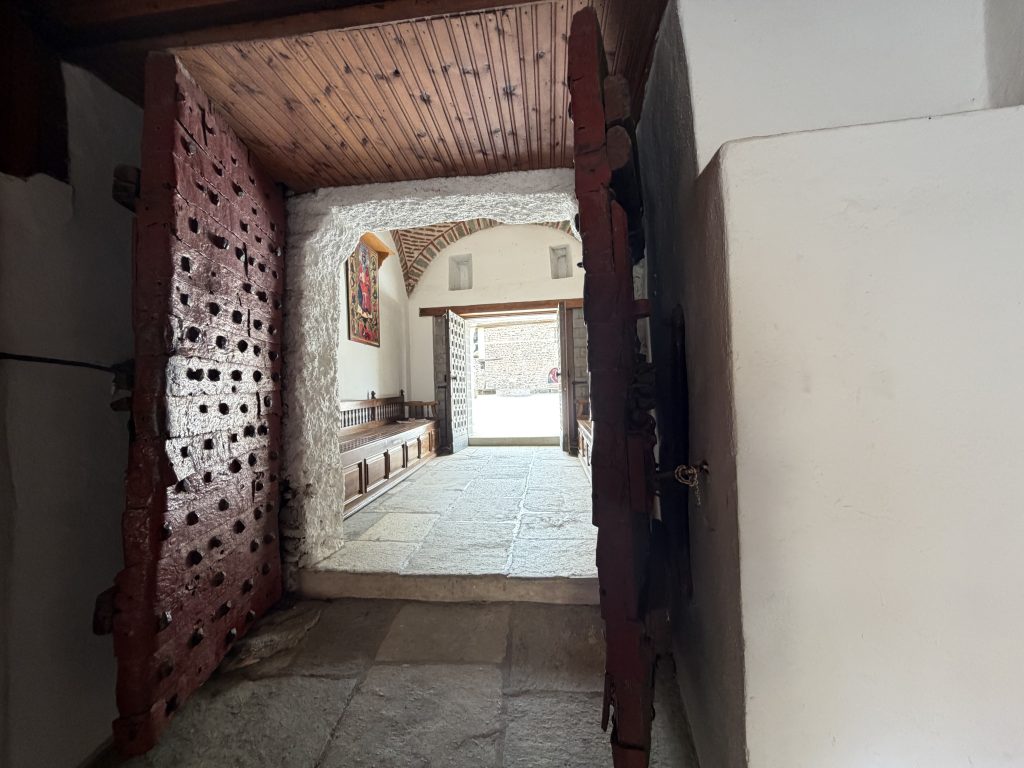
Again, as usual, very solid doors
The views were spectacular, and our room had a good view of the courtyard. The church was, of course, in the center, but behind it was a narrow way with a cross, some conveniently placed benches, and even a holy spring nearby which made for a perfect spot to sit, think, and pray. I needed that time by myself more than I can say, or even that I realized at first. It would have been nice to wander around more, but I had a LOT to think about that took priority over being a tourist.
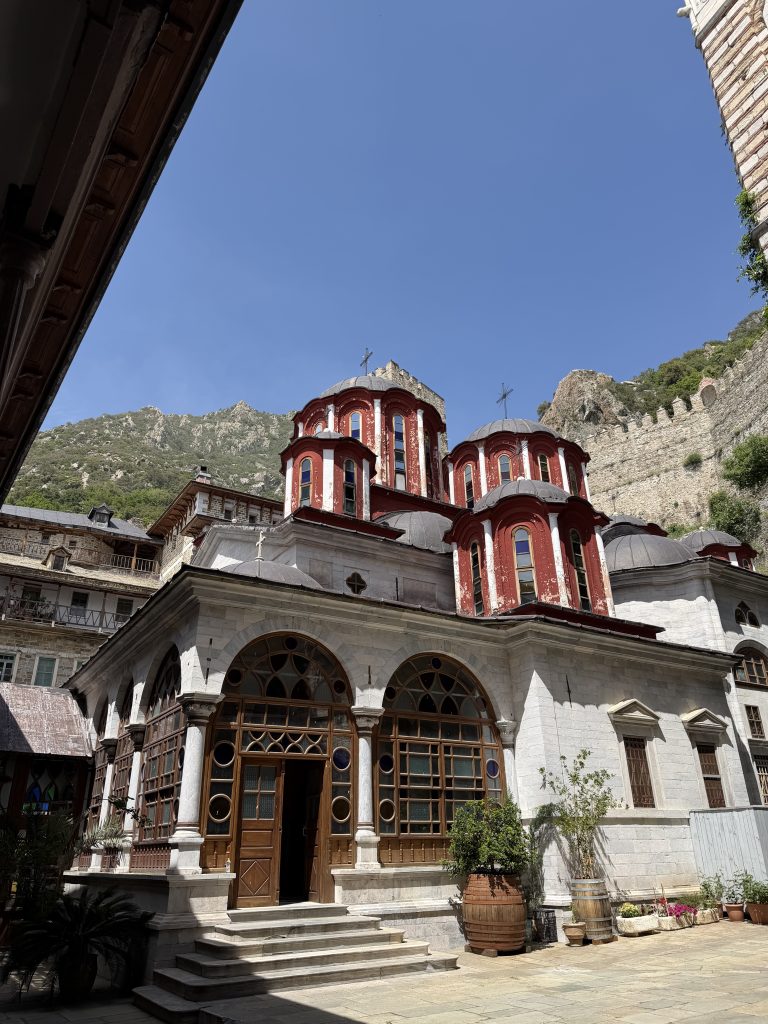
The church
I took the time while I could, and enjoyed the weather while I could, as I could feel the storms coming. Since I was hit by the lightning, if I pay attention I can get a pretty good idea of if storms are coming and even if there will be lightning (and sometimes where). Not one hundred percent, but better than average. I could feel the weather changing, so made the best use I could of the great weather while I could.
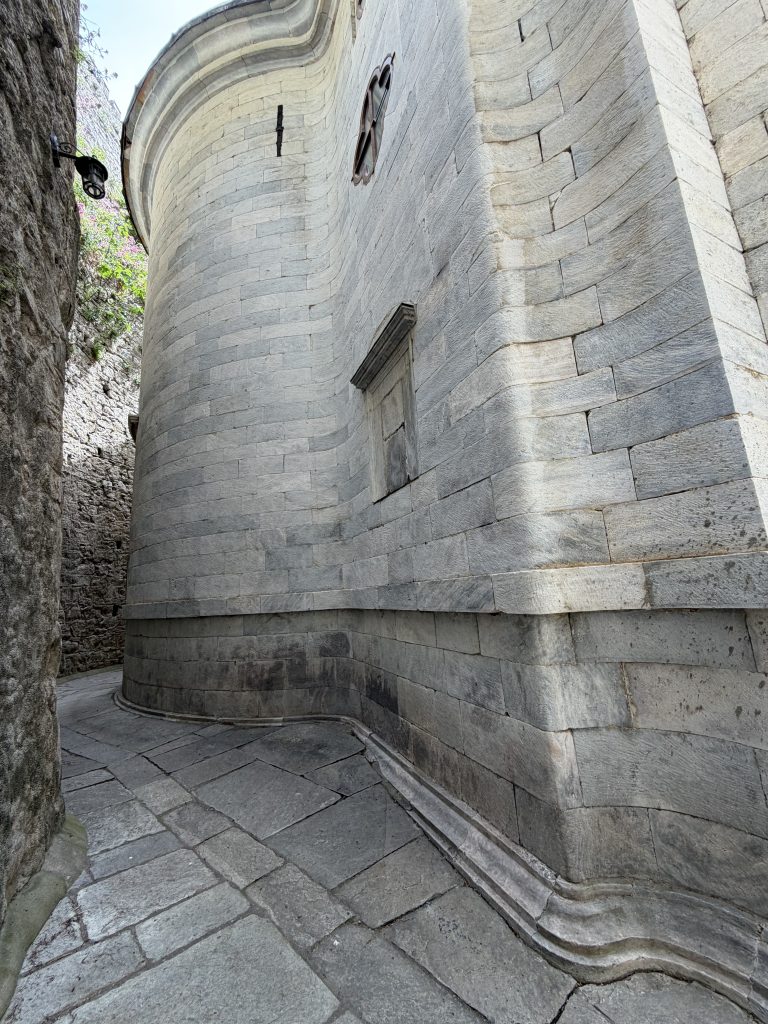
Behind the church were I found some much needed solitude
I was able to play tourist to a limited extent, and it is almost amusing to realize that I got more photos at my “bookend” monasteries than I did at Vatopedi. Then again, I still tend to lose myself a bit in the photography which helped give me time to process things. So, I would sit, think, and pray; then go do a bit of photography; and, then lather, rinse, and repeat. I needed that time.
The holy spring beside/behind the church
Soon it was time for the evening services and then dinner. Monastic services are a little different (if you want I can one day discuss the two periods where monastic and cathedral rites were joined together in synthesis) and I’ve come to enjoy them. Even when long, they tend to move along as monks have things to do. Though they move a bit faster than cathedral rites, you can quickly lose yourself into the service. Add in amazing architecture and art, and you truly do have a feast for the senses.
At the entrance to the church
There was a group of American pilgrims there that I was introduced to after service. It was a pleasure to meet them, and the priest leading them was a graduate of the seminary where I took my course this spring. I really enjoyed meeting him and came to appreciate his leadership as we were leaving.
A glimpse inside
After dinner, we were given a chance to learn about some of the icons and relics there, and to venerate them. While they have a portion of the Gifts of the Magi, for me there was one icon that particularly caught my attention. The icon was the Icon of the Virgin Mary Kathreptis. During the years of iconoclasm, this icon was protected by the Empress Theodora in her private chamber hidden behind a mirror. There are scorch marks on it hinting that it’s survival from the pagan fires of iconoclasm was close at some point. It is also extremely unique and if you are interested in iconography at all I would highly recommend reading up on it.
Photo courtesy of Nicolas Karellos
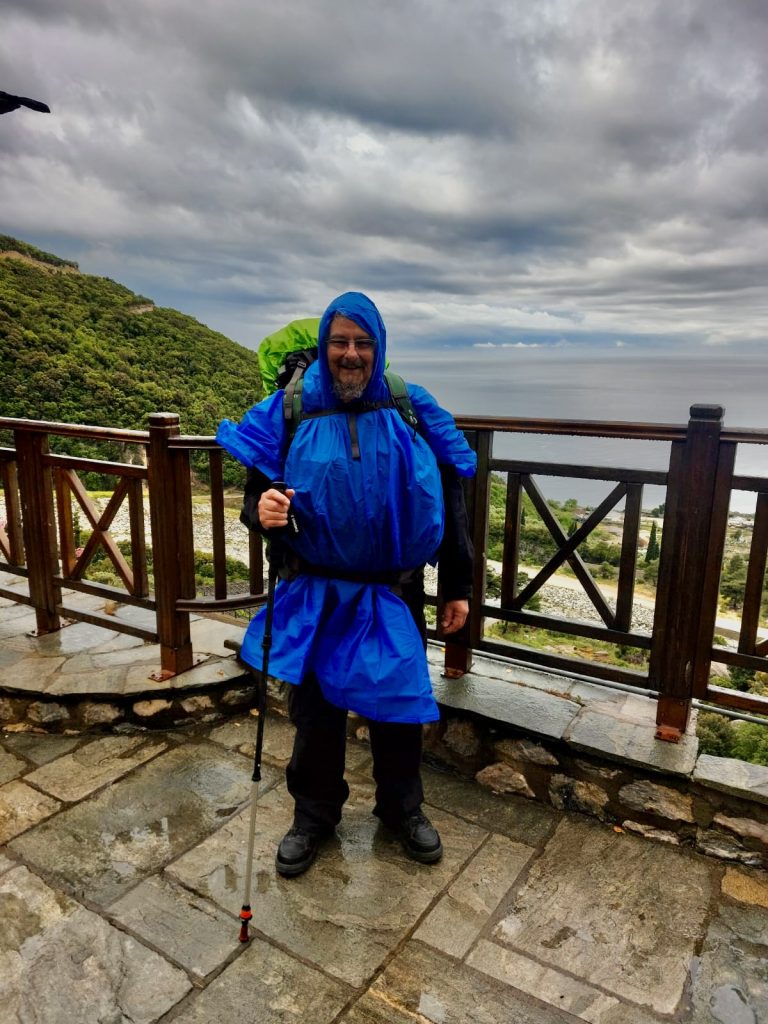
That night it did indeed storm, and the storm continued into the next morning. I donned the poncho my Godmother (Matushka) had given me to bring but as we were to leave to go back down to the port, the rain stopped. We got down to the port, and when the boat came we all got onboard despite objections from some that we should wait for the boat to come back since it was still on the outbound portion of its journey. The American priest overrode that bit of idiocy and I cheerfully went along with him as I had no desire to be out for an hour or so in rain and possibly lightning. I will have to share some video from that ride one day here soon, so glad we did it.
There is more to come. I will particularly ask you to hit the tip jar today if you can, as I am looking at taking one or more courses at the seminary this fall. If I take just one, looking at needing about $7k, and if two it will be another $4k on top of that. Would appreciate the help very much. Thank you for reading, commenting, and liking things. It is all very much appreciated!
If you would like to help me with this trip, seminary courses, and more, feel free to hit the fundraiser at A New Life on GiveSendGo, use the options in the Tip Jar in the upper right, or drop me a line to discuss other methods. I’ve added Cash App ($CliffPow7) and Venmo (@Clifford-Powers-5). There is also the Amazon Wish List in the Bard’s Jar. Getting hit by lightning is not fun!It is thanks to your gifts and prayers that I am still going. Thank you.
First, an apology to you the readers. I had planned to get a post up yesterday, but didn’t make it. The breakfast I had on Wednesday with a friend, who has been a bit under the weather as it were, ran delightfully into the afternoon. It was so good to catch up with them, laugh, share some memories, and just live. Had to run an unexpected errand afterwards which took up the rest of the day. Yesterday morning I had coffee with two dear friends and then had errands to run before the storms hit last night. Had breakfast this morning with a friend and former co-worker, and am now catching up here.
I also owe an apology to my “bookend” monasteries on Mount Athos. I sometimes glitch on their names. While each visit on Mount Athos was unique and even wonderful, so much happened at Vatopedi that it tends to eclipse everything else which is not fair to the other two. The first “bookend” is Karakallou Monastery and in some respects it was the perfect way to “break in” to the routine of life on Mount Athos.
Might notice how it’s built…
The monastery dates back to the 11th century, and is up a ways from it’s “port.” Something to keep in mind about the monasteries on Mount Athos is that each has (or had) it’s own port down on the coast. In this case, the port is about a mile down the hill from the monastery proper. The monasteries, be they on Mount Athos or elsewhere, strive to be as self-sufficient as possible. A lot of people seem to have the idea that monks are sitting in their cell (room) all day praying, and that’s just not the case. There are often animals for which to care; crops to tend, grapes to pick and wine to make, etc. It is not a sedentary life.
The main entrance, and yes most monasteries are built with pirate and other attacks in mind…
In the case of Karakallou, I would add to that list of chores expanding agricultural activities. While there, work was underway to expand grape and crop growing areas, and to repair and optimize such areas and roads. That was in addition to all the normal work of running a farm. One area next to the monastery had hundreds of onions planted, and we found out why later.
Most monasteries have very serious doors
Karakallu is probably best known for the icon of Saints Peter and Paul (take it as a given that most icons I mention here are miraculous); but, it also houses relics of the True Cross and a number of saints. For most visitors, these will be brought out during a special time after supper to learn about them and have the chance to venerate them.
The inner courtyard and church
When I said it was a great place to break into the routine of life on Mount Athos, it truly was such. We were somewhat encouraged to go look around, hike around, and otherwise explore the area. Other than being back in time for evening services and dinner (and not getting underfoot), relax and contemplate. We did walk around a bit, checked out some of the expansion work, and for me at least, to shed the stresses and cares of the world outside. The evening meal also got me back into the monastic meals. There are prayers said beforehand, and one does not eat or drink until the abbot rings his bell. When the bell rings again, you put everything down and stop.
A satellite chapel
I mentioned earlier the onions being grown and at dinner that night we found out why so many are being grown. Dinner was a lentil stew, and it was probably the best such I’ve ever had. I can’t cook lentils all that well, but the monks clearly could. Next to each bowl was a green onion with a small bulb at the end, peeled and with the roots cut off. One ate lentils, took a bite of the onion, and it was delicious.
Ruins of the old port
The next morning, we walked about a mile downhill to the old port, and the boat that services those ports came in and picked us up. We did have one small bit of excitement when a wild pig and piglets ran across the trail in front of us. Once we were sure all the piglets were across and they and mom were gone, we continued on.
Karacallou was a good place to shed the world and enjoy some quiet contemplation and prayer. That shift stood me in good stead for my visit to Vatopedi.
We may bounce around a bit over the next couple of weeks, as I am not going to be posting in the order things happened. Instead, I’m going to be trying to pick up the stories I have not yet told and or am still trying to process.
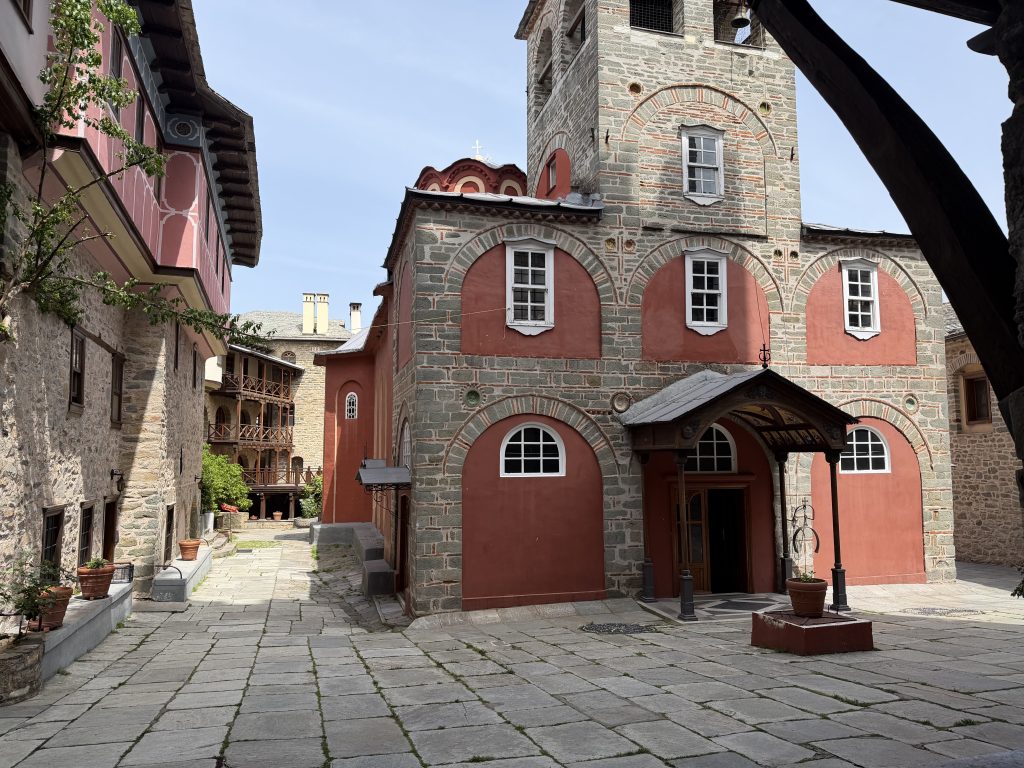
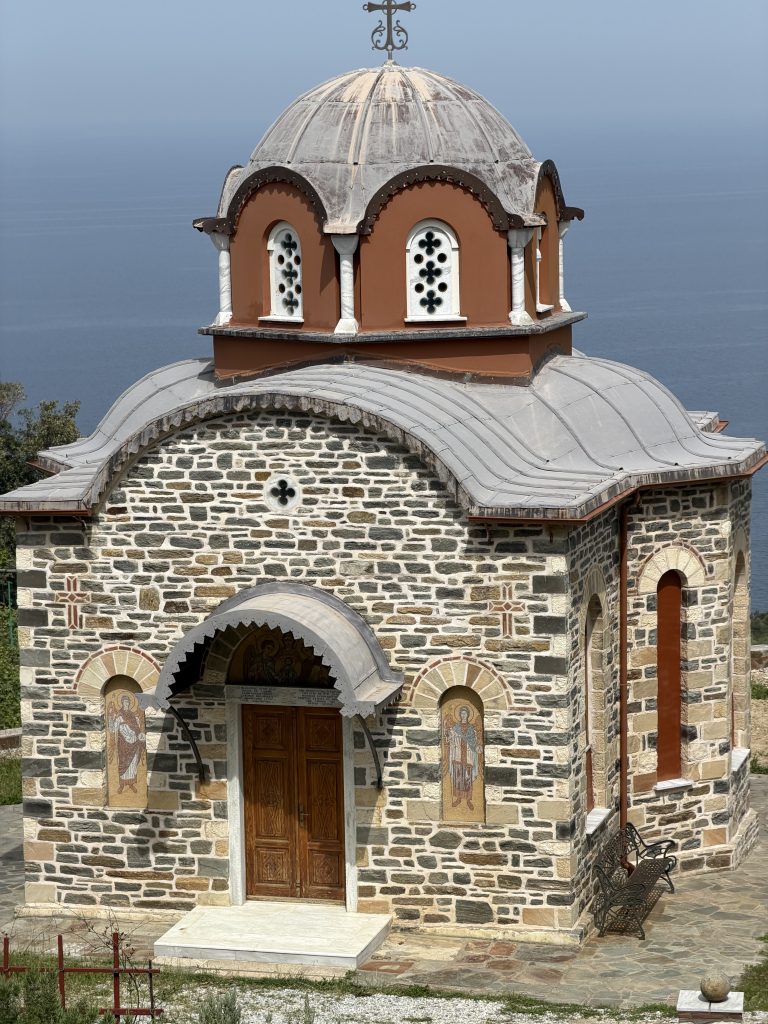
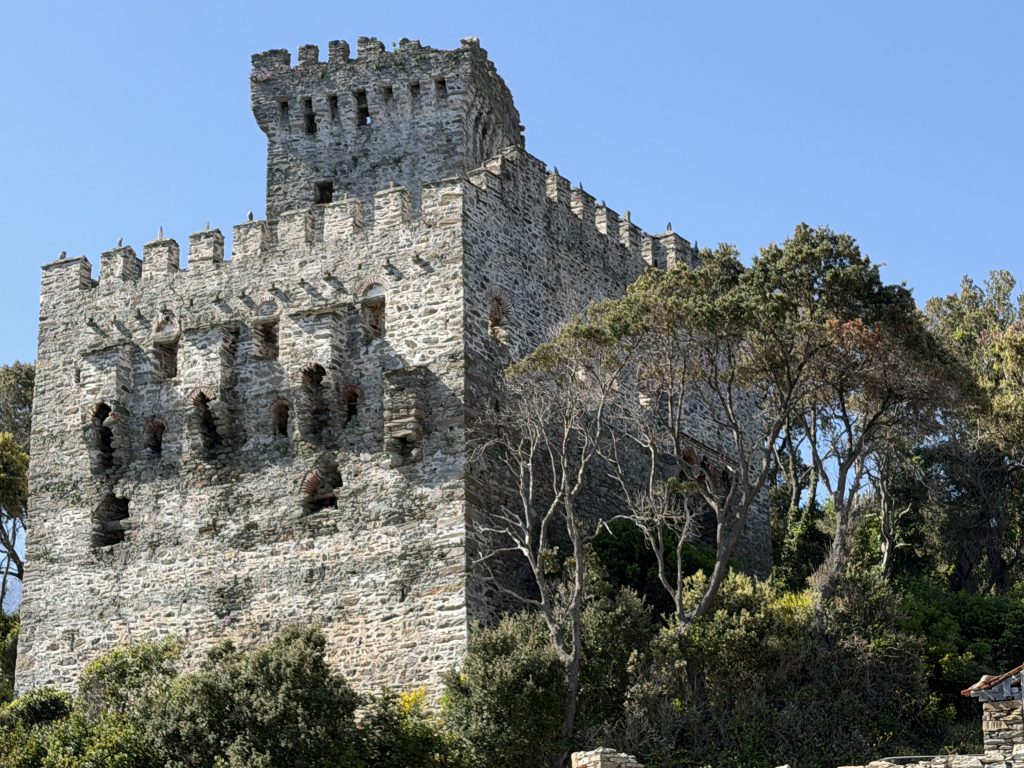
The Monastery of the Theotokos Kallipetra falls into both categories. My friend (and Sub-Deacon) Randy had — for him — strongly recommended I go there. It’s outside Veria (another topic/site we will be exploring some more) and it is, in fact, a work in progress. The monks there were murdered back 1908 and it was abandoned for decades. Locals still snuck down to the site to lite candles and pray, and there is (I’m told) still a foot trail from a nearby village. Local legends talk of hearing monks chanting in the church there while it was deserted.
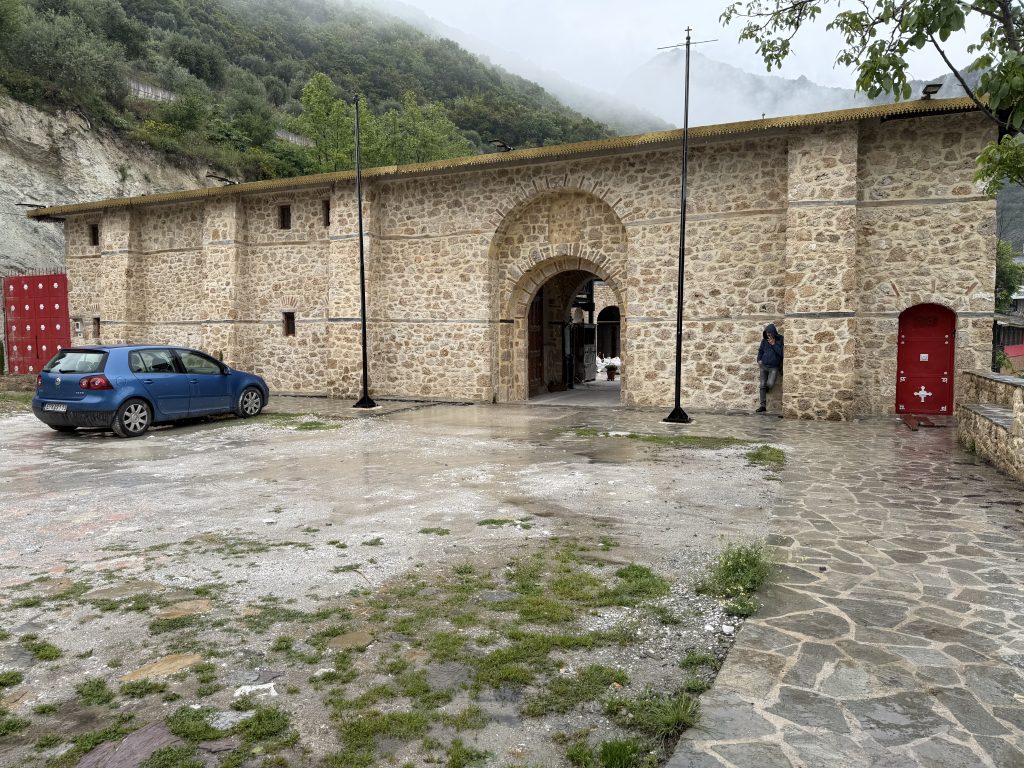
The main entrance and parking area
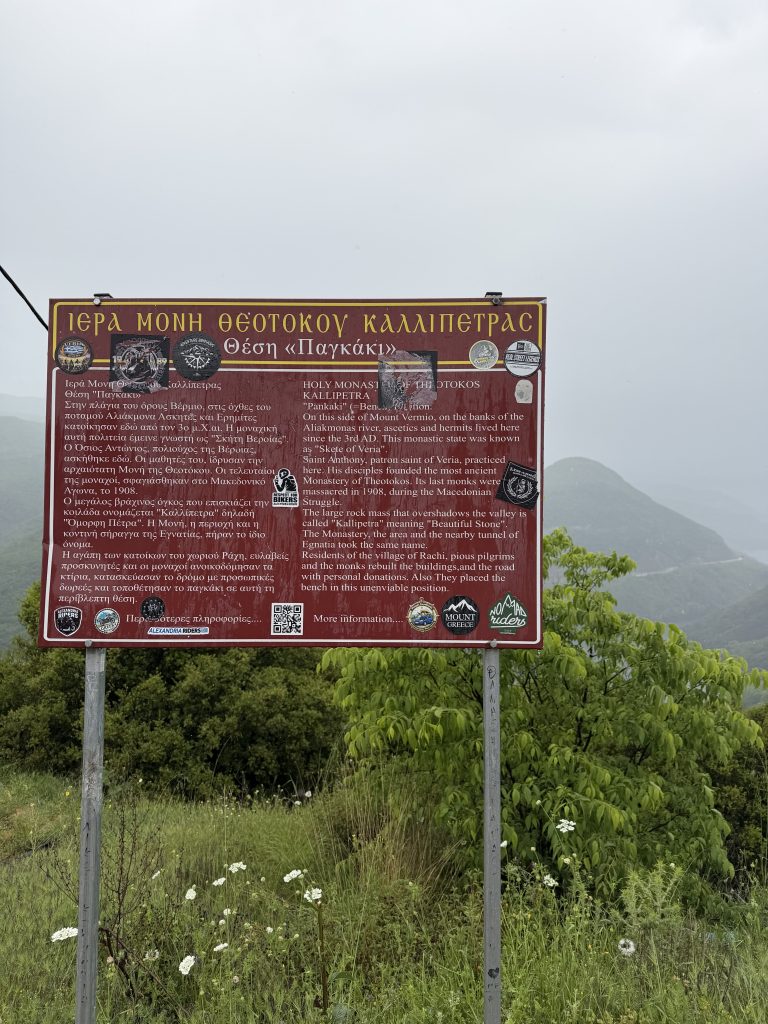
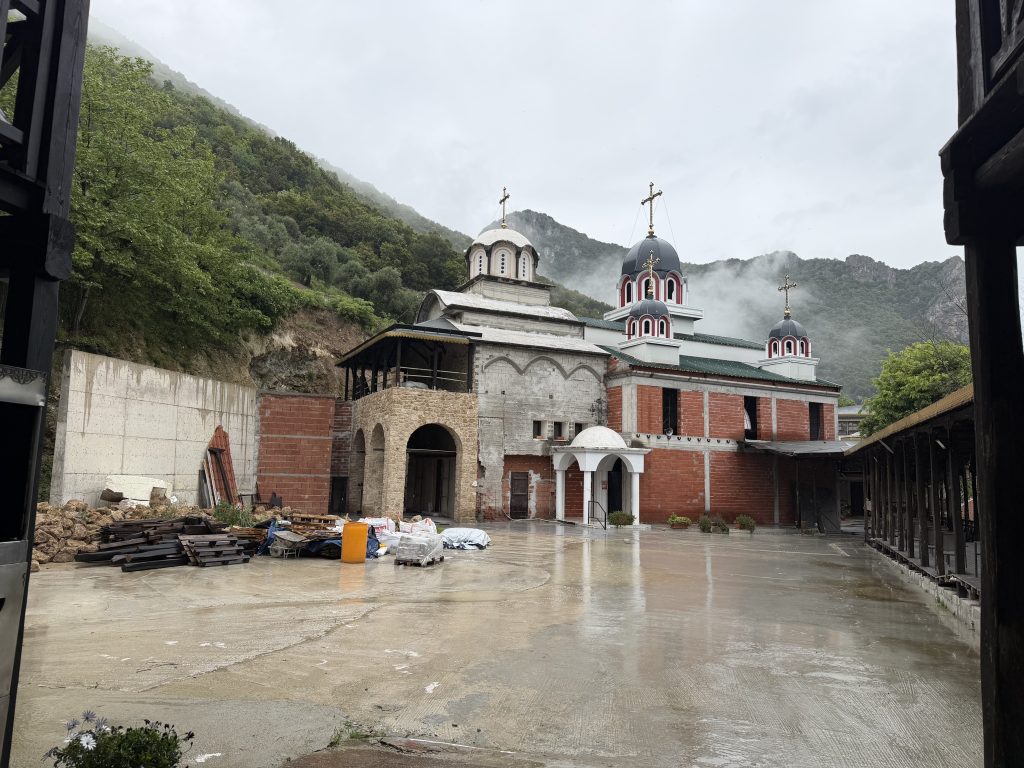
A group of monks returned and are working to restore the site and are doing some amazing work. The locals, monks, and pilgrims even raised funds to pave the road to the monastery. Read the first picture for more details.
They have done an amazing amount of work, but there is still a ways to go
I enjoyed meeting the monks, especially the Abbot Father Palamas. He was the first priest I met on this trip who seemed to know more about me that I had shared. Then again, I had been told that might be the case as I am not the first to experience that. During our talk, he invited me to come back for a longer stay — and I would very much like to do that. I would also like to help as much as I can with the work they are doing.
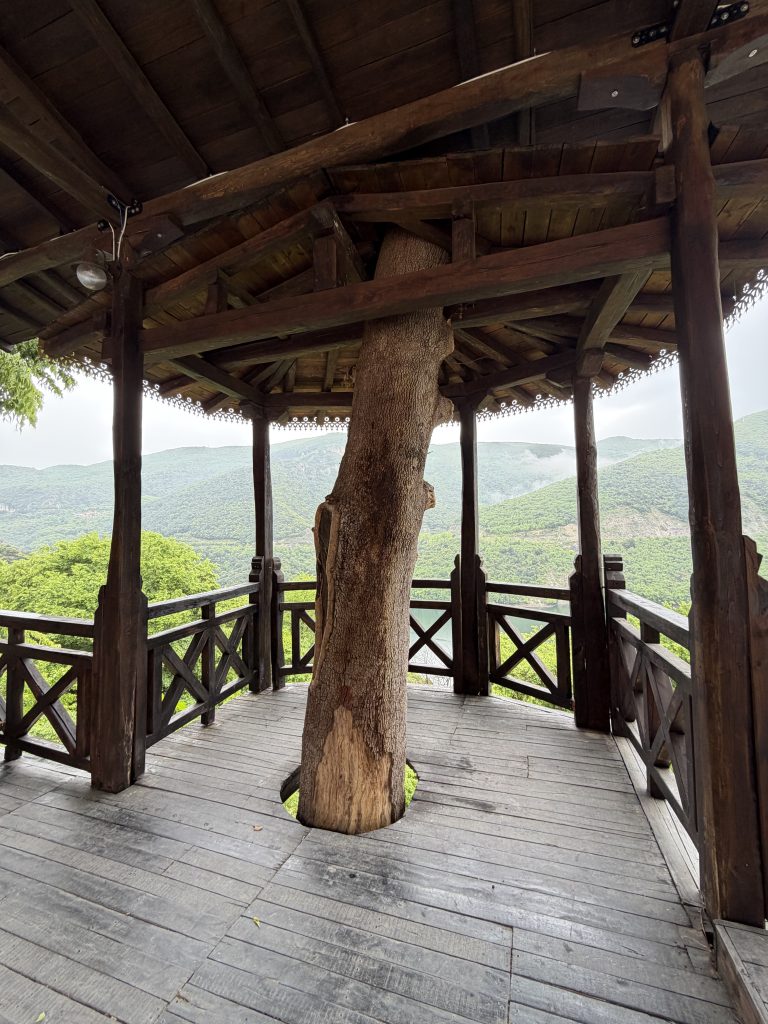
Why cut a tree when you can build around it?
Father Palamas was kind enough to let me stay for evening services and to enter the under-construction/restoration church, where I had the opportunity — among several — to venerate a relic of the Apostle Paul. My visit there was powerful and moving in several ways, and as I said above, I would love to go back for a longer visit as soon as I can.
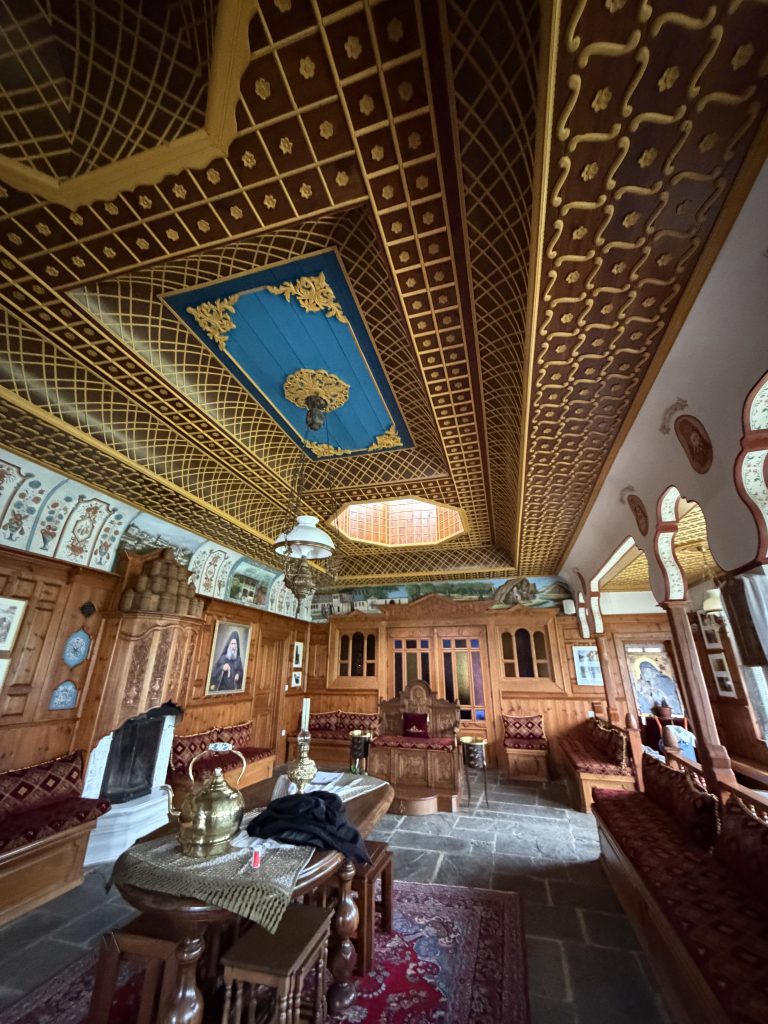
A view of the main hall
If you would like to help me with this trip, seminary courses, and more, feel free to hit the fundraiser at A New Life on GiveSendGo, use the options in the Tip Jar in the upper right, or drop me a line to discuss other methods. I’ve added Cash App ($CliffPow7) and Venmo (@Clifford-Powers-5). There is also the Amazon Wish List in the Bard’s Jar. Getting hit by lightning is not fun!It is thanks to your gifts and prayers that I am still going. Thank you.
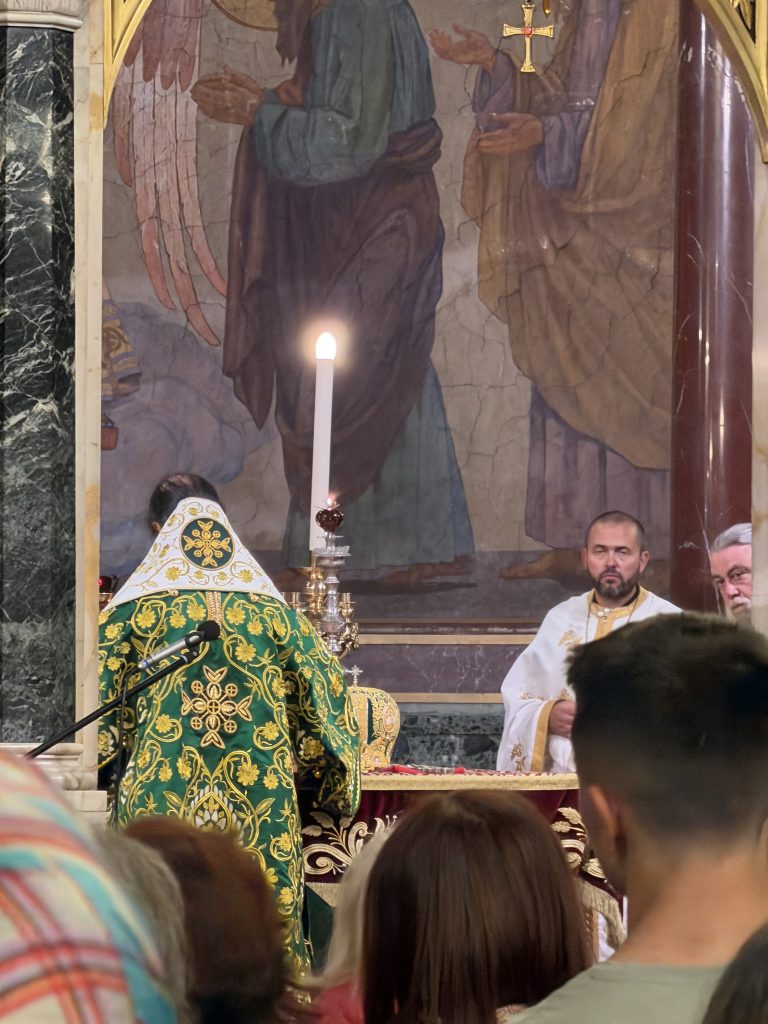
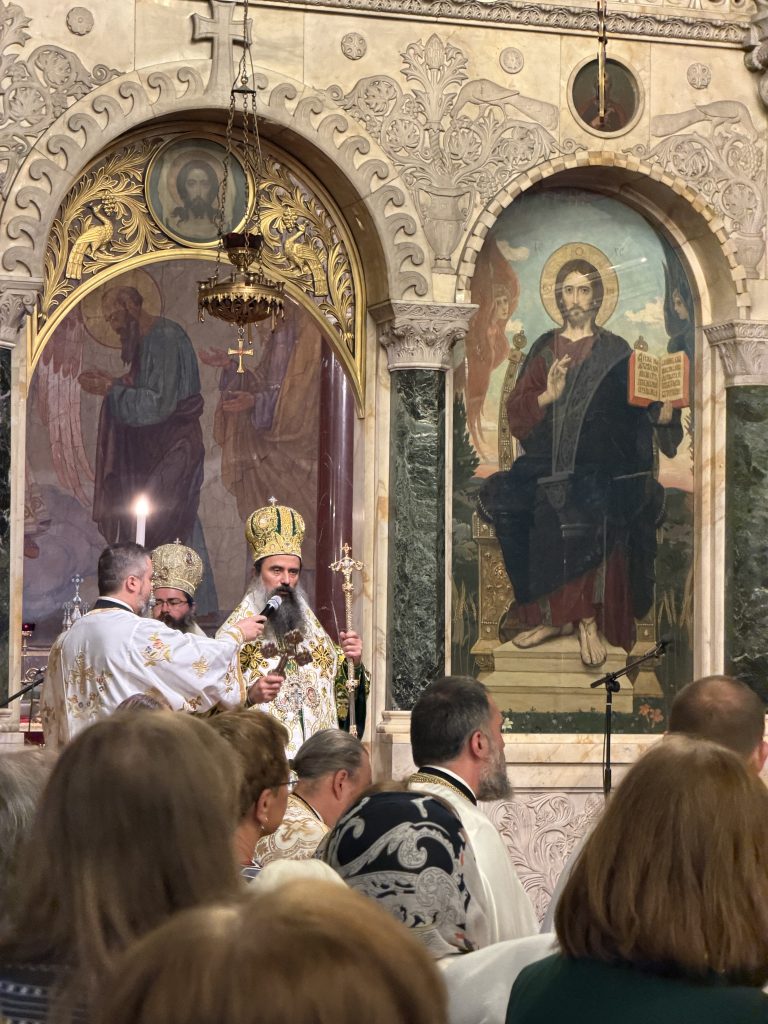
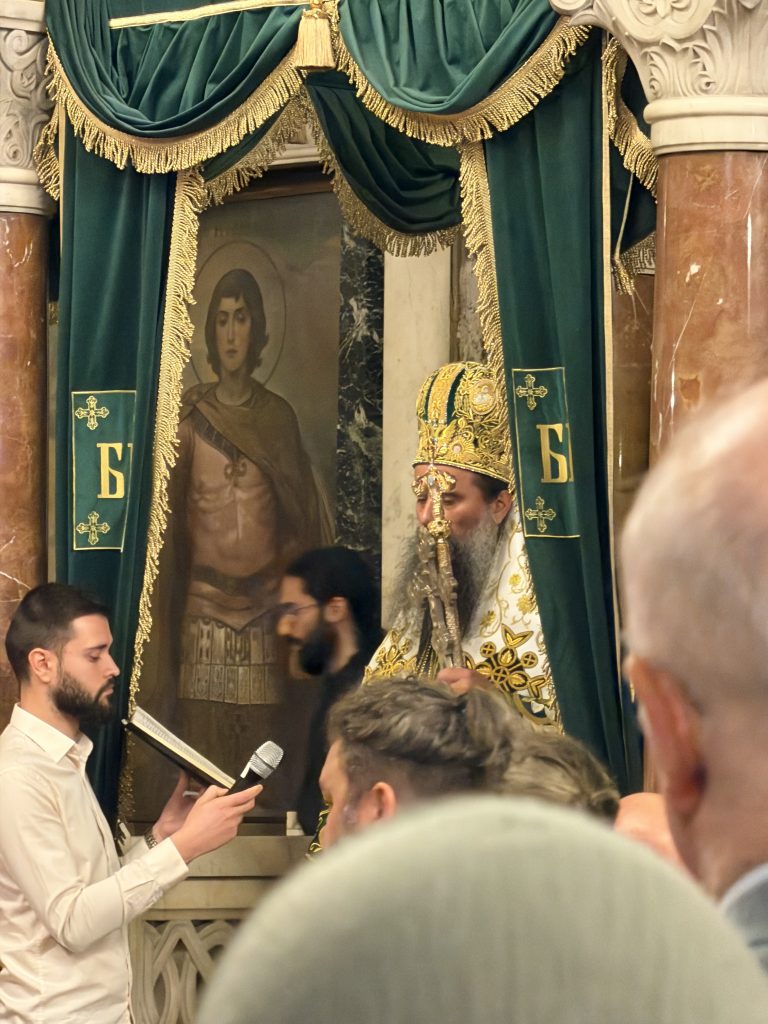
Early in the pilgrimage, possibly even during planning, someone had suggested that I attend the Pentecost service at the cathedral. As that time drew closer, I felt a strong push to be there as well. So, I did indeed attend the service at the cathedral and I’m glad I did. I miss my regular church already; but, I have to admit that attending a service officiated by our Patriarch, Daniil, was quite something.
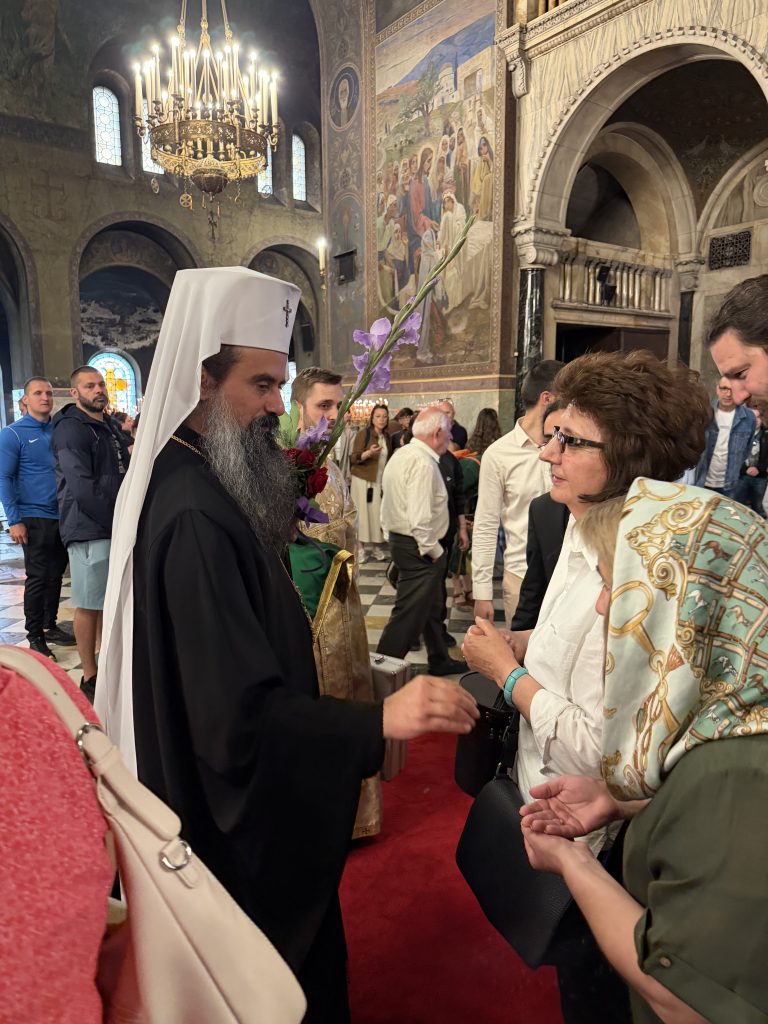
The entrance had all the pomp and ceremony one would expect. The exit was distinctly him, in that it was low-key, quiet, and warm before he walked back to his official residence.
Patriarch Daniil on his way out of the cathedral
I didn’t get pictures at the start, as the entrance was the start of the service and that had my full attention. I did get a few shots right near the end of the liturgy and the start of the Kneeling Vespers. I also grabbed a couple when he quietly walked through the crowd giving blessings and greetings. Yes, I did get a blessing from him. No, I didn’t try to take a selfie (some did) as that’s just not my thing.
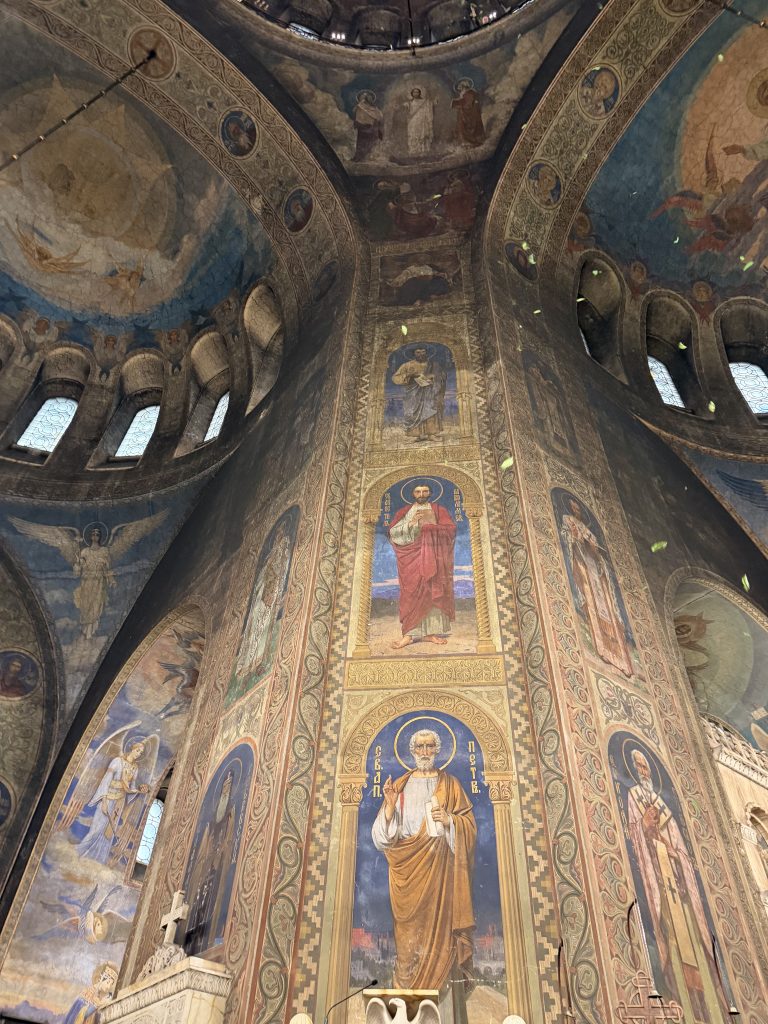
I did take a couple of photos of the leaves and small branches being tossed from the top of the cathedral. The Patriarch had tossed some out to the crowd, and the matrons attending went after them like the front line of the old Green Bay Pachaderms and I chose not to get into that melee. Instead, I managed to catch one of the falling leaves in my hat, and have it tucked into the band. At least until I have to go to the airport as CBP is death on ag products, dirt, etc. being brought back into the U.S.
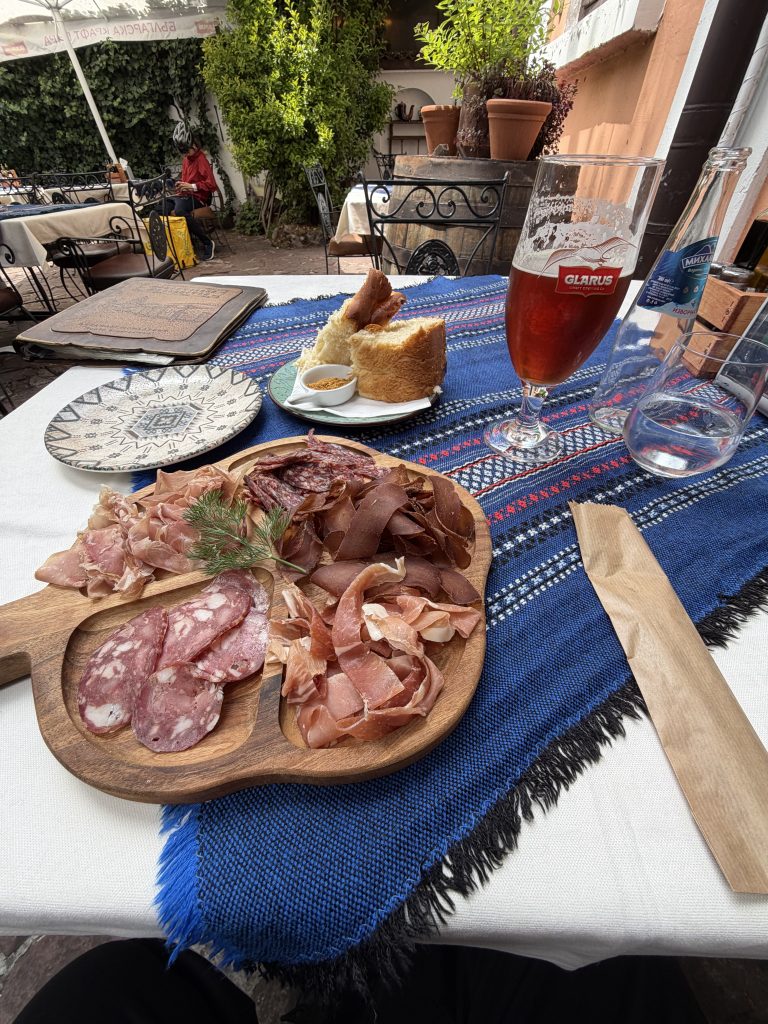
After the service, I sat for a few minutes watching the kids expo taking place in the square around the cathedral. It was fun, and interesting as different parts of the military were there helping kids to climb rock walls, handle weapons, and other cool and fun things. Then, I walked about a mile to have lunch at what has become my favorite traditional Bulgarian cuisine place. I had an appetizer that was a full meal for me, along with a really nice red ale.
More soon I hope. Today looks to be administrative rather than exploratory. Among other things, it appears I did pass my seminary class but have no idea of my final grade. Going to see what I can find out, along with a number of other things that need to be dealt with.
All was good, but loved the spicy dried sausage at the top
If you would like to help me with this trip, seminary courses, and more, feel free to hit the fundraiser at A New Life on GiveSendGo, use the options in the Tip Jar in the upper right, or drop me a line to discuss other methods. I’ve added Cash App ($CliffPow7) and Venmo (@Clifford-Powers-5). There is also the Amazon Wish List in the Bard’s Jar. Getting hit by lightning is not fun!It is thanks to your gifts and prayers that I am still going. Thank you.
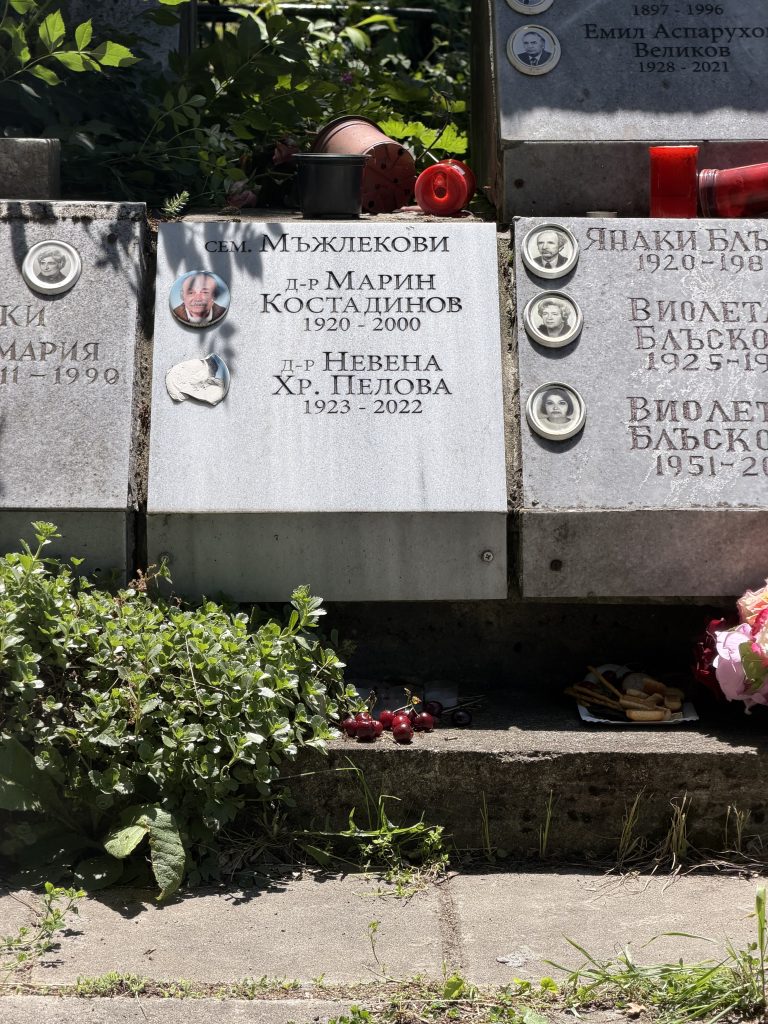
Today is the Bulgarian version of “Day of the Dead.” Families and friends go to visit the graves of loved ones in repose. They talk with them, pray for them, and they leave some food. Thing is, the food has to include cherries. It can, in fact, just be some fresh cherries; but, cherries are essential.
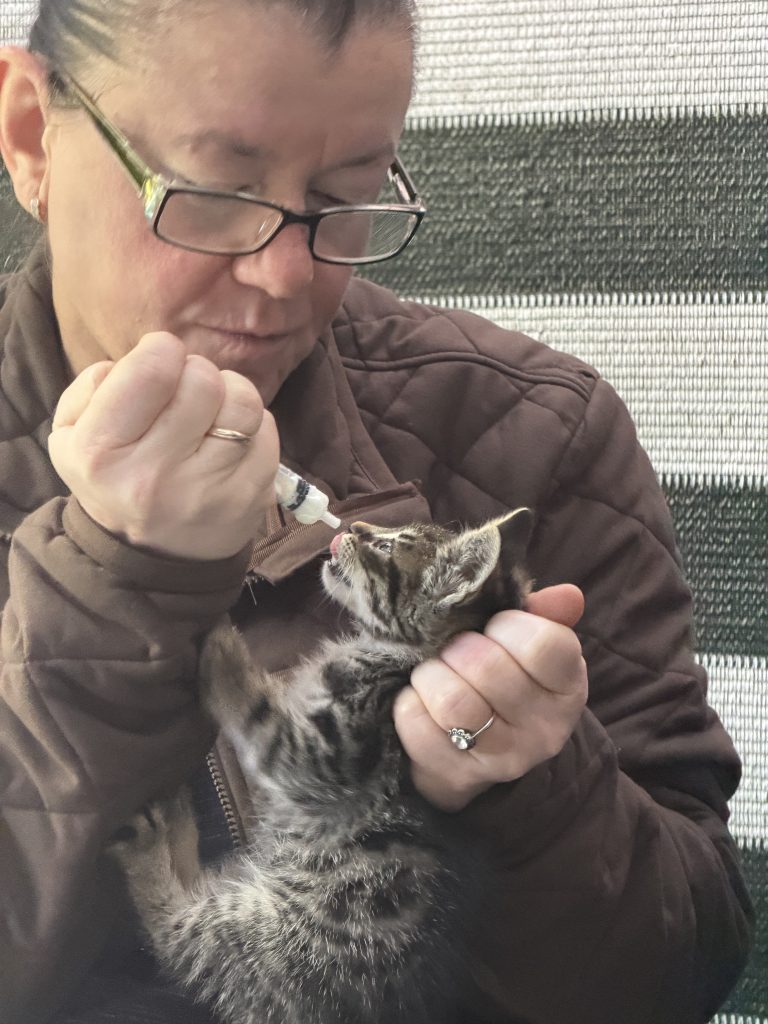
My neighbors here invited me over this morning to share some cherry cake (she is quite the cook I’m learning) she had made, as part of the day is also sharing food with family and friends who are still living. Our little repast ended up including a feral kitten as a guest, who’s mother brought her surviving male kitten to their garden. They have been feeding both of them, him with a syringe of milk that he eagerly takes down as often as he can. In fact, he’s known for coming over, climbing up her pants and into her lap, and asking to be fed. Momma seems quite glad for the help.
I think he would try to swallow the syringe if he could, usually his paws are around her wrist pulling…
I start packing and cleaning tomorrow after church. Current plans are to leave the apartment early next week, spend the night at a hotel near the airport as I have to be there at 0600 for my first flight of the day. That’s going to be a long day I suspect. Feel free to hit the tip jar as I’m shipping some things back and that looks to be more than I care for. That said, it beats an overweight luggage fee. More soon.
If you would like to help me with this trip, seminary courses, and more, feel free to hit the fundraiser at A New Life on GiveSendGo, use the options in the Tip Jar in the upper right, or drop me a line to discuss other methods. I’ve added Cash App ($CliffPow7) and Venmo (@Clifford-Powers-5). There is also the Amazon Wish List in the Bard’s Jar. Getting hit by lightning is not fun!It is thanks to your gifts and prayers that I am still going. Thank you.
The theology class I just finished included a section on the Hagia Sophia cathedral and it’s interactions with theology. When this pilgrimage moved from a day dream into reality and plans were moving along, I started quietly looking into doing a day trip with two main goals: visit the Hagia Sophia and then go visit the “Iron Church.” Going by air was expensive (not to mention a PITA in general); bus travel was an option but was long; and, then, there were trains. In fact, I had read about night trains to various cities and liked the idea.
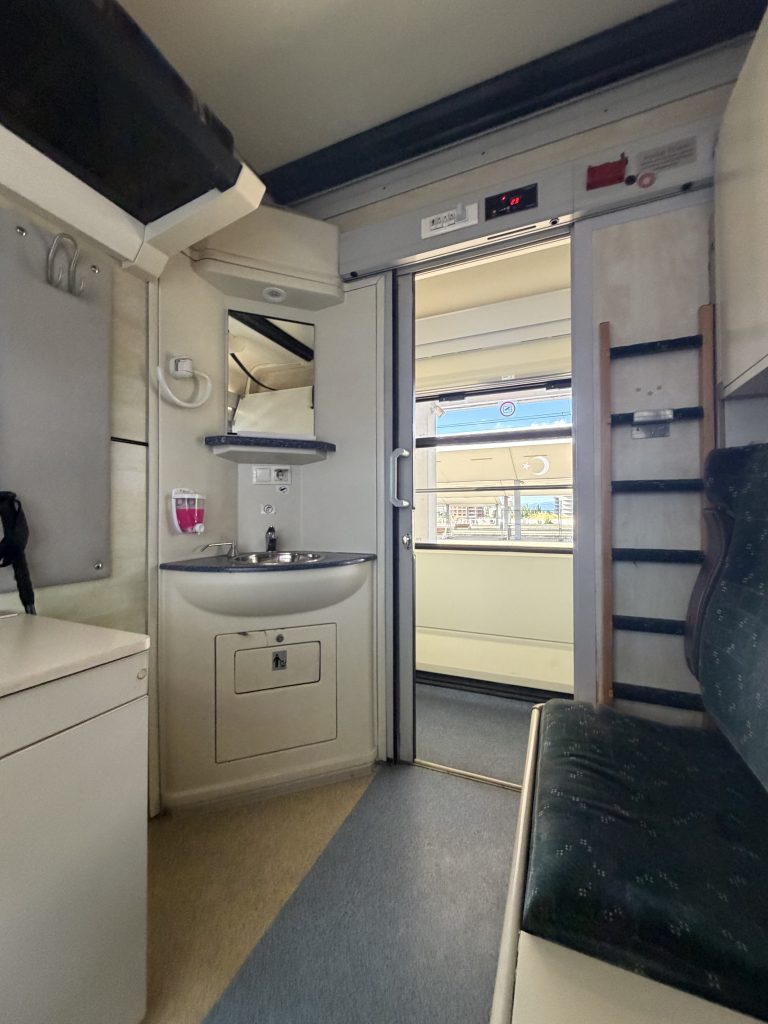
Only problem was that you can’t buy tickets for the night train to Istanbul online. So, I went in person and was able to get the tickets about a week ago without having to get my landlord to translate by phone (something she kindly offered to do). Round trip, second class, with what turned out to be effectively a private sleeper cabin (technically someone else could have been put in with me) was less than $100. I will have to check the bank statement, but after adjusting Euro to Dollar I think it was between $70 and $90. Again, that is round trip.
My sleeper cabin on the night train
So, I showed up at the Sofia main train station and was allowed to board about an hour before departure. The sleeper cars were part of the Turkish railway system, and when we got to Turkish territory the Bulgarian locomotive was switched out for a Turkish locomotive. Someone had warned me there wasn’t a restaurant car, so I had water and such with me and ate not long before our 6 pm departure. Turns out I really should have brought some breakfast along as we did not get to Istanbul quite as early as I had thought we would.
My plan had been to get some breakfast in Istanbul, then head to the Hagia Sophia. My “impression” had been that we would arrive around 7 am and instead we finally got there about 10 am. Side note: on the way back I had the impression we would be back around noon and instead got back around 1. Going to budget more time if I do something like this again.
One thing that did go as planned was getting from the train station to the area of the Hagia Sophia. There was a “metro” train that runs from the rail station through Istanbul, and I hopped off at the stop indicated by both people in advance and the Moovit app on my phone. More on it later on a pure travel post, but it even indicated which exit from the station to use to be on the way to the Hagia Sophia.
Navigation was easy using Apple Maps on the phone. Once I was out of the station, I checked where I was, found the site, and walked the route it chose. Under other circumstances, it might have been a very pleasant walk. However, I had failed to realize that I was there on Eid, and every Muslim who could get to Istanbul had done so in order to visit the Blue Mosque and other sites as it was also the start of three days with most things (various markets and such) shut down. Add that to the normal tourist load and it was extremely crowded (understatement).
A number of us made progress getting up the hill by walking in the trolley track when they weren’t using it. My own preferred method was swing out, pass group slowing things down, then cut back in before another trolley came along. I thought of taking a trolley up; but, they were packed tighter than a sardine can and there was a wait to get on any of them. So, walking I went.
At the top of the hill, I found yet more crowds and a lot of hustlers and scam artists offering to act as guides and such. Danger Will Robinson Danger! Long story, but I did let one young man guide me to where I wanted to go and went inside the Hagia Sophia by myself. When I did come out, he took me to the family business where his older brother was disappointed to find out that I wasn’t supposed to buy anything or even accept the $2,500 rug gift he offered (I didn’t fall off the turnip truck yesterday) given the nature of the pilgrimage.
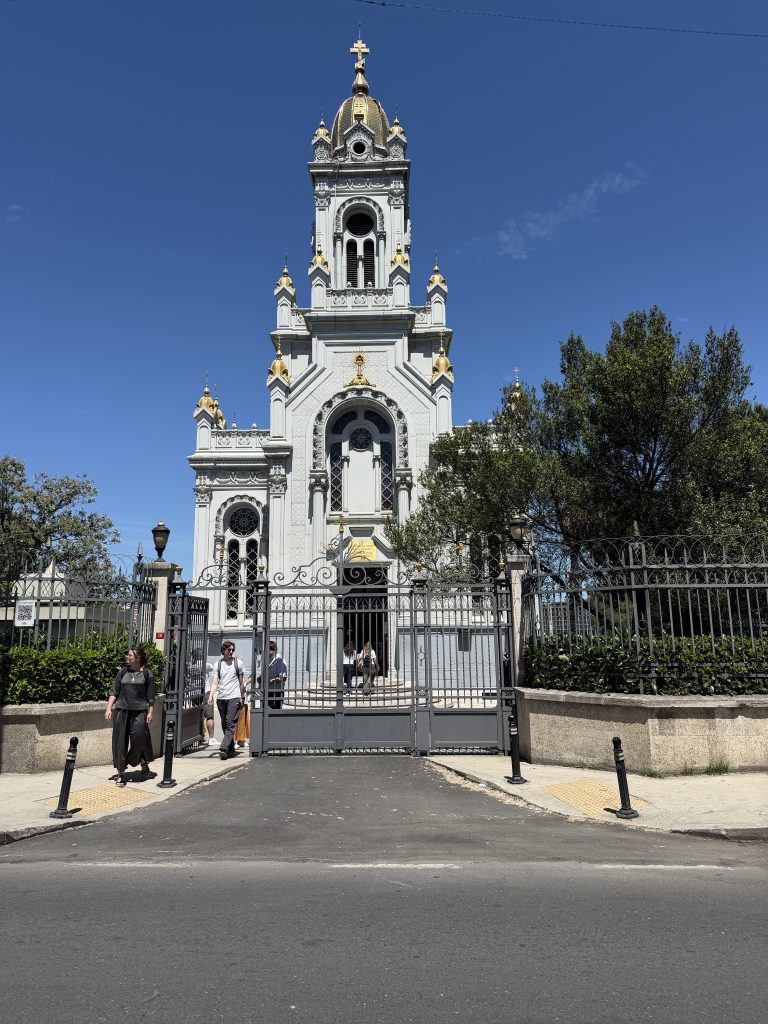
That matter dealt with, I then headed to my second “must do” of the day, visiting the “Iron Church” properly known as St. Stephen of the Bulgars church. It is also made of pre-fabricated cast iron. The story is a long one and wrapped up with the history of the Bulgarian Orthodox Church and how it came into being. The short version is that the original wooden structure was rotting given the wet seaside ground; stone was too heavy for the soil in the area; and, it was decided to show that Bulgaria (and it’s Church) were part of the modern era.
Technically, you could say this church was built twice. Once in Vienna where the iron was cast, and once in Istanbul where the 500 pieces were reassembled. The pieces were shipped down the Danube then across the Black Sea. Various parts were/are even painted to look like marble. It is a fascinating structure and a solid working church that was a pleasure to visit.
The “Iron Church” St. Stephen of the Bulgars
That said, I almost didn’t get there. When I was up at the Hagia Sophia, the map said it was around two miles and would take more than an hour to get there. I walked back down the hill to the metro station, checked again, and it said just under two miles and an hour to walk there. My response to that was ??? I don’t move as fast as I used to, but can still walk a good clip on level ground. This was now level ground. Again, I had forgotten the crowds, and they did indeed make the early going slow. Once I got out from the worst of them, I could, would, and did make good time. I’m very glad I went and need to thank my friend Angel for recommending it to me.
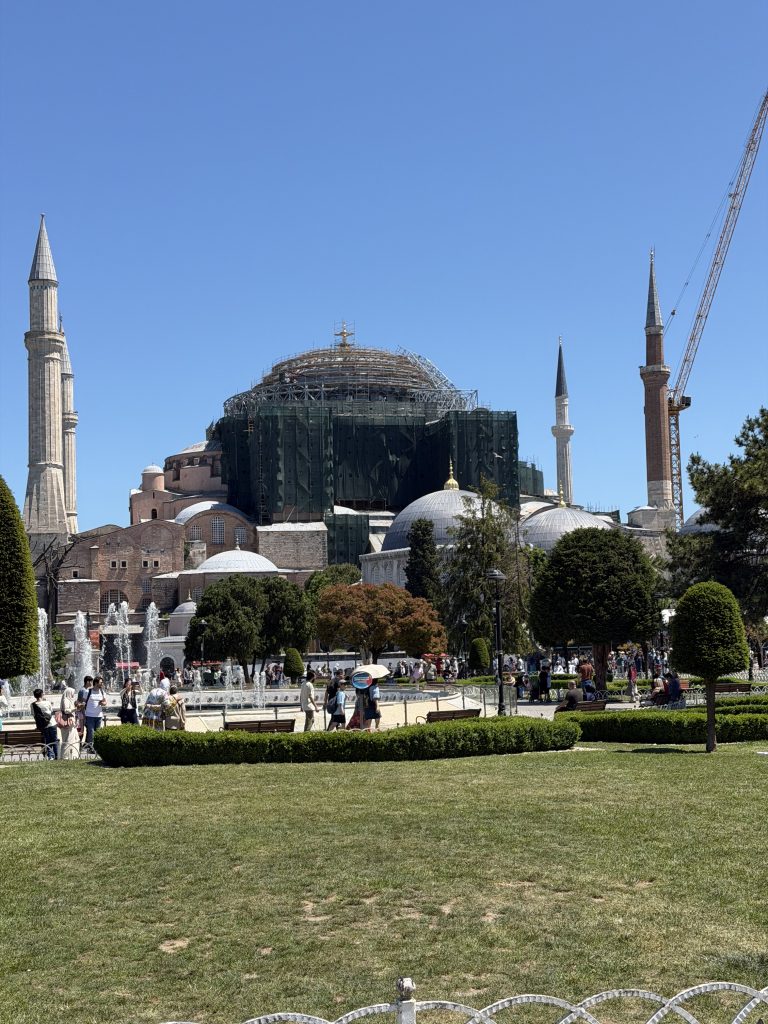
The true high point, literal and figurative, was the visit to the Hagia Sophia. It’s actually the third church built on the site. The first was replaced by a larger church. That church was then damaged/destroyed during anti-Justinian riots and Justinian saw an opportunity. He wanted the new structure to be the greatest Christian church in the world, and to set the bar for future basilicas/cathedrals. This would, of course, show the glory of the Empire and it’s commitment to Christianity. Once source I’ve read says that when he saw it completed that Justinian remarked “Solomon, I have outdone you!” in reference to the temple in Jerusalem.
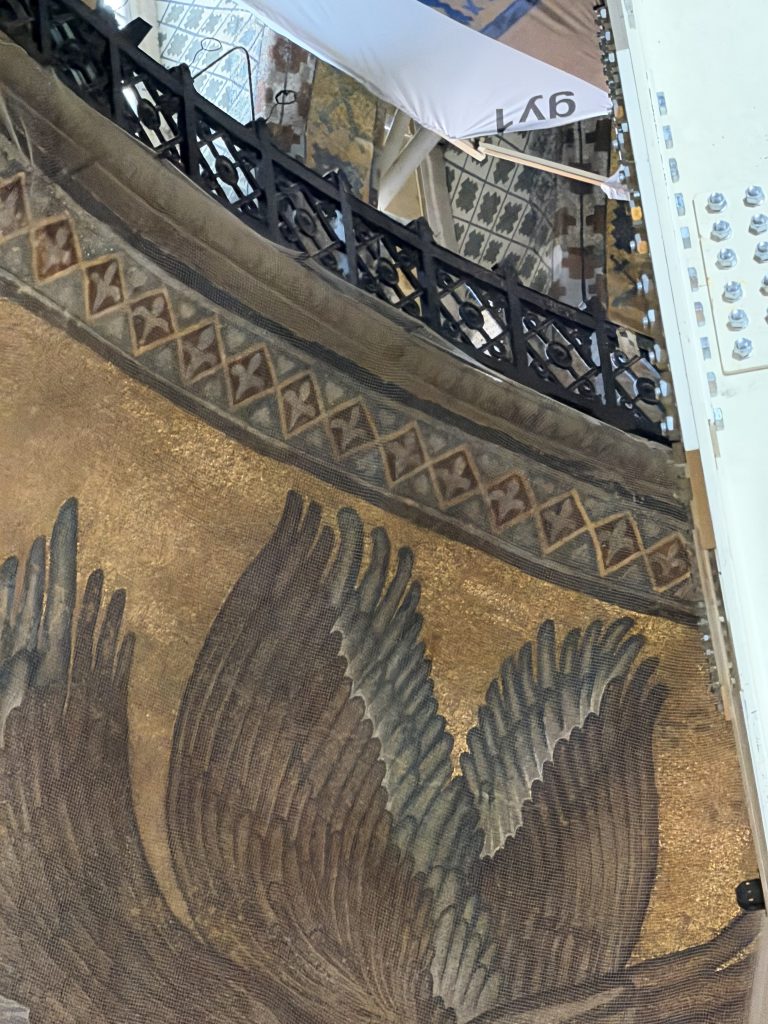
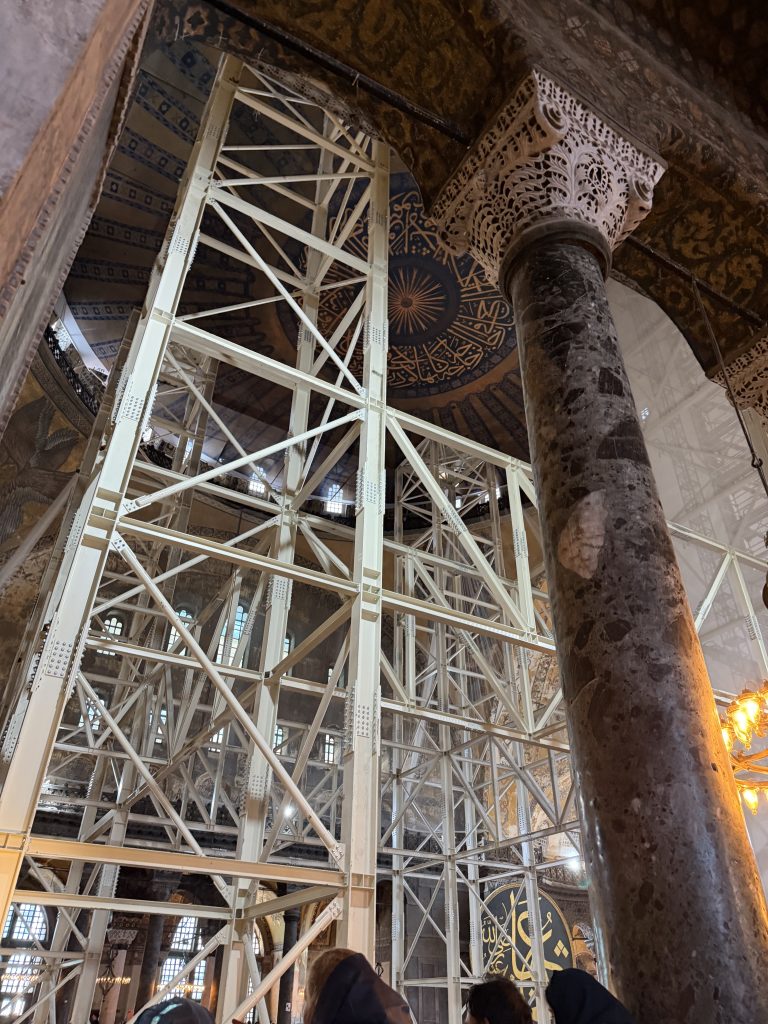
The two designers/architects of the church, Anthemius of Tralles and Isidore of Miletus, definitely got their sums right. They not only designed and built the largest and grandest church of the day; but, it has withstood time and earthquakes as well. Right now, it is undergoing major renovations to repair damage from an earthquake and to make it even more earthquake proof. Which is a very good thing in my book, even if it does make photographing the grandeur a bit of a challenge.
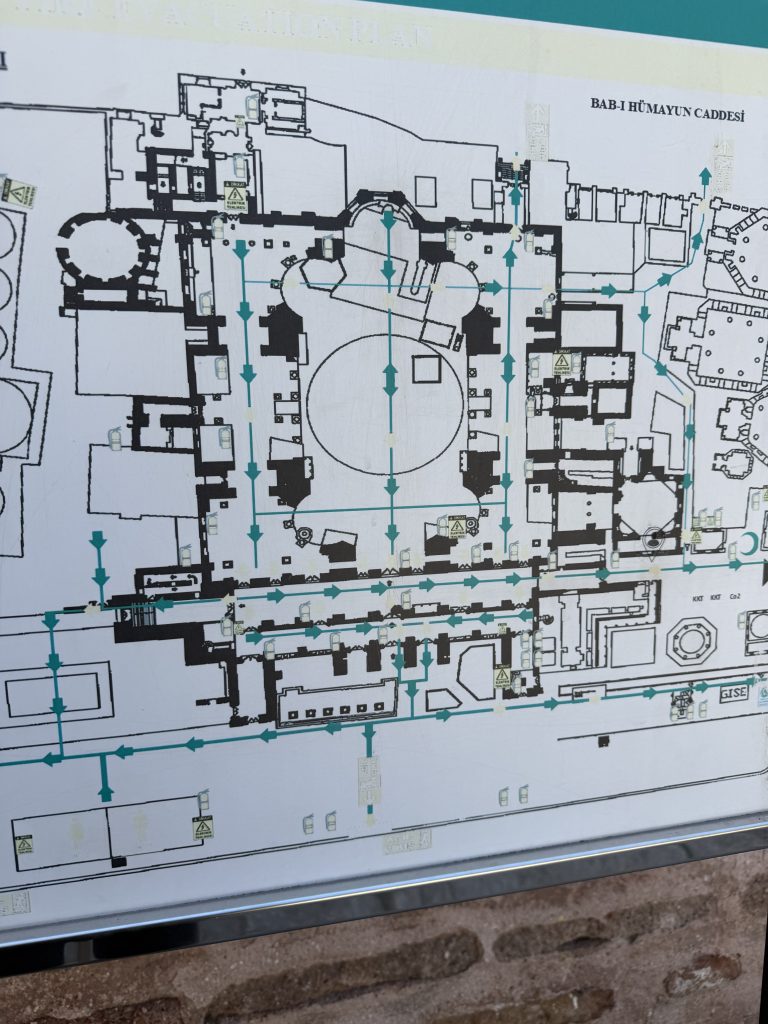
The basilica was the perfect design for the extroverted service used in the capital of the Empire. Going to church didn’t mean going and sitting quietly in the same spot of the same pew every time. Services might start at one church or holy spot (often a site dedicated to a saint) then process across the city, possibly stopping at several other sites before arriving at the basilica where the emperor (or designate) would pray and open the Royal Doors from the Narthex into the church, which was the signal for everyone to enter through the 35 doors into the church.
You can see a small part of one of the upper triangular structures supporting the dome
Keep in mind that a service at the Hagia Sophia almost literally involved a cast of thousands. I can’t find my notes right now, but I seem to recall that there were up to 1,100 door wardens, 80 or so deacons, 60 or so deaconesses, and a few others involved with each service. The men filled the floor of the church and the women went up to the second floor, where the empress had a special area set aside for her and women from the court. The emperor had a special area on the main floor that allowed him to both view and take part as required.
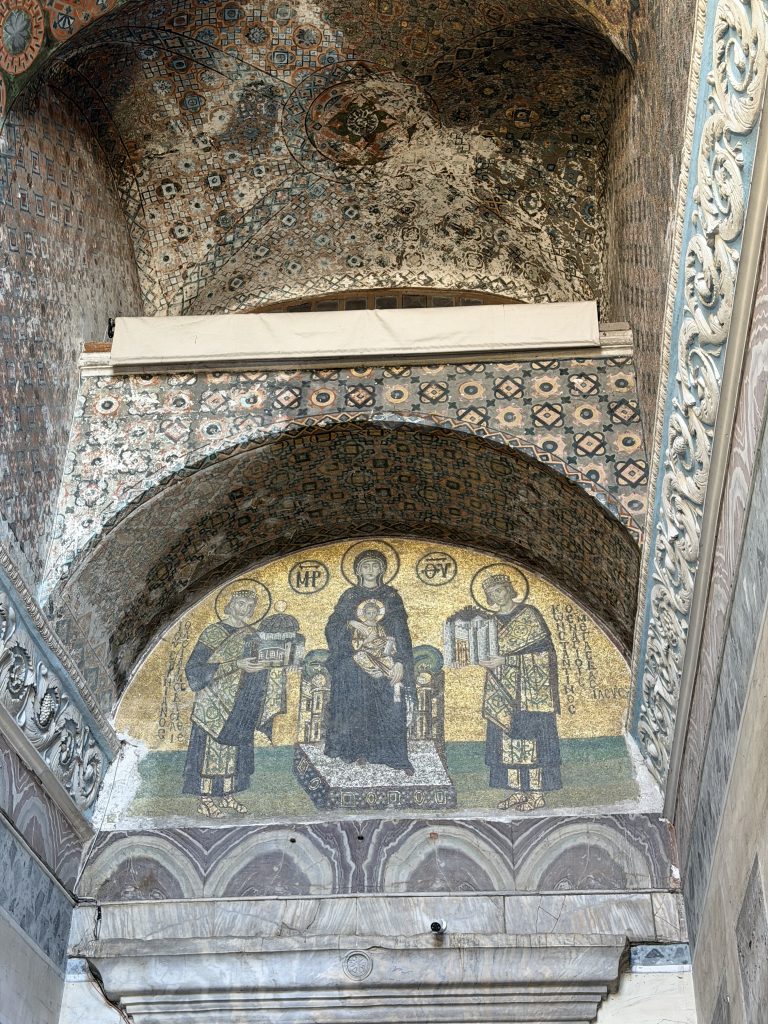
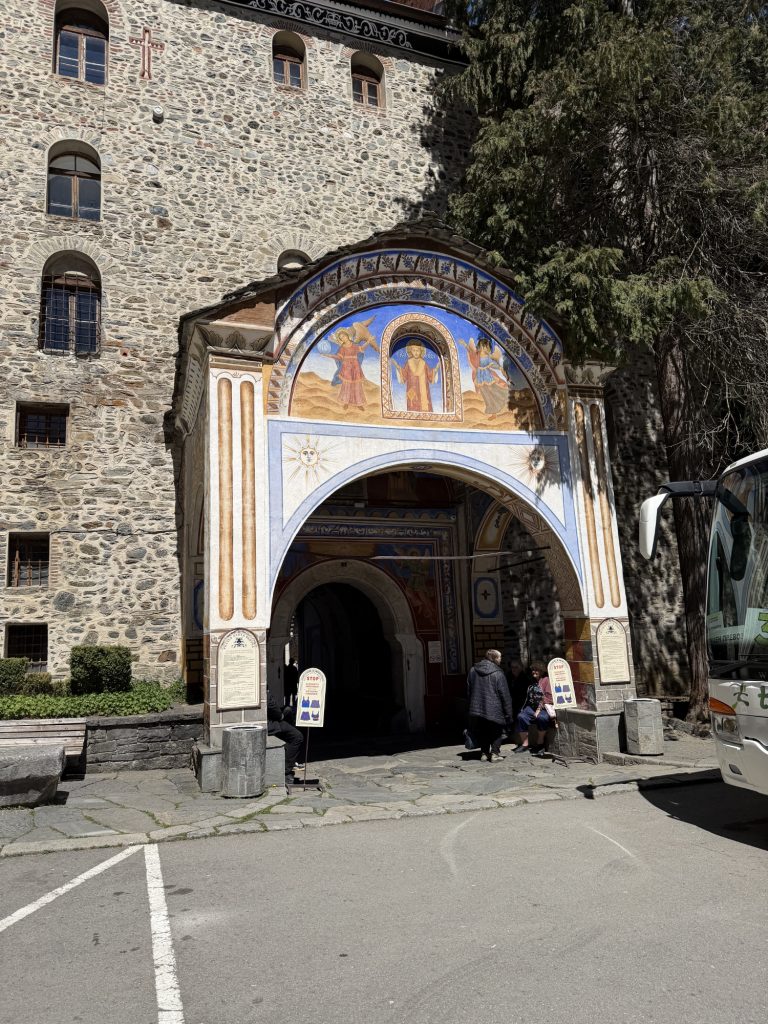
Above one of the outside entrances
The altar area actually was out among the people, with an open and airy structure around it to separate it from the main part of the church. Keep in mind that the current Orthodox solid iconostasis is fairly modern thing that got started around the 14th and 15th centuries. The actual altar was under a canopy structure within it. The ambo, or raised speaker’s platform was closer to the center of the church and had two interesting features. One was a raised walkway from the altar area so the priests and others could get to it through the crowds. The other was that under the ambo was a lower area for the professional choir. They were not visible to those on the main floor, but the idea was that having their voices come out of the air as it were, would encourage the laity to join in the singing. Even today the acoustics are amazing.
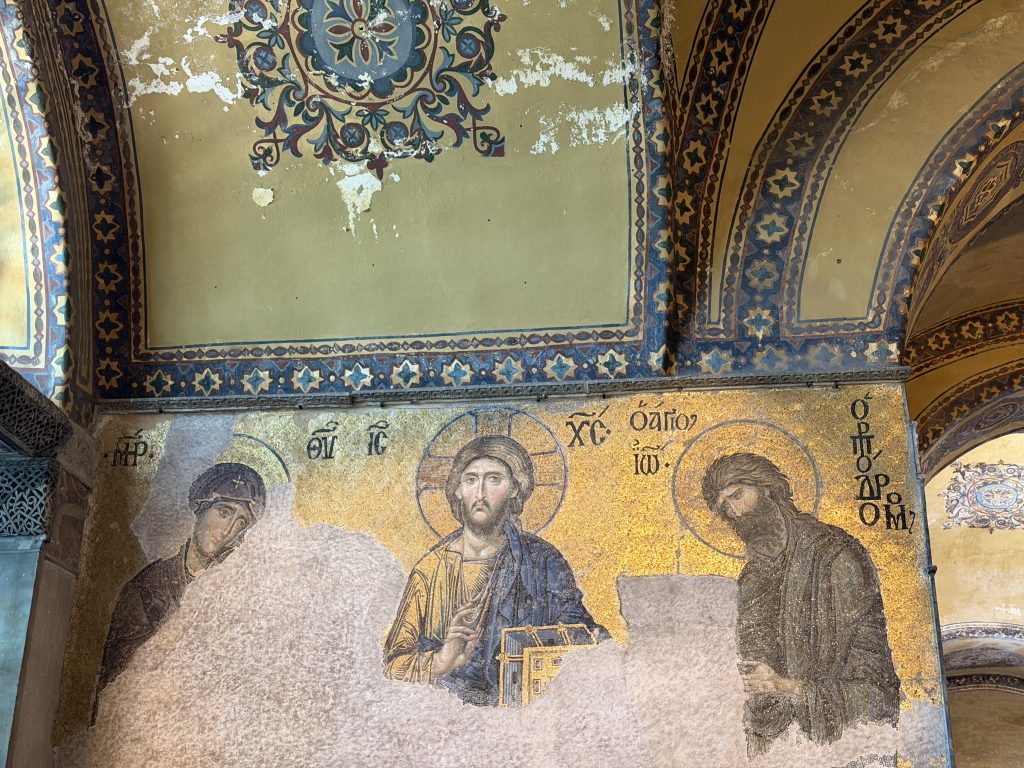
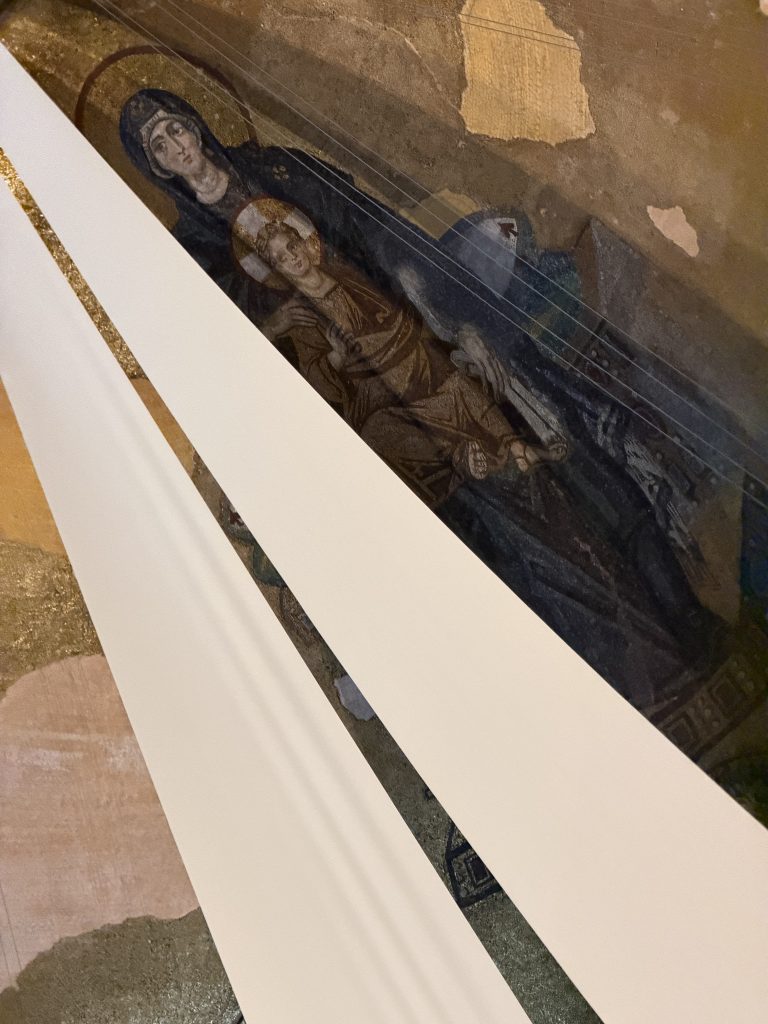
The years have taken a toll, as has the conversion into a mosque then museum and recently back into a mosque. The ambo and choir area are long gone, as is the solea and iconostasis and the direct connection to the emperor’s palace. That said, some of the original mosaics and such still survive. The Theotokos and Child is still there above the nave, screened from general view by fabric. Those glimpses of the rich decoration give you some idea of what it must have originally been like.
The key feature of the Hagia Sophia is, however, the dome. It was an architectural and engineering marvel that appeared to float above the church. The innovative use of arches and special triangular support structures gave the illusion that it was floating, so much so that when it opened people were literally afraid that it might stop floating and fall on them. You can’t really get the full effect today, but enough can be seen to give you at least some small idea.
Ah, to have seen it when it first opened and to have attended a service there. That said, getting to see it now — particularly after studying it in the theology class — is a treat and a bucket-list item. If I ever return to Istanbul, particularly at a less crowded time, I would love to go back and to also see some of the items pulled from the church that still exist. There are a few other places to see and things to do there, but to visit the Hagia Sophia again would be the top thing to do.
If you would like to help me with this trip, seminary courses, and more, feel free to hit the fundraiser at A New Life on GiveSendGo, use the options in the Tip Jar in the upper right, or drop me a line to discuss other methods. I’ve added Cash App ($CliffPow7) and Venmo (@Clifford-Powers-5). There is also the Amazon Wish List in the Bard’s Jar. Getting hit by lightning is not fun!It is thanks to your gifts and prayers that I am still going. Thank you.
I’m working on a little surprise, and if all goes well I might not be posting tomorrow (Wednesday). Or, at least not much of a post (if anything goes up it is likely to be short and sweet). Onwards!
If you would like to help me with this trip, seminary courses, and more, feel free to hit the fundraiser at A New Life on GiveSendGo, use the options in the Tip Jar in the upper right, or drop me a line to discuss other methods. I’ve added Cash App ($CliffPow7) and Venmo (@Clifford-Powers-5). There is also the Amazon Wish List in the Bard’s Jar. Getting hit by lightning is not fun!It is thanks to your gifts and prayers that I am still going. Thank you.
Some have asked: why Bulgaria? The fact is, the church I joined is part of the Bulgarian Patriarchate for the U.S., Canada, and Australia (and sometimes other countries they aren’t quite sure what to do with initially). We are known to some in the Orthodox community as “the converts church” I’ve come to find out, because our original members were all converts to Orthodoxy, and we continue to accept converts who have no tie to Bulgaria or the Bulgarian church. We are, in fact, mostly American converts along with some Russian, Ukrainian, and Romanian (I think) members. The other Bulgarian Orthodox church in Indianapolis is composed of families and/or members who immigrated from Bulgaria.
So, the fact is that most of us converts have no ties to Bulgaria. Part of my spiritual development on this pilgrimage has been learning about the history of the Church in Bulgaria and more about the saints and others who made the Church what it is today.
One of those is St. John of Rila (St. Ivan Rilski), who was the first Bulgarian hermit, first saint, and is the patron saint of the Bulgarian Church. While we have an icon of him, and know a bit about him, he doesn’t necessarily get the attention he is due in some respects. Until this trip, he has not been a major part of my spiritual life (see this for more info). More on that in a minute.
The short version of his life is that he was born in 876 in or near Serdika (modern Sofia) and was orphaned at an early age. He hired out as a cow herder, and one of his first miracles involved the recovery of a missing calf. The owner, who had beaten him for the calf (and/or mother) being missing was hiding and watching when St. John found the calf, and making the sign of the Cross on his cloak, used it to still the flood waters and return it safely to its mother. Somewhat terrified at what he had done in beating the child/youth, the man rewarded him richly — which John fairly promptly gave away.
He was a hermit in the area of modern Sofia, and the monastery where I’ve been attending services on Sunday is believed to be on the site where he had a hermitage. Depending on the source, people recognized that he was no ordinary hermit and so came to visit. The Bulgarian king even wanted to meet him, among other notables. All the attention, however, was not to his liking and after sending a polite letter declining to meet with the king, he took off for the area around Rila where he reportedly lived for a time in a hollow tree.
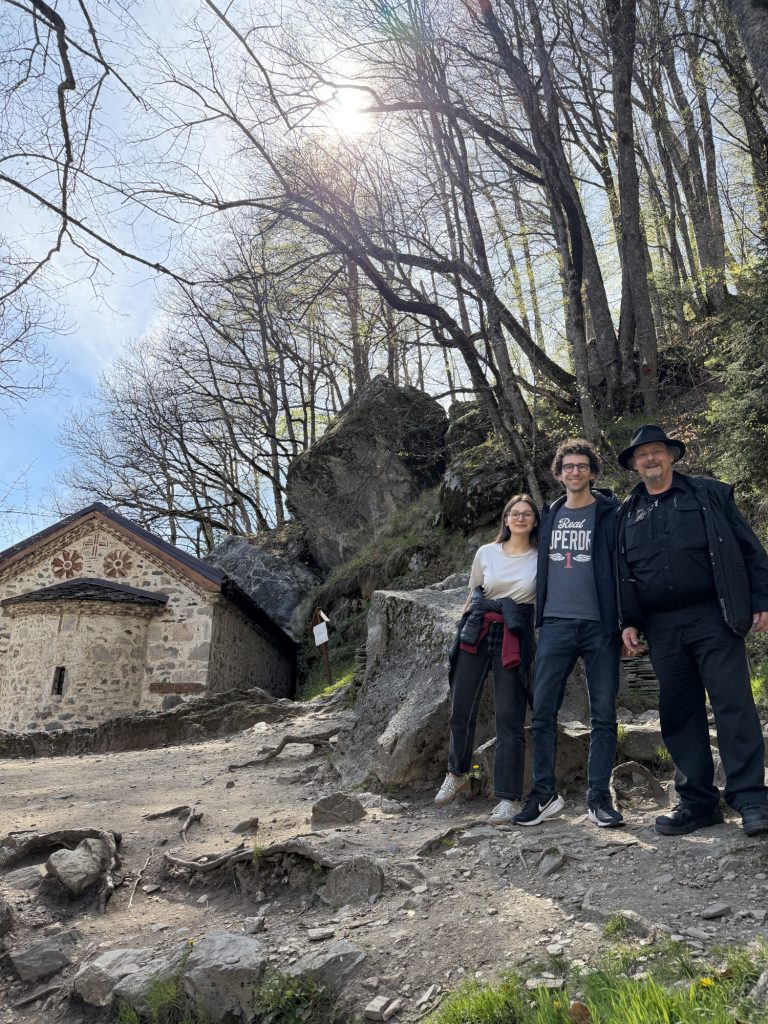
The church built just outside/below St. John’s cave
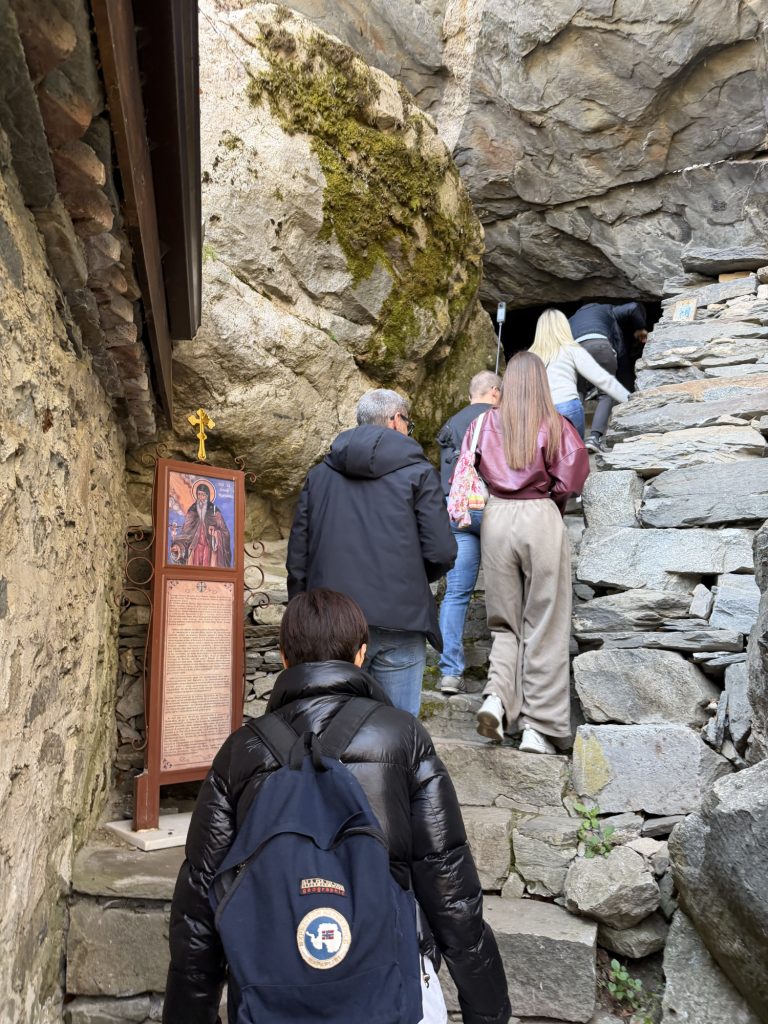
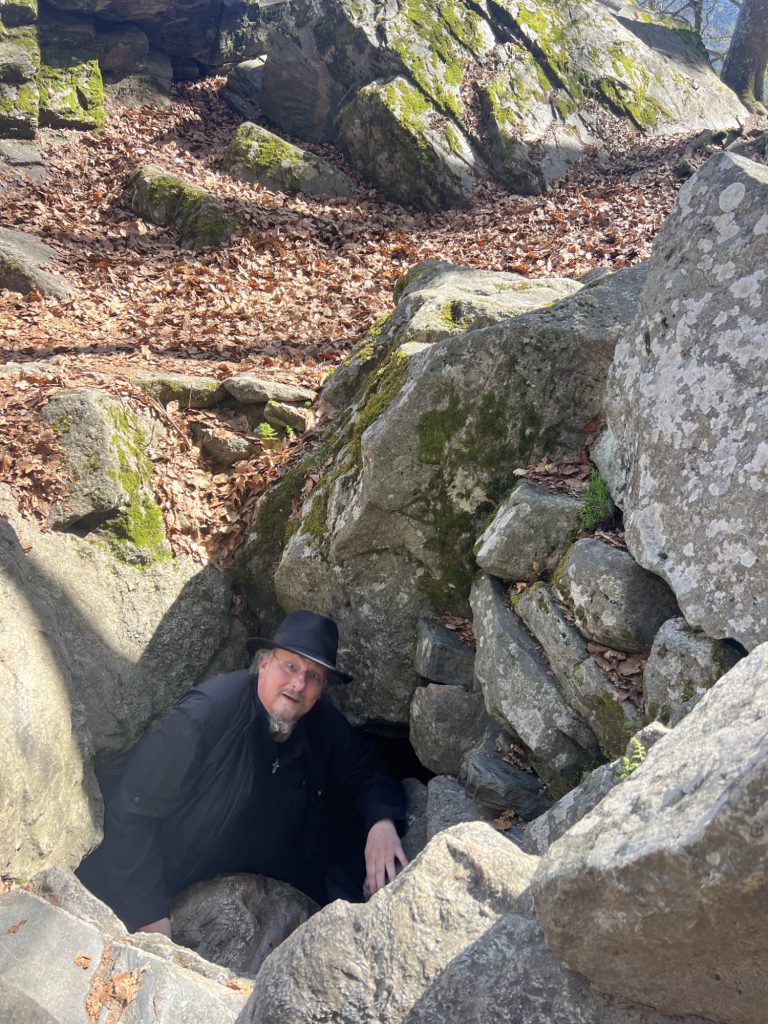
Discovered once more, he ended up taking residence in a cave up a rather steep climb (I did it, fell flat on my face at the base). There was a spring nearby providing running water, and it was a while before the dedicated group of students caught up with him again. They built a small church just outside/below his cave, and tried to protect him from visitors.
The actual entrance to his cave, you have to bend over pretty far to get under the lip
Today, his major relics are in the Church at the Rila Monastery built in his honor. I got the distinct impression that the monks consider the fact that it is now a major tourist destination a very mixed blessing. I rather strongly suspect he would be horrified at it on several levels.
The “narrow way” out of his cave, which can be challenging
As for me, I’ve come to empathize with him quite a bit, particularly after watching the news. I’ve joked a few times on this pilgrimage about wondering how much a gently used cave might cost, either here in Bulgaria or on Mt. Athos where I saw a couple that were unoccupied. It would, after all, be fairly close to what I was thinking of doing if/when I moved to the Southwest.
To skip back to his part in this journey, I offer the following. I venerate him but he has not been one of those that has been a large part of my spiritual life. When this pilgrimage became more than a dream, I asked him to help guide it, especially my visit to him. I mentioned it before, but once here, I wasn’t guided to go to Rila on a certain day as much as I was told to do so. I did, and while there — among other things that happened — I was given the chance to venerate his relics. That was just one of several things that happened that day, and I do feel that he was behind them and behind my getting the most possible out of that visit and some other things.
It’s left me with a good bit to think about, and to talk over with my priest and others. There’s a lot that has happened that is not mine to share, and a lot where I’m having trouble putting parts into words. I will simply state that this trip has indeed been rich and rewarding for spiritual growth and discernment.
If you would like to help me with this trip, seminary courses, and more, feel free to hit the fundraiser at A New Life on GiveSendGo, use the options in the Tip Jar in the upper right, or drop me a line to discuss other methods. I’ve added Cash App ($CliffPow7) and Venmo (@Clifford-Powers-5). There is also the Amazon Wish List in the Bard’s Jar. Getting hit by lightning is not fun!It is thanks to your gifts and prayers that I am still going. Thank you.