Pilgrimage: Food Favorites

I had a lot of good food while on pilgrimage; but, a few stand out above the rest. Today, I’m going to share a few with you starting with Sofia and then two in Thessaloniki.
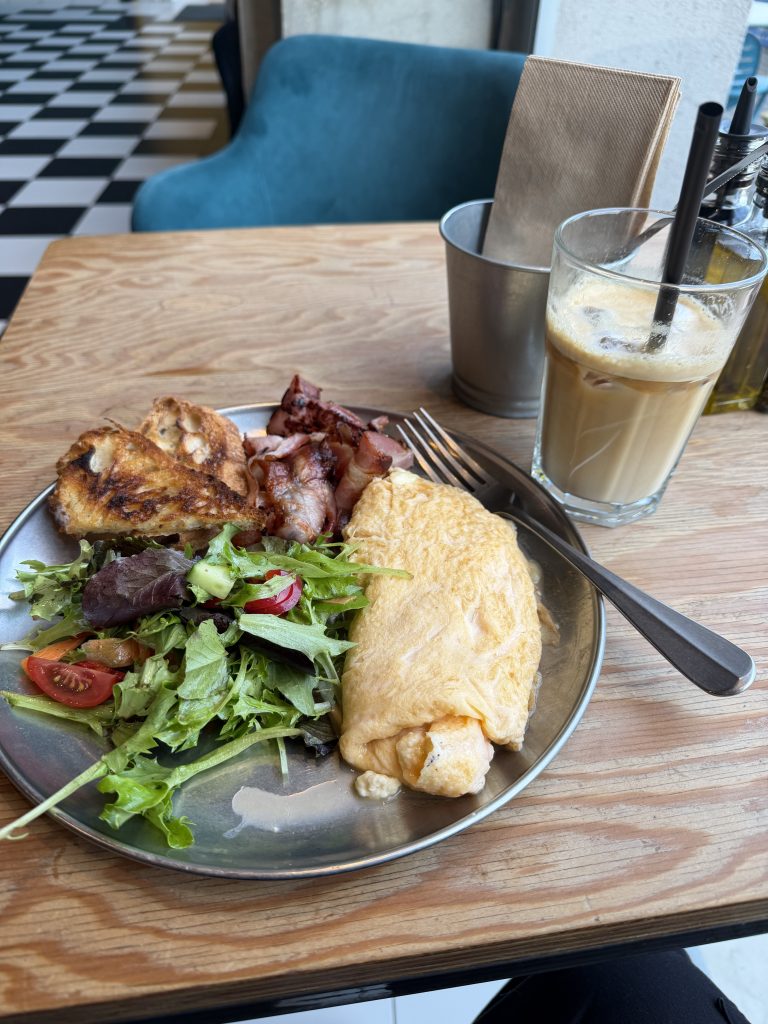
Cafe 1920 (Maria Luiza 60, Lavov Most, Sofia, BG 1202) is located near the Lion’s Bridge and does very good breakfasts along with some other fare for the brunch/lunch crowd. It is usually packed at opening, though the afternoons tend not to be as crowded. They also have a bloody mary that I would rate as one of the five best I’ve had anywhere in the world. It is not spiced anywhere close to a typical American bloody mary, which is good thing IMO, and the spices reflect Bulgarian culinary culture. Good service, and it is also a good spot for simply people watching. Alas, their website is FB, and I won’t link to that.

Which reminds me that I need to note that the wait staff in most restaurants and such in Bulgaria tend not to fawn over people. Some people see it as stand-offish or that they are ignoring you, which is not the case. They simply don’t try to rush people for turnover purposes and as long as you seem content they won’t bother you. The idea is for you to relax and enjoy the meal, and signal if you have a need. I found it rather pleasant, and a welcome change.
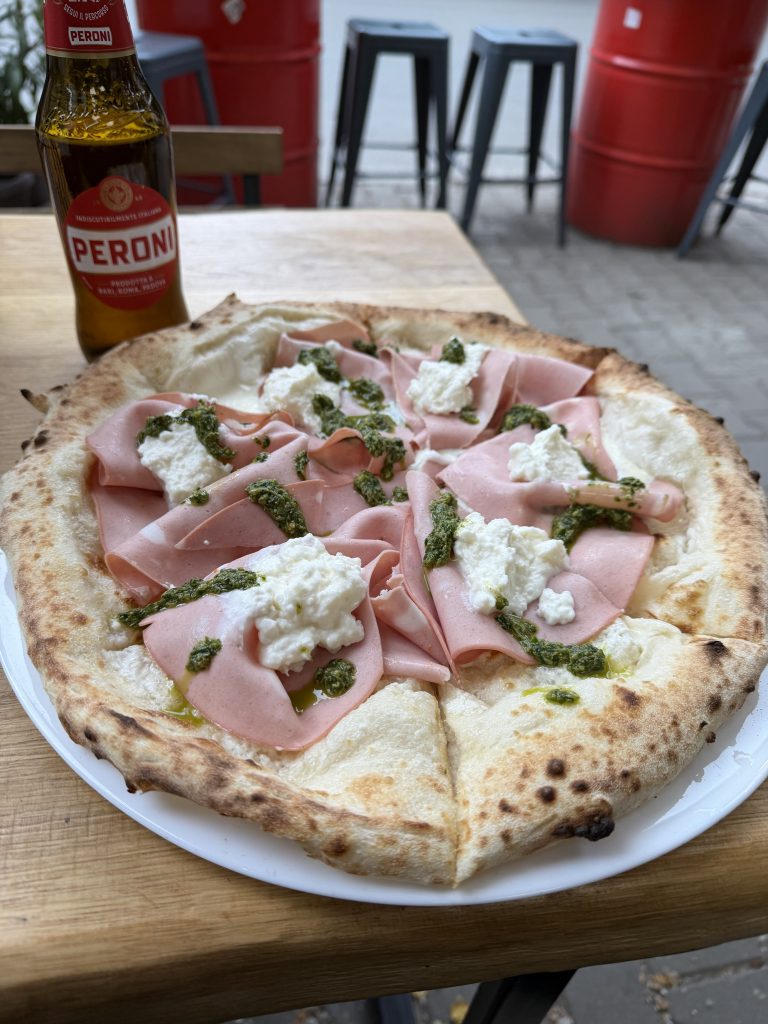
Very good pizza is to be found at Caruso Pizza (52 Georgi S Rakovski Street, Sofia 1202). It’s a small shop, with a table on the sidewalk, primarily focusing on take out. They have a good menu and everything I tried there was good. Give it a try.
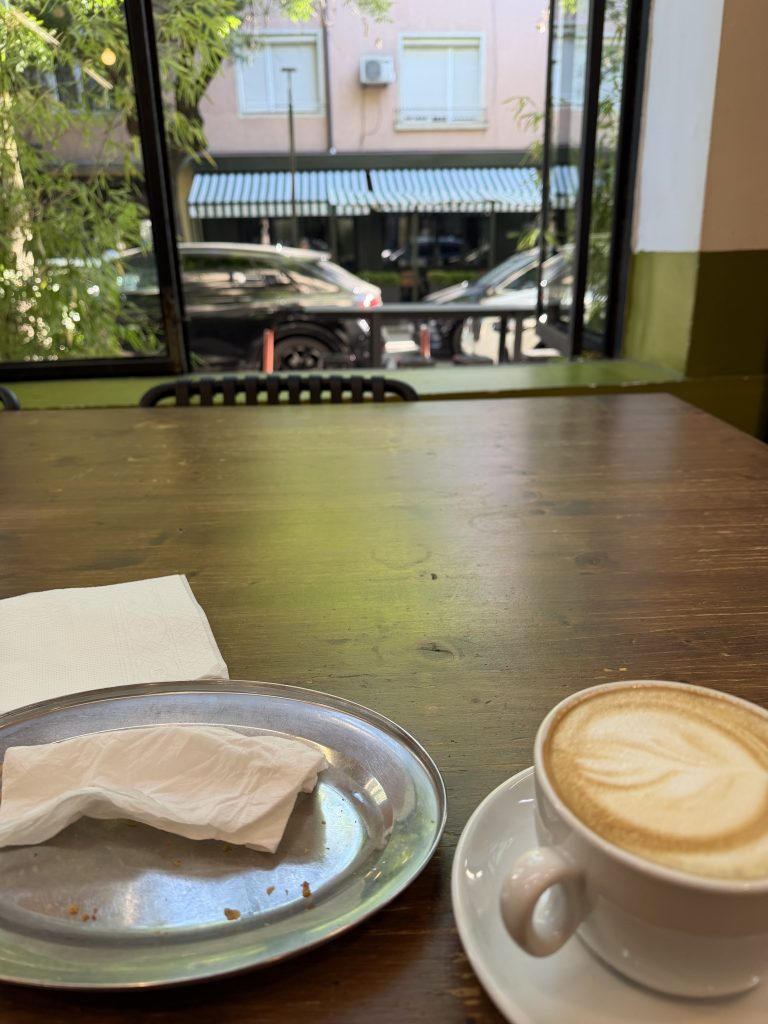
My favorite bakery in Sofia is Hle Bar (Oboriste Str, 16, Sofia 1504 Bulgaria). Loved their bread, they had very good savory banitsa, and good coffee. They are also a small grocery and their house wine is decent. They are not too far from Sofia University and the Cathedral, just down the street from the French ambassador’s residence.
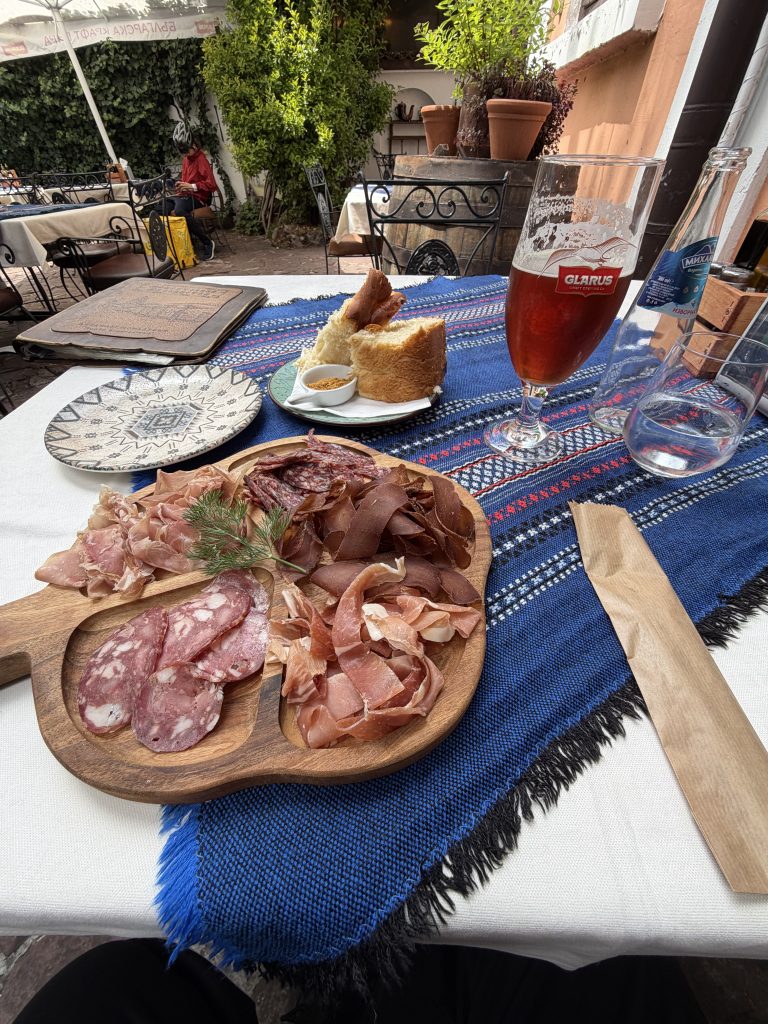
My favorite traditional Bulgarian restaurant is Manastirska Magernitsa (Monastery Magernitsa, 67 Khan Asparouh Str., Sofia, BG 1000). A friend at the church I was attending in Sofia recommended them, and I’m glad he did. The menu is extensive and even features a page of vegetarian dishes from historic Bulgarian monasteries. To be honest, with the weather being as nice as it was, I enjoyed dining in the courtyard rather than the historically furnished and very nice interior. If you are looking for traditional dishes done well, this is the place to start.
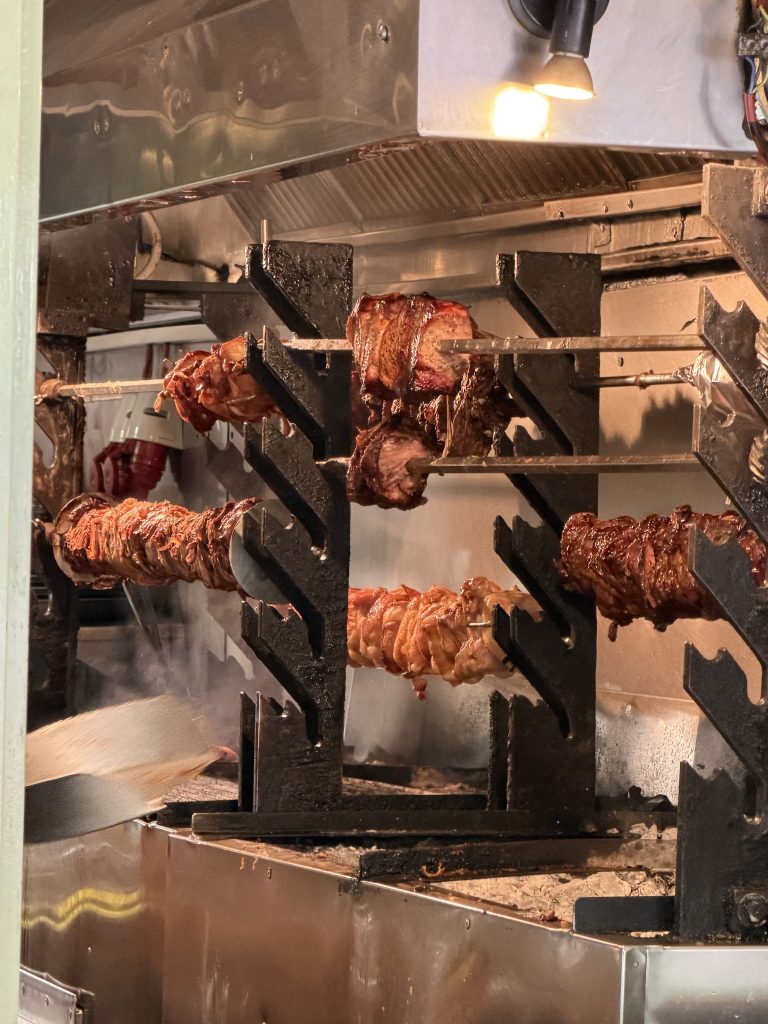
In Thessaloniki, allow me to recommend Katsamaka (18 Athonos, Thessaloniki 546 33). I smelled the delicious odors coming from it as I was walking to a church, did a double-take, then followed them to the source. One look at the meat roasting and I knew where I was eating dinner latter. Had I more time in Thessaloniki I would have eaten there more than once.
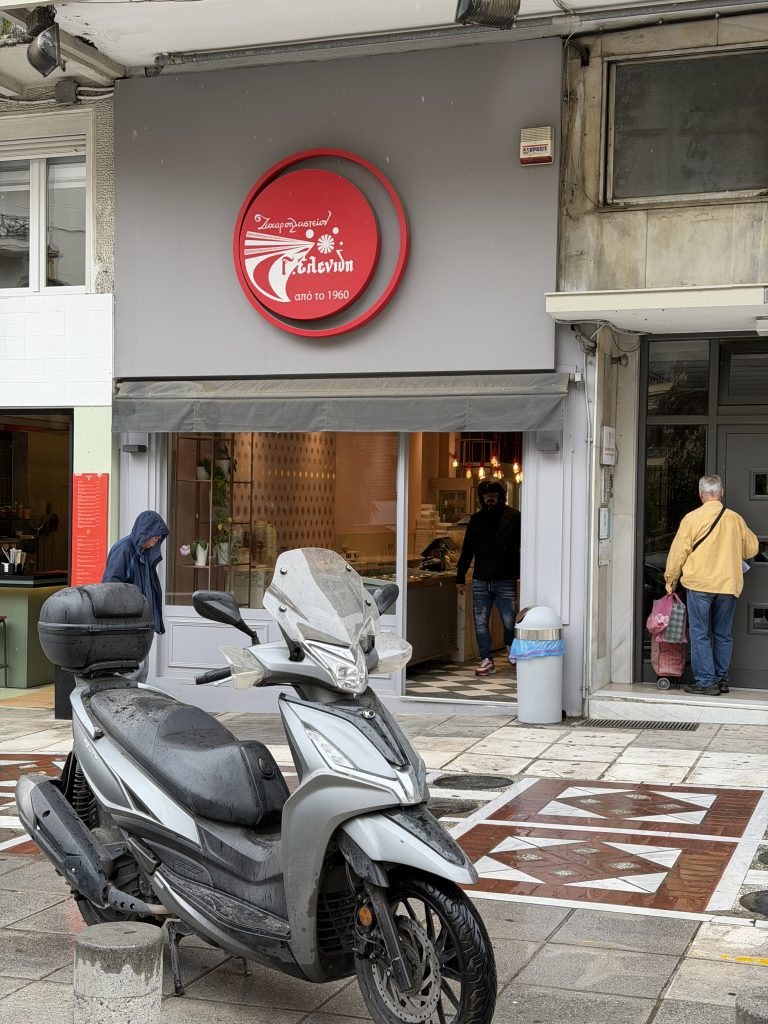
The other place I will recommend in Thessaloniki is not my usual forte. I love sweets, but try to stay away from them. I’m so glad I didn’t when it came to trying trigona panoramatos, and also very glad I had it at Trigona Elenidi at at their location near the White Tower (Dim. Gounari 13, Thessaloniki 546 22). Trigona is their specialty, and they do this traditional dessert right. You will have sticky fingers after eating the delicious cream/custard filled cone, but that’s part of the fun. Besides, if you’ve been walking all over Thessaloniki, you deserve a sweet treat.

Those are my top recommendations, and there are a lot of honorable mentions. There is a lot of good food in Sofia and Thessaloniki, but this list will get you off to a good start with any culinary explorations you want to do. Enjoy.

Please check out my Summer Bleg.

Getting hit by lightning is not fun! It is thanks to your gifts and prayers that I am still going. If you would like to help me with seminary courses, pilgrimages, and more, feel free to hit the fundraiser at A New Life on GiveSendGo, use the options in the Tip Jar in the upper right, or drop me a line to discuss other methods. There is also the Amazon Wish List in the Bard’s Jar. Thank you.
Old Elevators & Special Rooms

Had planned to do something else today, but things changed and put this together instead. The elevators are interesting, and if you’ve not encountered them yet, check out James Bond “Diamonds Are Forever” for a glimpse. The other is very common in the heart of the EU as they try to ensure no resource is wasted while you are not in the room.

Check it out.

Please check out my Summer Bleg.

Getting hit by lightning is not fun! It is thanks to your gifts and prayers that I am still going. If you would like to help me with seminary courses, pilgrimages, and more, feel free to hit the fundraiser at A New Life on GiveSendGo, use the options in the Tip Jar in the upper right, or drop me a line to discuss other methods. There is also the Amazon Wish List in the Bard’s Jar. Thank you.
Travel/Pilgrimage: Public Transport

A couple of questions/points have come up revolving around the use of public transportation, especially given differences in self-defense laws between countries (and here, states and cities even). The adage “Know Before You Go” comes strongly to mind.

There are cities where I would not hesitate to use public transportation any time of the day or night. There are cities where I would not use it any time of the day or night. Most are a mix to be honest, and the late night/early morning (say about midnight to 0400) are generally times to be on high alert, particularly on subways/metro trains.

In terms of this trip, Sofia had a wonderful subway system that I cheerfully made use of to get around. In fact, I got on it at the airport, rode into downtown, made one change, and came up less than a full city block from my apartment. The subway runs very much to schedule, the stations I used were safe and usually had some LE presence at the turnstiles (or whatever you want to call them), and you frequently saw LE and such taking the subway to and from work. So, while I was alert I seldom went to high alert while using the system. I was told one of the larger dangers were pickpockets, but never had a problem.

The only real downside to the Sofia subway system was that quite frequently the elevators used by those with mobility issues or luggage did not work. Those with escalators generally worked but I would still rate them as being on the edge of iffy, and therefore not something you could fully rely on.

I would also note that one thing helping with the safety was that panhandling on the trains was not allowed or encouraged and even traditional panhandling was not allowed in the stations. The one type of panhandling that did seem to be allowed were musicians, usually with a violin or chello, who played in various corridors. I will also add that most of them were quite good.

Quick note before I forget, most panhandling on the streets in Sofia is organized and comes primarily from one particular ethnic group. The people panhandling have an assigned location, are reported to have quotas to make, and can be quite aggressive. There are limits to that though, and I had the impression local cops could and would deal with anyone who got too aggressive.

Thing is, anytime there are panhandlers or people who try to walk close even when there is room, think and prepare for pickpockets. Crowded places, like markets or events, are sadly fertile grounds for them. Plan ahead, take proactive steps, and engage in passive if needed. I actually used to carry a dummy wallet as a passive measure, and will note that plastic grocery bags in the tops of pockets and purses can be a good barrier (noise, movement, blocking).

Tangent, but worth noting. RFID scanning seems to be a growing problem. I have anything with a chip, including my passport, in RFID-blocking sleeves, my wallet is shielded to block signals, and I even carried a passive jammer that works off the intruding signal. All I can say is that so far there seem to have been no problems and the expenses were frankly miniscule in the grand scheme of things. Can’t prove they did or didn’t help, and am very glad I took the steps.

Sofia also has busses and trolleys, which seem to go everywhere. I did not get to use these as much as I could or should have, and when I go back I hope to use them a bit more. Some are newer, some are older, but from what I saw and heard from those that did use them extensively, generally safe and relatively clean.

Constantinople (Istanbul to the heathen) had a metro train that got me from the train station to the area near the Hagia Sofia fairly quickly. The trains I was on were clean and, if you could get a seat, comfortable. The largest problem is that they have a fully automated entrance system that blows chunks as far as I am concerned. Getting assistance with it was problematic and I thought I was going to have to spend $$$ to get back to the train station via a taxi. They also allow musical panhandlers (often making use of small children) to operate on the trains. Not impressed and can’t recommend.

Just as an aside, as of the last time I used them, I’ve had good luck with the Paris metro; Moscow metro; Washington DC metro; and the Tokyo metro. In fact, I would rate Tokyo as my favorite. Sofia is high on my list, and I appreciate that stops are called in both Bulgarian and English. I will also note that when using any system you need to check on where the bad areas/stations are and avoid them.

As for self-defense and related topics, always check the laws where you are going. For example, when I grew up everyone carried a pocket knife as it is a useful tool. Even carrying a kitchen knife in your luggage for cooking may be illegal. Pretty much any type of knife or sharp objects is now illegal in the U.K, as is pretty much all self-defense.

Bulgaria has some of the best knife laws in Europe in my opinion, is good about self-defense, and there were even street/market vendors selling a variety of edged items. I liked that about Bulgaria. Greece, on the other hand, is more towards the U.K. in terms of pocket knives and such, though somewhat better on self-defense. Turkey, well, I was pretty sterile for other reasons but will just note that having a pocket knife makes a dandy excuse to detain someone for a while without charges while things are “checked out”. Again, know the laws where you are going, and make sure your travel insurance covers legal assistance for various contingencies.

Just a few thoughts to share this day. Always research, always double check, and always be prepared.

Please check out my Summer Bleg.

Getting hit by lightning is not fun! It is thanks to your gifts and prayers that I am still going. If you would like to help me with seminary courses, pilgrimages, and more, feel free to hit the fundraiser at A New Life on GiveSendGo, use the options in the Tip Jar in the upper right, or drop me a line to discuss other methods. There is also the Amazon Wish List in the Bard’s Jar. Thank you.
Pilgrimage/Travel: What Worked

My recent pilgrimage allowed me to try out several new things, from clothing to apps, and I thought I would share a few quick notes on what worked. Probably not going to say a lot about what didn’t work (apps). Always glad to share the good stuff.

My first recommendation wins the “Where were you 40 years ago” award: the SCOTTeVest. Oh my stars and garters, it made life so much easier. That’s even without tapping the Personal Area Network capabilities. For me, the vast array of secure pockets, one of which is even RFID shielded, made it indispensable. For going through security I put everything in it that would set off the magnetometer or scanner, dropped it on the x-ray belt, and mostly got through fine. The metal plates and artificial joints I now carry did cause some problems, but the vest cut the hassle a LOT. I also could change the loadout as needed, and always had potentially useful paperwork on me — along with my Billa shopping bags.

Honorable Mention: My Billa cloth shopping bags. Plan to start carrying them here too.

The vest held up well overall. My build was not a perfect fit for it (chest and shoulders) but overall a good fit. I would not recommend it for high summer, as it did get a bit warm once the weather turned hot, but it worked well for cold then spring.

I tried a couple of different translation apps, including one that had been highly recommended. I ended up trashing them and just going with Google as it did better than the pricey apps. Handled text, photos, and voice well and came in very handy. Worked well on cellular data and very well on wifi. Also, unlike the bought ones, worked everywhere I went. Next time not likely to bother with anything else.

Financial apps I used a good bit were Revolut and Venmo. Revolut was great for dealing with exchanges, getting money to a guide, and offers a lot more services I did not fully explore this trip. It does more than I know how to do, and I hope to find a good tutorial one it one day. Venmo I had not used before, but it also came in handy. Not used as much in Europe as Revolut, but still handy to have.

The communications app I used the most was WhatsApp. A majority of businesses had a WhatsApp number on their website or advertisements; many of the people I met there had accounts, and it was probably my most used means of communication. Why make potentially expensive phone calls when you can use the app?

The most intriguing app on the trip was AR Time Machine. I don’t know if it works anywhere but Sofia/Serdika; but, it made spending time in the Roman ruins much more interesting. When you scan QR codes in the ruins and hold your phone up, it doesn’t show the present but what the area looked like in Roman times. Turn around/look around with the phone, and it shows you what was where then, not now. Educational and entertaining and didn’t seem to be a data hog. Glad I tried it out and am keeping it on the phone just in case it is in use elsewhere.

Two transport apps I can recommend. First up is TaxiMe which probably only works in Sofia but was a great way to get a good taxi safely and without potentially getting gouged. It even has some limited English capabilities. The other is called Moovit and it handles public transport in multiple locations. My only issue with it is that I thought I got the ad-free, and didn’t. Before I try to use it again on a trip I will upgrade to avoid the hassle and delays of the ads. Not quite as intuitive as I would like, but it worked well enough to get me by.

Final app getting a worthy mention is the MPC app from Customs and Border Patrol. Returning to the U.S. used to mean a flimsy odd-sized paper form and the need to have receipts and more handy. It took me less than five minutes to get the app, set it up, and take care of the paperwork while the plane taxied to the gate. Very much simplified the arrival process.

Just a quick look at the things that worked. Hope they help you in your travels.

Getting hit by lightning is not fun! It is thanks to your gifts and prayers that I am still going. If you would like to help me with seminary courses, pilgrimages, and more, feel free to hit the fundraiser at A New Life on GiveSendGo, use the options in the Tip Jar in the upper right, or drop me a line to discuss other methods. There is also the Amazon Wish List in the Bard’s Jar. Thank you.
Pilgrimage: Random Mount Athos

Things have been interesting, and tomorrow my church is re-opening Brother Juniper’s sandwich shop for one day — a yearly event in conjunction with the Talbot Street Art Fair here in Indianapolis. Along with Vespers it is going to be a long day. Sunday, of course, is Sunday.

So, for your enjoyment, a few random photos — most taken from one of the boats ferrying people between monasteries — that I hope will share a bit and tide you over (pun intended) until Monday.

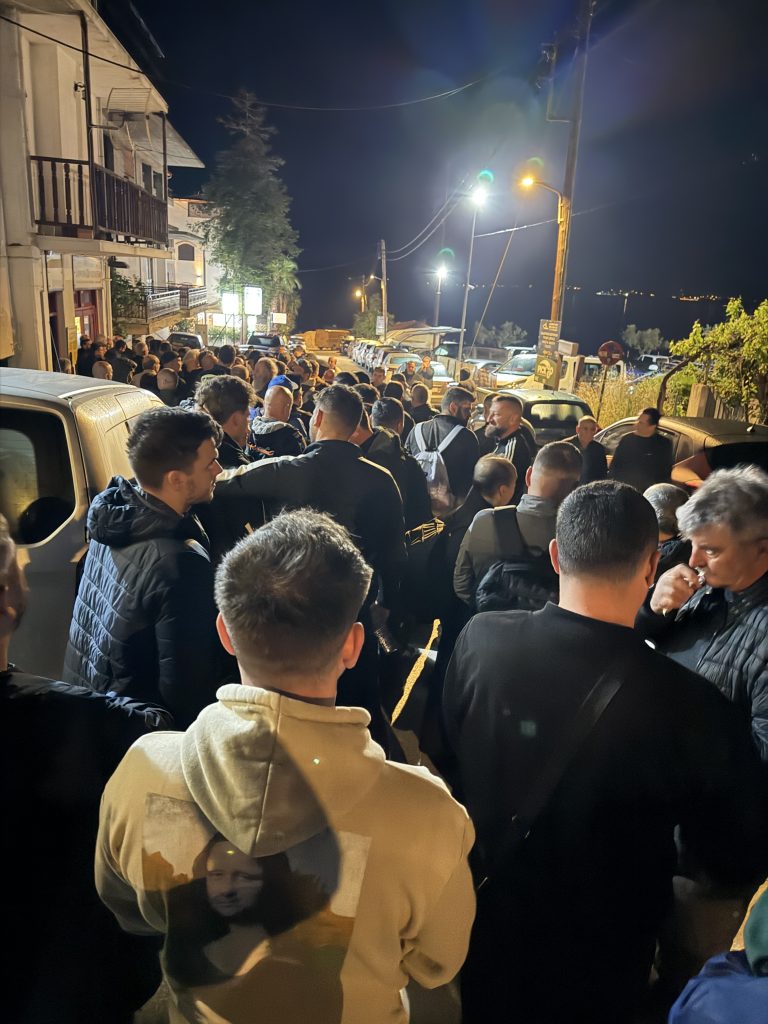
0600 waiting for the passport office to open so we could get our travel documents to go to Mount Athos
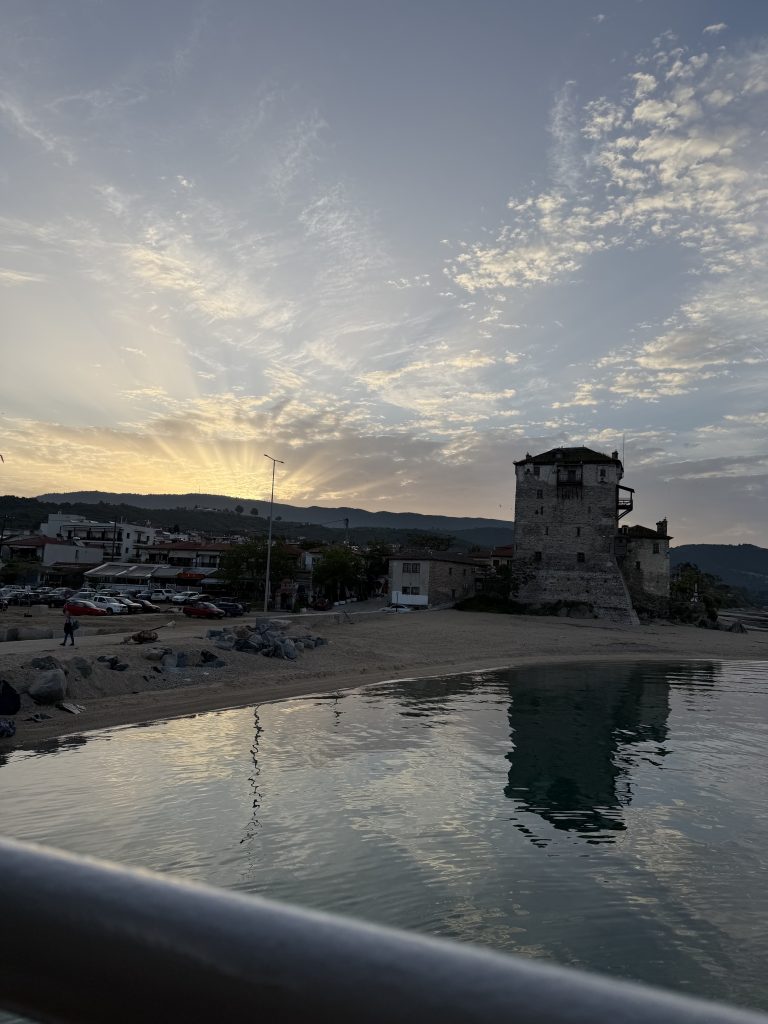
Sunrise from the boat while in harbor
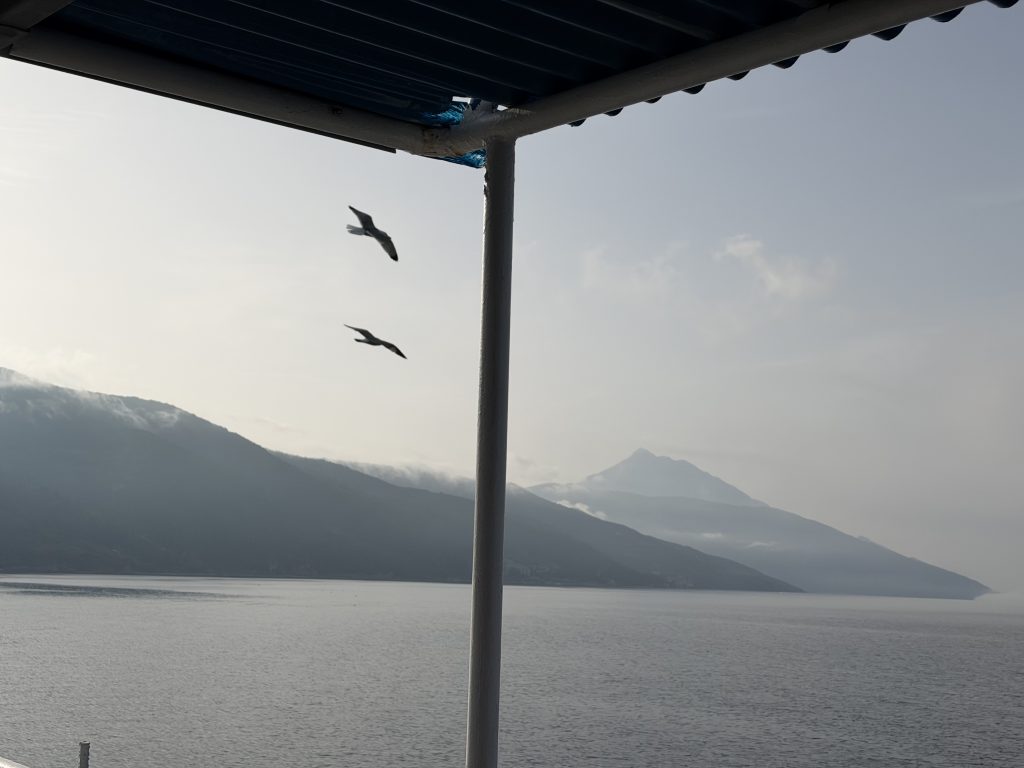
A view looking towards Mount Athos proper
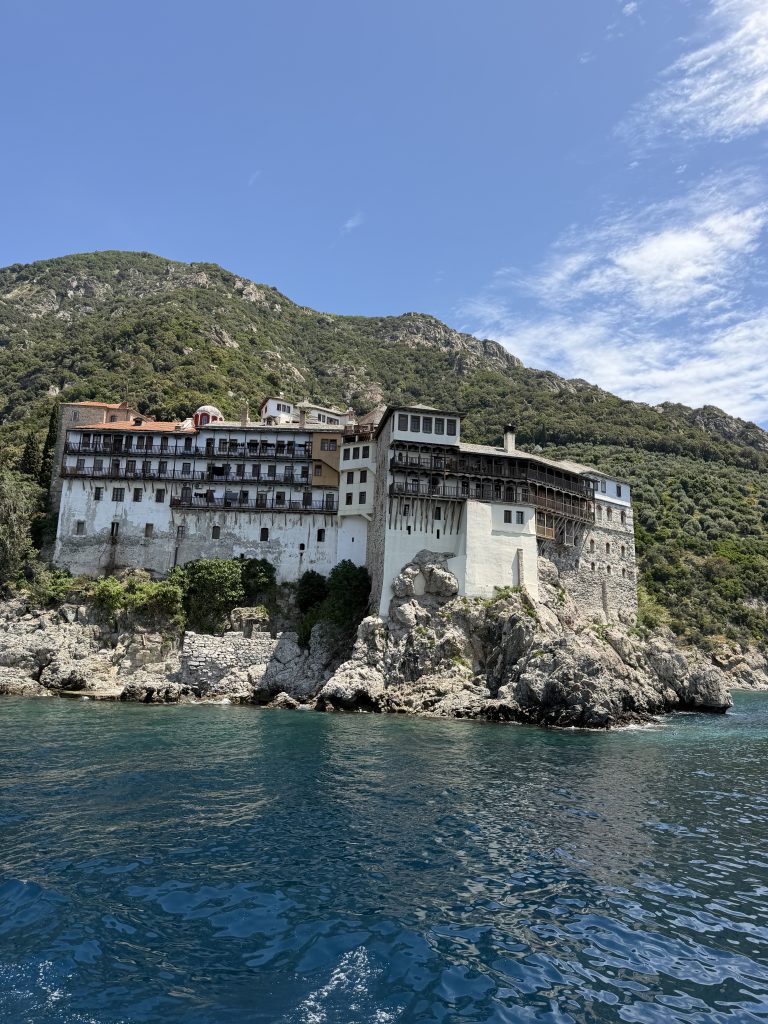
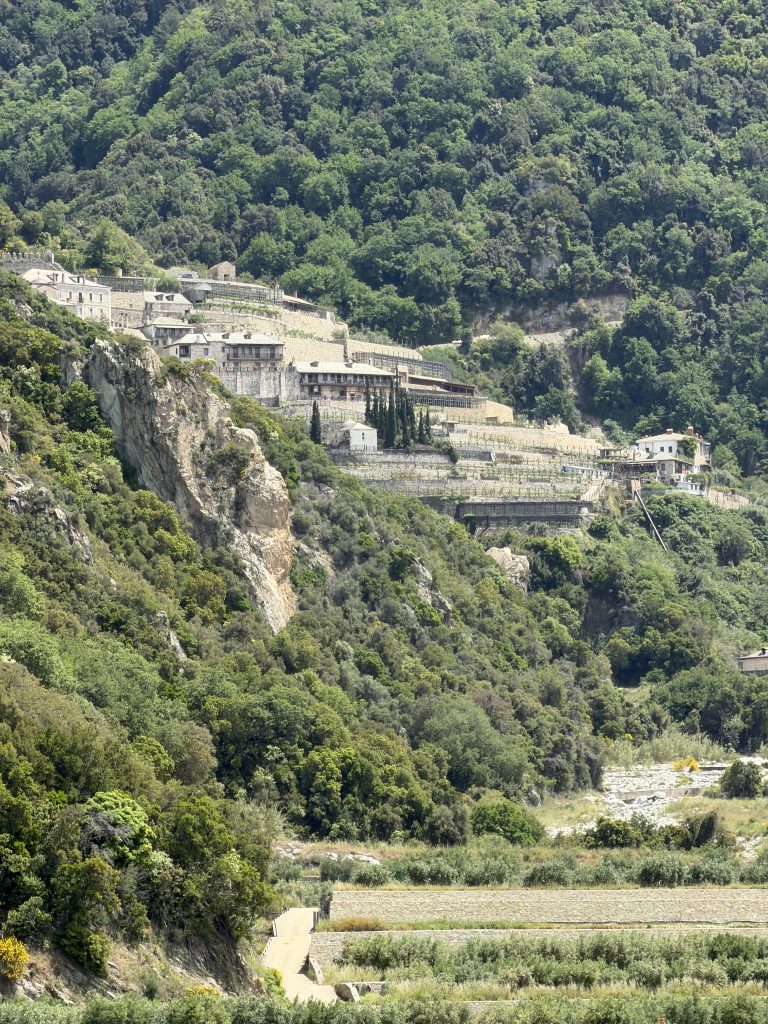
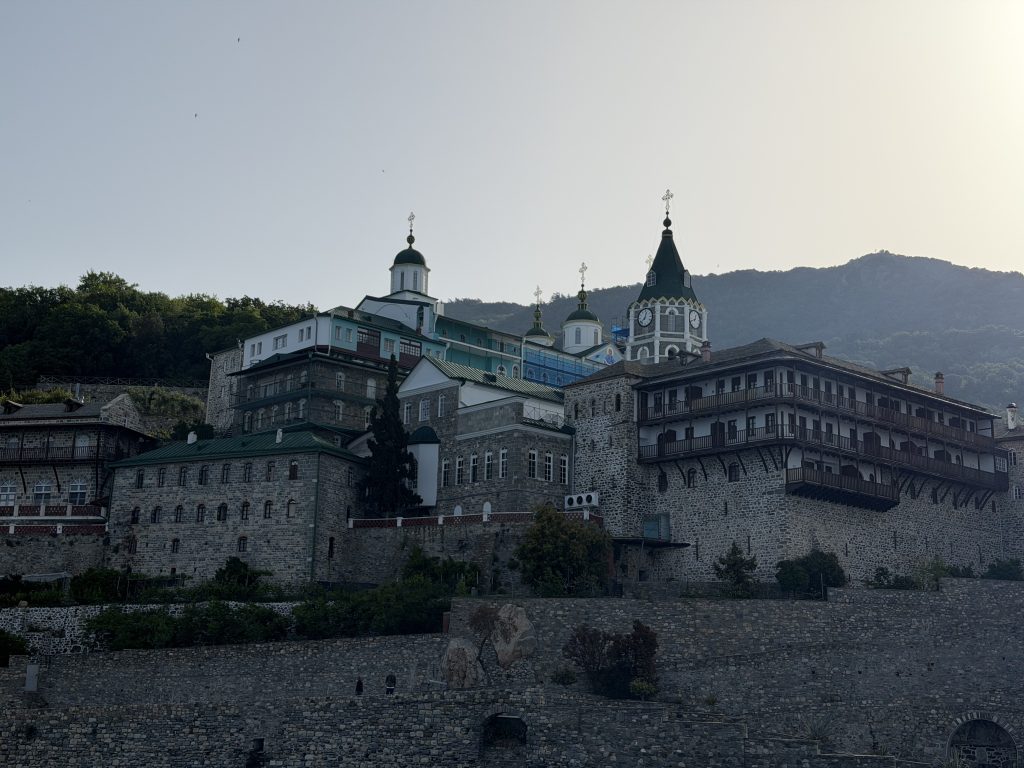
One of the sea-side monasteries as seen from the boat
A smaller port serving one of the inland monasteries
Another monastery as we cruised by

If you would like to help me with this trip, seminary courses, and more, feel free to hit the fundraiser at A New Life on GiveSendGo, use the options in the Tip Jar in the upper right, or drop me a line to discuss other methods. I’ve added Cash App ($CliffPow7) and Venmo (@Clifford-Powers-5). There is also the Amazon Wish List in the Bard’s Jar. Getting hit by lightning is not fun! It is thanks to your gifts and prayers that I am still going. Thank you.
Pilgrimage: Saint Seraphim Of Sofia

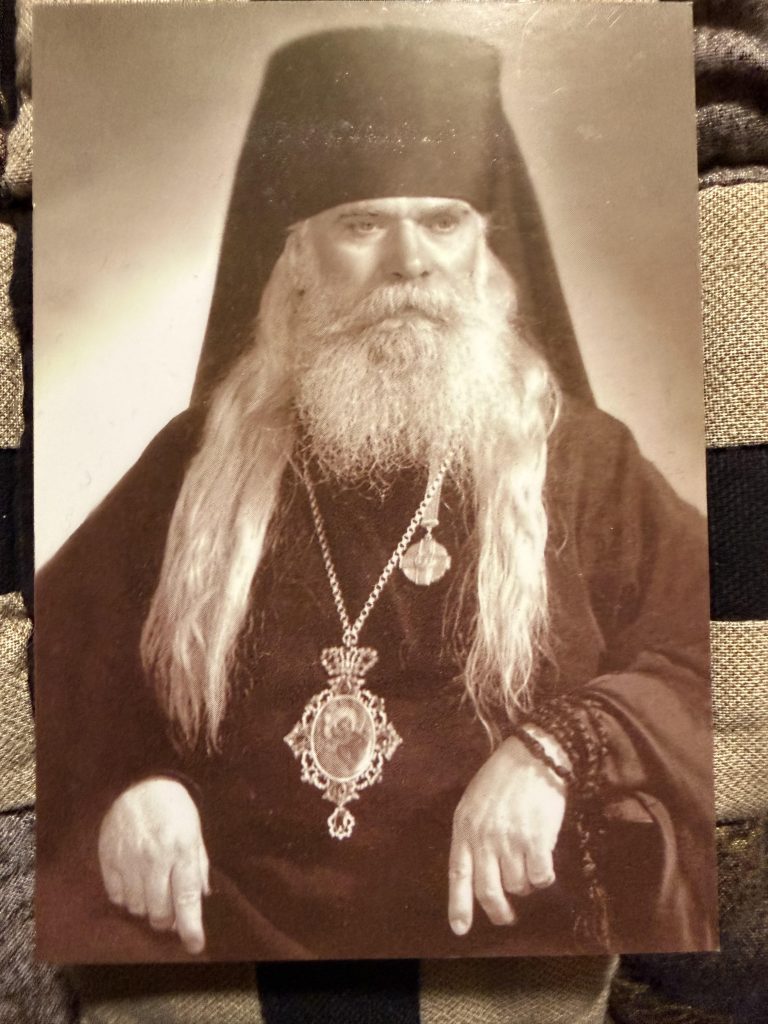
St. Seraphim of Sofia, photo of a photo

There is almost no way to do the life of any saint justice. There are often struggles, sometimes hidden; there is sorrow; but, above all there is Faith. Some saints overcome sinful lives to become saints. Others seem destined to that path from birth. St. Seraphim of Sofia is one of the latter, and I am very glad I got to know him a bit on this pilgrimage.

St. Seraphim was born December 1, 1881 in Ryazin, Russia as Nikolai Borisovitch Sobolev. He was the last child born to his mother, who had lost many of her children quite early in childhood. The story of his sister, Vera, is also a part of his story, and I will recommend this article and this article for learning more about him. There is also a book I will recommend if anyone is interested in learning more.

The tales of his studies and how he became a monk then priest are one of the things that drew me to him. Like many students, he had his challenges in school, but was guided such that he not only passed, but became known for his scholarship. I will note that he is still quite often invoked by students, many of whom credit him with their success.

It is also interesting how he became Seraphim. When he was to be tonsured, his name was originally going to be something else. But that day, the person performing the tonsure was moved to name him Seraphim after St. Seraphim of Sarov. Given that Saint Seraphim of Sofia had a special place in his heart for St. Seraphim of Sofia, it filled him with great joy and an even stronger sense of purpose.

He was a teacher at all times, but a teacher of students more than once. His path led him to being ordained a Bishop, and in August 1921 he was sent to Bulgaria after a short stint in Constantinople. His work in Bulgaria was ceaseless, and with his aesthetic practices led to contracting tuberculosis. It is worth noting that until the end he rented the most humble of accommodations and was noted for giving away clothing and possessions to those in need.

Near death in February 1950, he is said to have told his spiritual children that “If I find boldness before the Lord, I will not leave you.” I can only say that it appears he did and he has not left his flock. The number of intercessions and miracles attributed to him is considerable, and my own time with him powerful.

Again, keep in mind we do not pray to our saints, but we ask them to intercede for us with God, and the miracles that accompany them are of God through the intercessions of the saint. An important point worth driving home relentlessly and repeatedly.

This is far too short to do him justice, but I hope it may lead you to learn more about him. It is well worth your time.

If you would like to help me with this trip, seminary courses, and more, feel free to hit the fundraiser at A New Life on GiveSendGo, use the options in the Tip Jar in the upper right, or drop me a line to discuss other methods. I’ve added Cash App ($CliffPow7) and Venmo (@Clifford-Powers-5). There is also the Amazon Wish List in the Bard’s Jar. Getting hit by lightning is not fun! It is thanks to your gifts and prayers that I am still going. Thank you.
Pilgrimage: Vatopedi Monastery

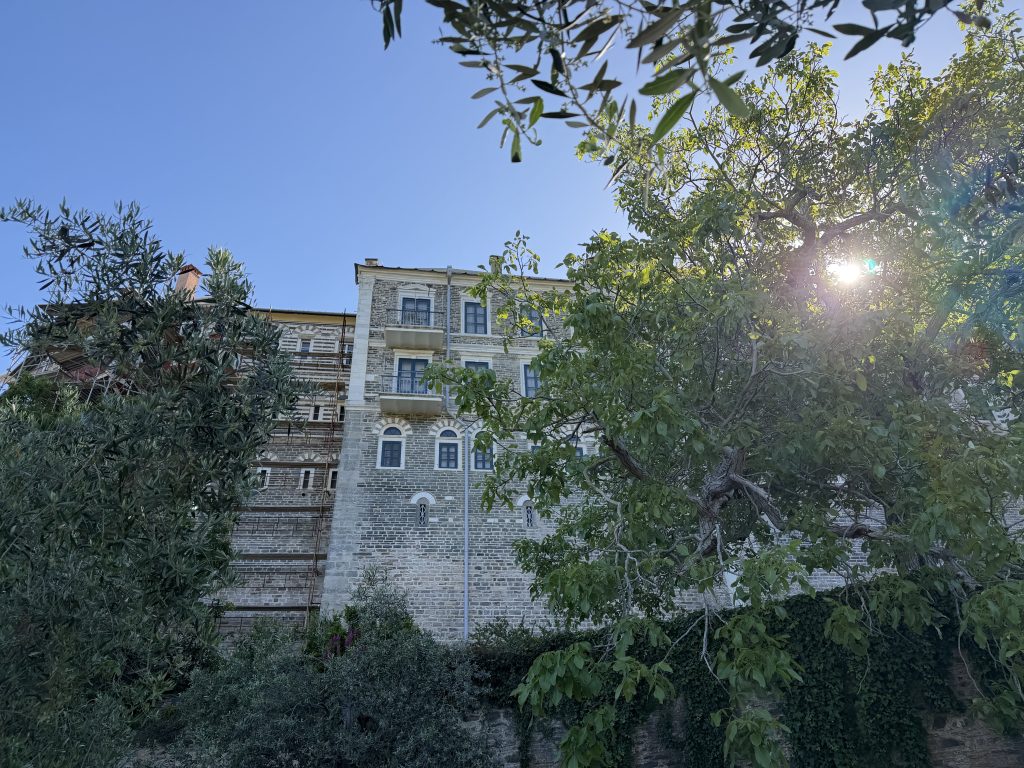
The only outside view I got

I’ve put this one off for several reasons, mostly to do with all the amazing things that happened there. Of the three monasteries I visited on Mount Athos, this was the most profound experience. Extremely positive, but it has given me a LOT to think about and work through. Some of the things I experienced I still can’t put into words, some is not for public consumption, and some I will share a bit of with you.

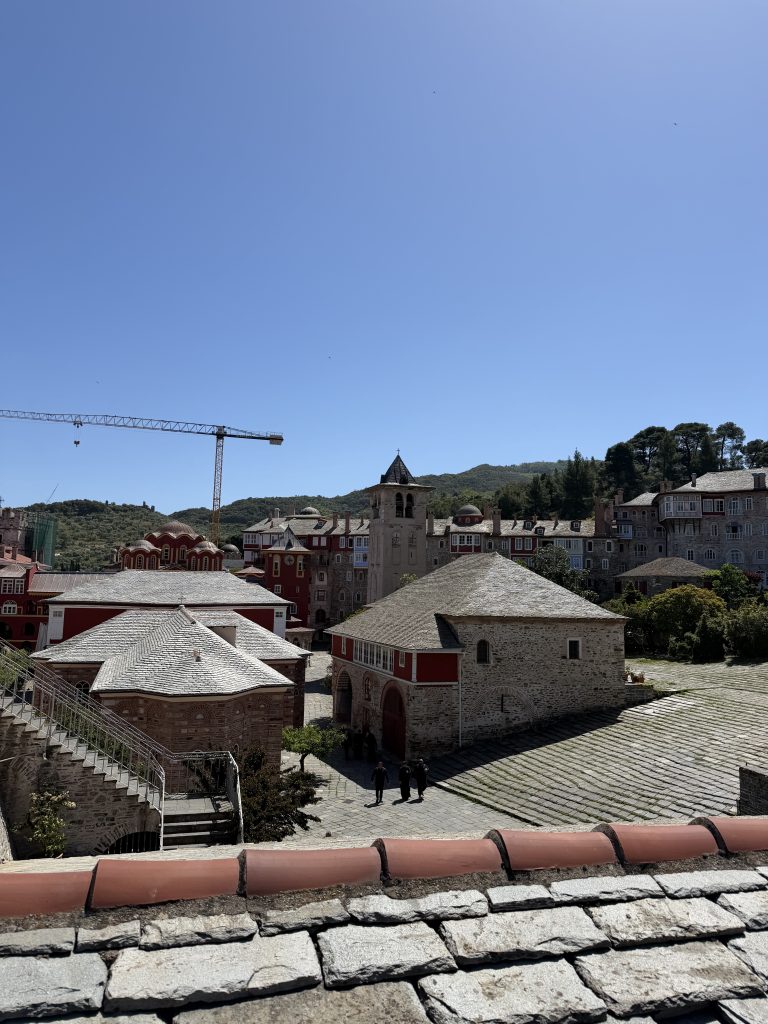
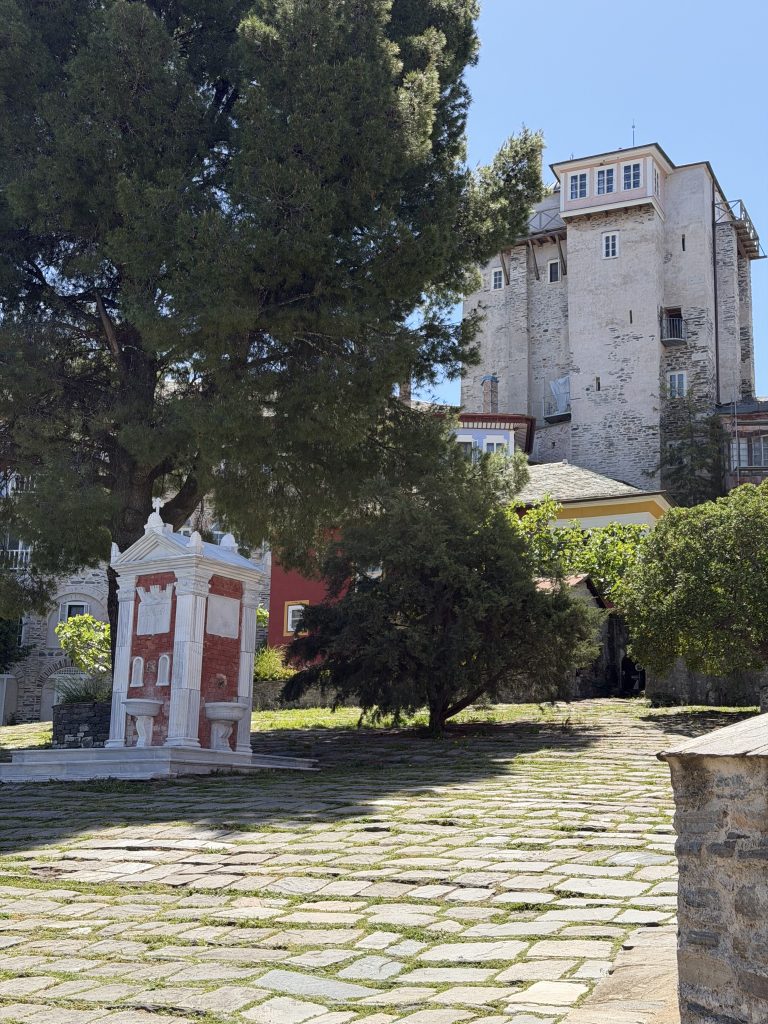
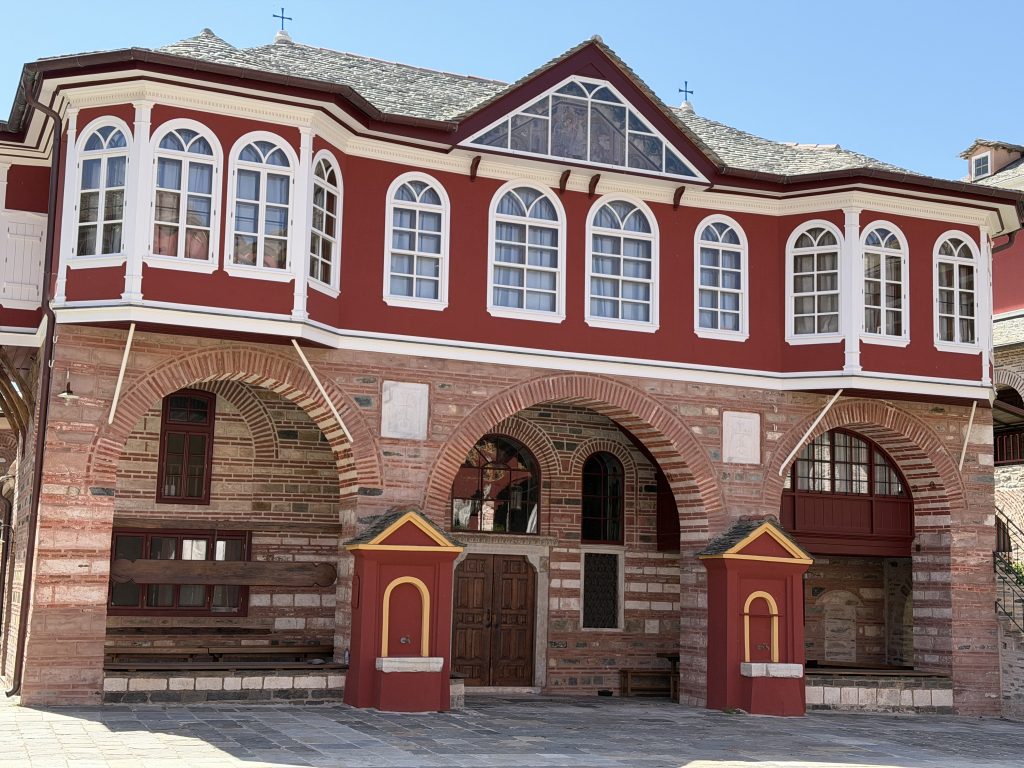
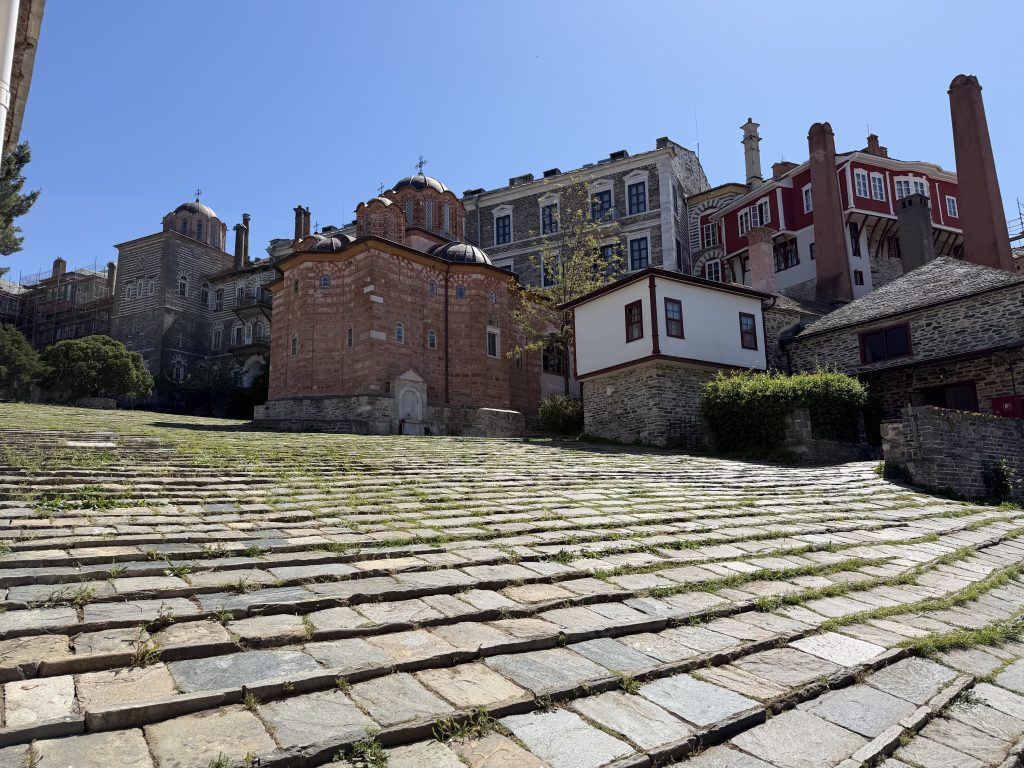
A view over the large interior courtyard

As I mentioned earlier, I didn’t get nearly as many pictures here as I did of the others, primarily because so much was happening. Have you ever walked into a place and just instinctively known that this was a place things would happen? If so, that’s pretty much what I felt. I also felt oddly at home, safe isn’t quite the right word, but it’s close enough for now.

Part of the interior courtyard

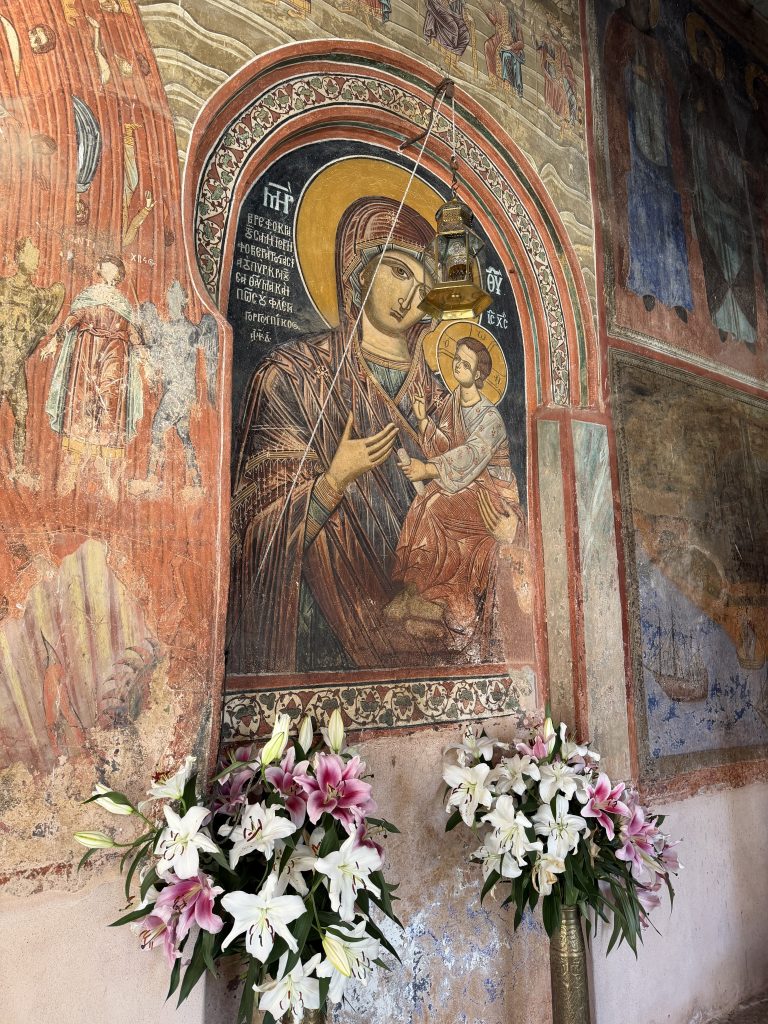
Vatopedi was founded in the 10th century, and has an extremely rich history. This gives a little bit of it, and it is well worth reading more. There are several miraculous icons and some awe-inspiring relics (and, yes, I was given the opportunity to venerate almost all of them). I want to avoid some of what Sarah A. Hoyt calls the “woo woo” but do need to share this. Not long after we arrived, I went to look around and do some prayers. Along the way, I chanced on the icon seen below, and then went up some stairs to a chapel above the main church where I venerated an icon you could feel the power rolling off. I spent twenty or so minutes in there praying for various people and things. I did not know the story of that icon at the time, but learned it later. The story of that icon is here, and I hope I never see that look on the Lord’s face directed at me. The icon below was put where the miraculous icon formerly resided.

The original was moved upstairs, read the story

I’m going to skip some of the amazing things that happened after that, but will share a small bit. I had wanted to partake of the Eucharist while there, and as such wanted to do confession. It worked out that to do so, I got up at 0300 and joined the monks as they entered the church to start morning prayers. I followed their lead, and was told that one of the monks would take me to confession in a bit.

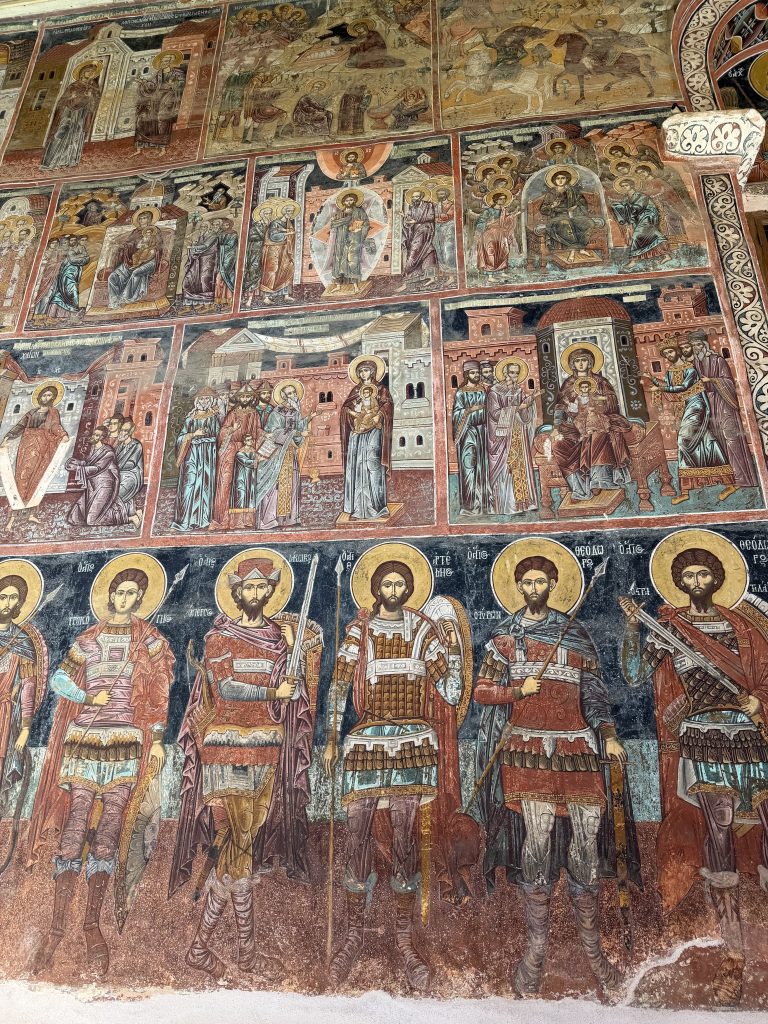
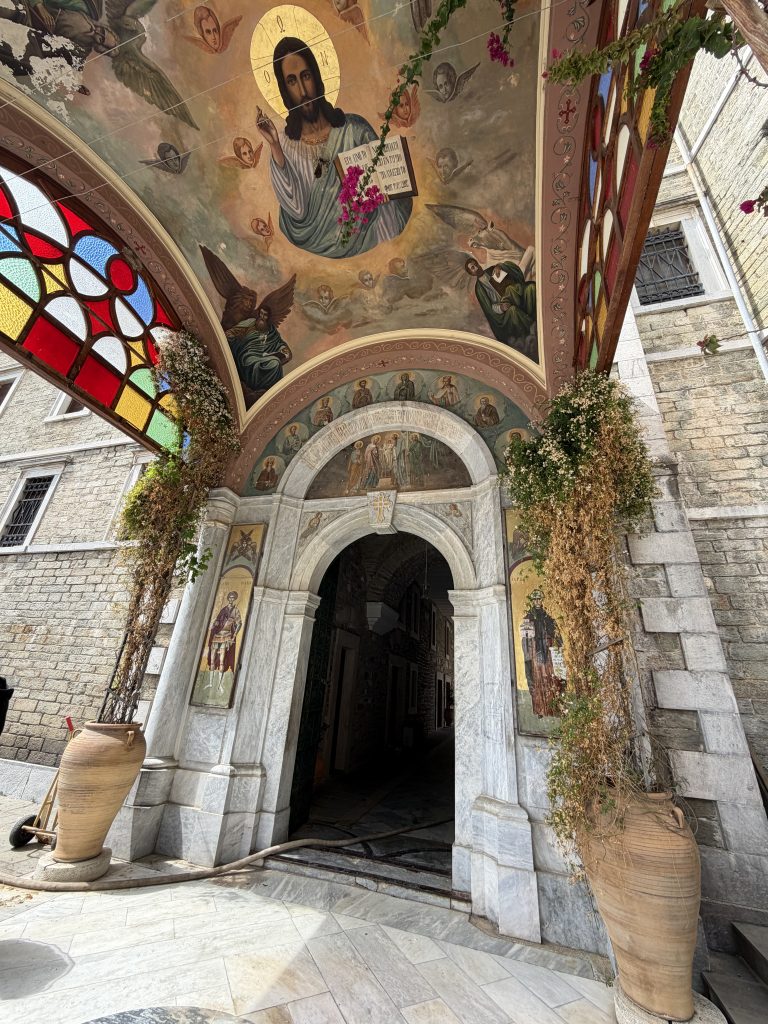
Some of the artwork outside the church

This did happen, and what I will share is that the priest knew more about me than I had shared with him. It was one of the best confessions I’ve had in any church with no disappointment, guilting, and such that can happen (and has happened with both Catholic and at least one Orthodox priest). Instead, it was thorough, supportive, encouraging, and remarkably positive. My regular confessor is good, but this priest gave a master-class on how to do a good confession. Yes, I made mental notes. I also hope he is right on a couple of things he told me.

The main dining hall

Afterwards, I went back to the church and re-joined the morning prayers. I wish there was some way to share what it was like as the sun came up and light began to fill the huge church dimly lit with candles and lamps. The beauty of it is not something you can easily catch with a camera, as rays from the rising sun begin to bounce off the brass and gold and stream down upon those within filling the church with a golden glow.

Another part of the interior courtyard

At a certain point, the crowd being so large, we broke up into groups and went to smaller churches located around the monastery. There, we finished the service and partook of the Eucharist. Then, we went to breakfast. Sadly, not long after that, it was time to leave. If I could go back right now, I would. I do hope that I can go back soon. More on this in a future post, as I have invitations to return to two monasteries for more extended stays.

If you would like to help me with this trip, seminary courses, and more, feel free to hit the fundraiser at A New Life on GiveSendGo, use the options in the Tip Jar in the upper right, or drop me a line to discuss other methods. I’ve added Cash App ($CliffPow7) and Venmo (@Clifford-Powers-5). There is also the Amazon Wish List in the Bard’s Jar. Getting hit by lightning is not fun! It is thanks to your gifts and prayers that I am still going. Thank you.
Pilgrimage: Pavlou

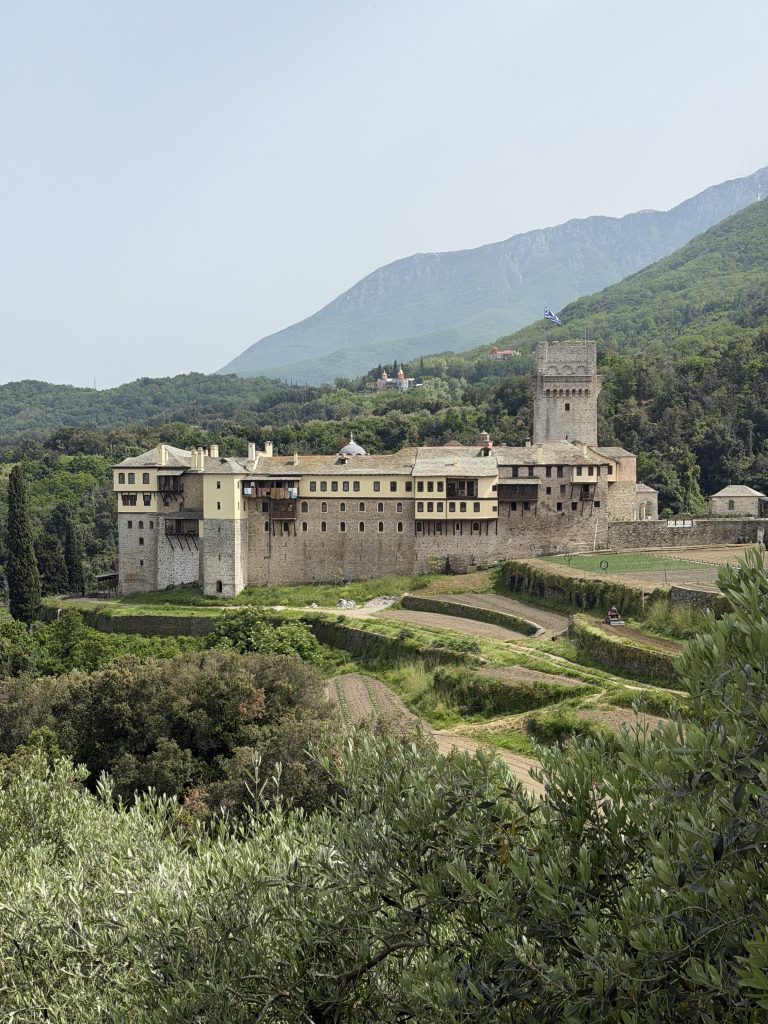
My first view from the boat

The Pavlou Monastery was a great place to end my time on Mount Athos. After all that went on at Vatopedi monastery (some of which I will share soon), I needed some quiet time for thought and contemplation. Pavlou was the perfect location for such.

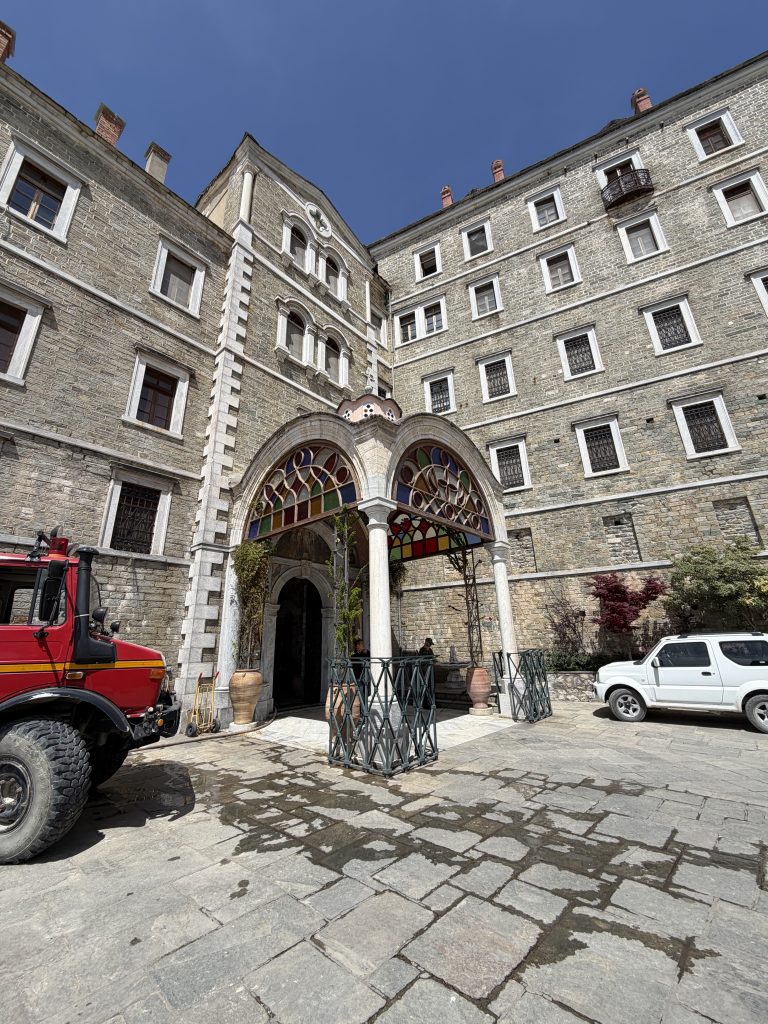
The main entrance

It is not far from the base of Mount Athos, and my hat’s off to those who climb that snow-capped mountain. I actually felt very sorry for the group(s) doing so that day, for reasons that will be clear in a moment. It is up the side of the “hill” and I was glad for the ride up to the monastery from the port. Lots of work going on there to secure things and deal with occasional floods coming down the mountain.

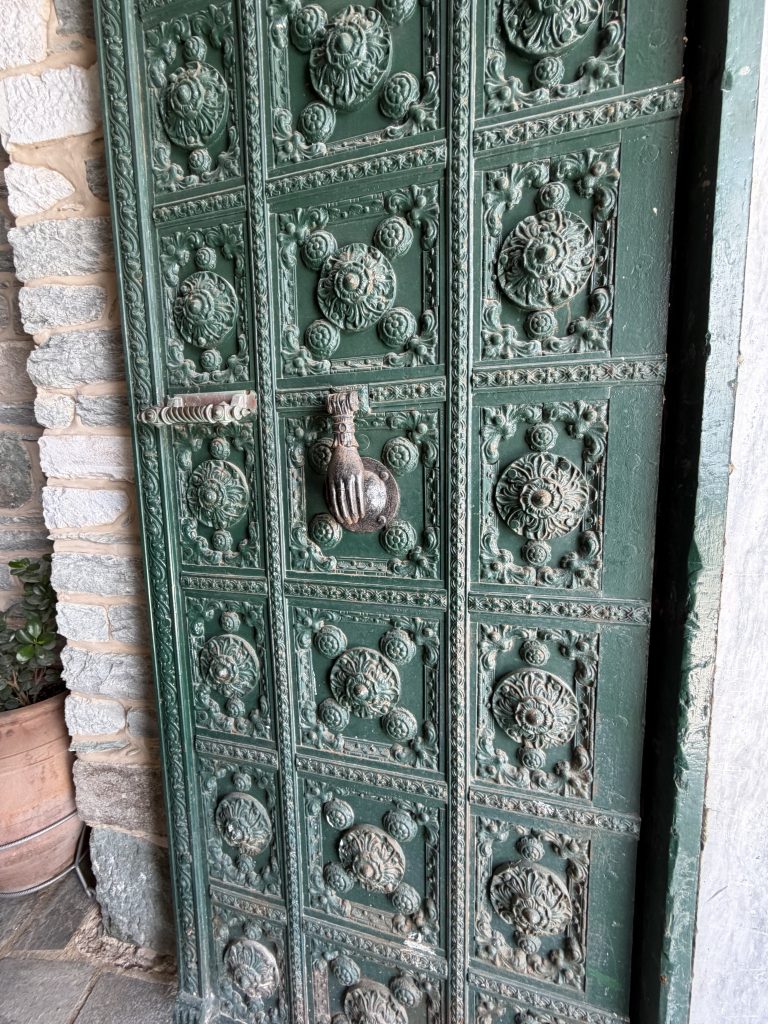
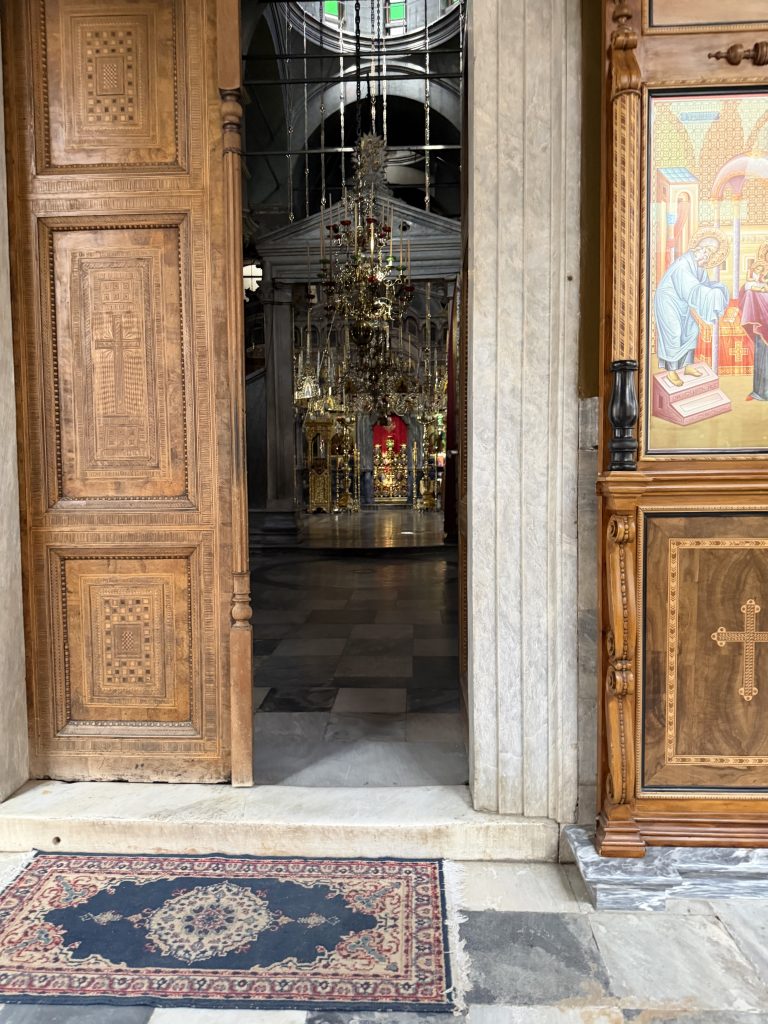
Again, as usual, very solid doors

The views were spectacular, and our room had a good view of the courtyard. The church was, of course, in the center, but behind it was a narrow way with a cross, some conveniently placed benches, and even a holy spring nearby which made for a perfect spot to sit, think, and pray. I needed that time by myself more than I can say, or even that I realized at first. It would have been nice to wander around more, but I had a LOT to think about that took priority over being a tourist.

The church

I took the time while I could, and enjoyed the weather while I could, as I could feel the storms coming. Since I was hit by the lightning, if I pay attention I can get a pretty good idea of if storms are coming and even if there will be lightning (and sometimes where). Not one hundred percent, but better than average. I could feel the weather changing, so made the best use I could of the great weather while I could.

Behind the church were I found some much needed solitude

I was able to play tourist to a limited extent, and it is almost amusing to realize that I got more photos at my “bookend” monasteries than I did at Vatopedi. Then again, I still tend to lose myself a bit in the photography which helped give me time to process things. So, I would sit, think, and pray; then go do a bit of photography; and, then lather, rinse, and repeat. I needed that time.

The holy spring beside/behind the church

Soon it was time for the evening services and then dinner. Monastic services are a little different (if you want I can one day discuss the two periods where monastic and cathedral rites were joined together in synthesis) and I’ve come to enjoy them. Even when long, they tend to move along as monks have things to do. Though they move a bit faster than cathedral rites, you can quickly lose yourself into the service. Add in amazing architecture and art, and you truly do have a feast for the senses.

At the entrance to the church

There was a group of American pilgrims there that I was introduced to after service. It was a pleasure to meet them, and the priest leading them was a graduate of the seminary where I took my course this spring. I really enjoyed meeting him and came to appreciate his leadership as we were leaving.

A glimpse inside

After dinner, we were given a chance to learn about some of the icons and relics there, and to venerate them. While they have a portion of the Gifts of the Magi, for me there was one icon that particularly caught my attention. The icon was the Icon of the Virgin Mary Kathreptis. During the years of iconoclasm, this icon was protected by the Empress Theodora in her private chamber hidden behind a mirror. There are scorch marks on it hinting that it’s survival from the pagan fires of iconoclasm was close at some point. It is also extremely unique and if you are interested in iconography at all I would highly recommend reading up on it.

Photo courtesy of Nicolas Karellos

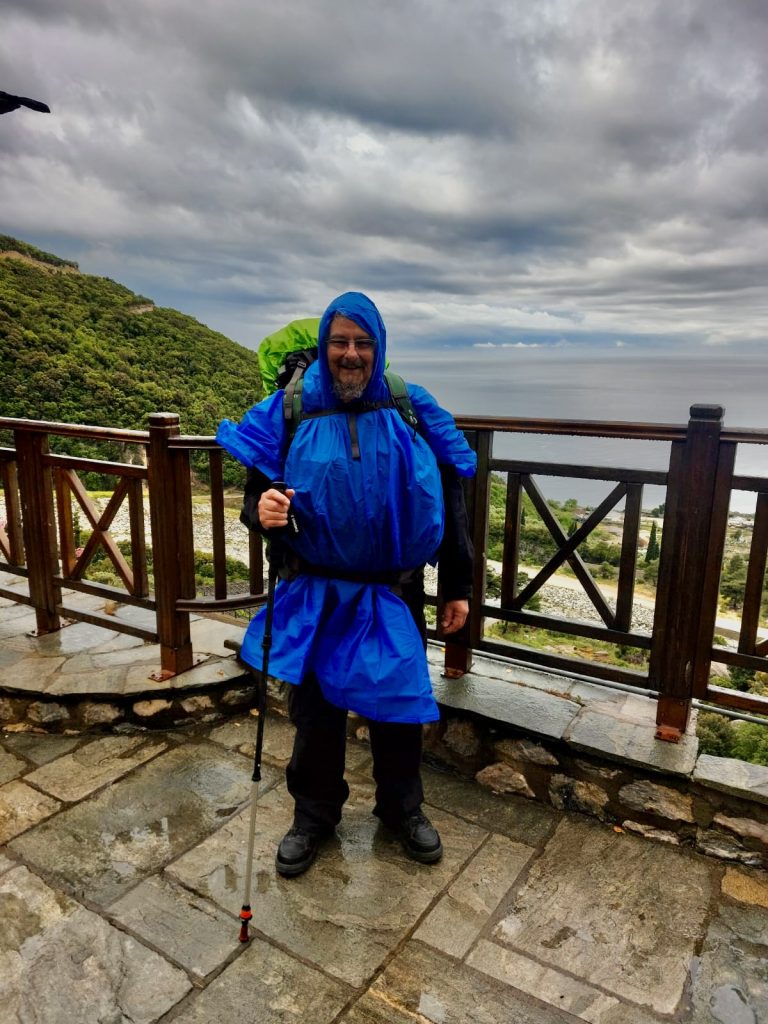
That night it did indeed storm, and the storm continued into the next morning. I donned the poncho my Godmother (Matushka) had given me to bring but as we were to leave to go back down to the port, the rain stopped. We got down to the port, and when the boat came we all got onboard despite objections from some that we should wait for the boat to come back since it was still on the outbound portion of its journey. The American priest overrode that bit of idiocy and I cheerfully went along with him as I had no desire to be out for an hour or so in rain and possibly lightning. I will have to share some video from that ride one day here soon, so glad we did it.

There is more to come. I will particularly ask you to hit the tip jar today if you can, as I am looking at taking one or more courses at the seminary this fall. If I take just one, looking at needing about $7k, and if two it will be another $4k on top of that. Would appreciate the help very much. Thank you for reading, commenting, and liking things. It is all very much appreciated!

If you would like to help me with this trip, seminary courses, and more, feel free to hit the fundraiser at A New Life on GiveSendGo, use the options in the Tip Jar in the upper right, or drop me a line to discuss other methods. I’ve added Cash App ($CliffPow7) and Venmo (@Clifford-Powers-5). There is also the Amazon Wish List in the Bard’s Jar. Getting hit by lightning is not fun! It is thanks to your gifts and prayers that I am still going. Thank you.
Pilgrimage: Karakallou

First, an apology to you the readers. I had planned to get a post up yesterday, but didn’t make it. The breakfast I had on Wednesday with a friend, who has been a bit under the weather as it were, ran delightfully into the afternoon. It was so good to catch up with them, laugh, share some memories, and just live. Had to run an unexpected errand afterwards which took up the rest of the day. Yesterday morning I had coffee with two dear friends and then had errands to run before the storms hit last night. Had breakfast this morning with a friend and former co-worker, and am now catching up here.

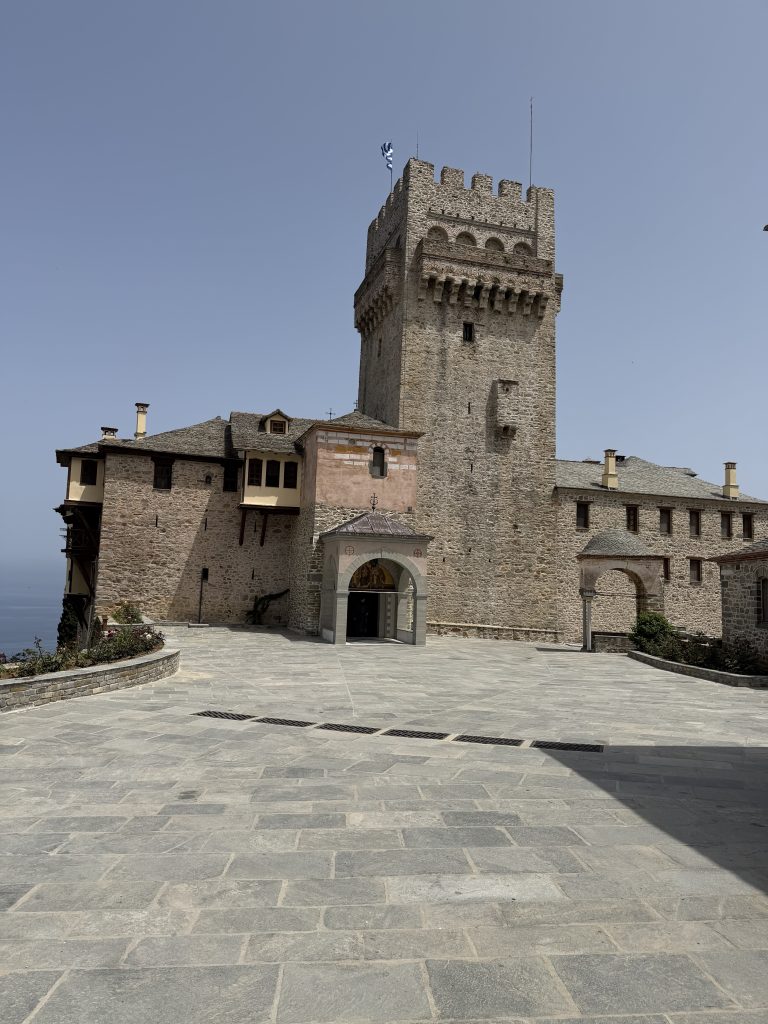
I also owe an apology to my “bookend” monasteries on Mount Athos. I sometimes glitch on their names. While each visit on Mount Athos was unique and even wonderful, so much happened at Vatopedi that it tends to eclipse everything else which is not fair to the other two. The first “bookend” is Karakallou Monastery and in some respects it was the perfect way to “break in” to the routine of life on Mount Athos.

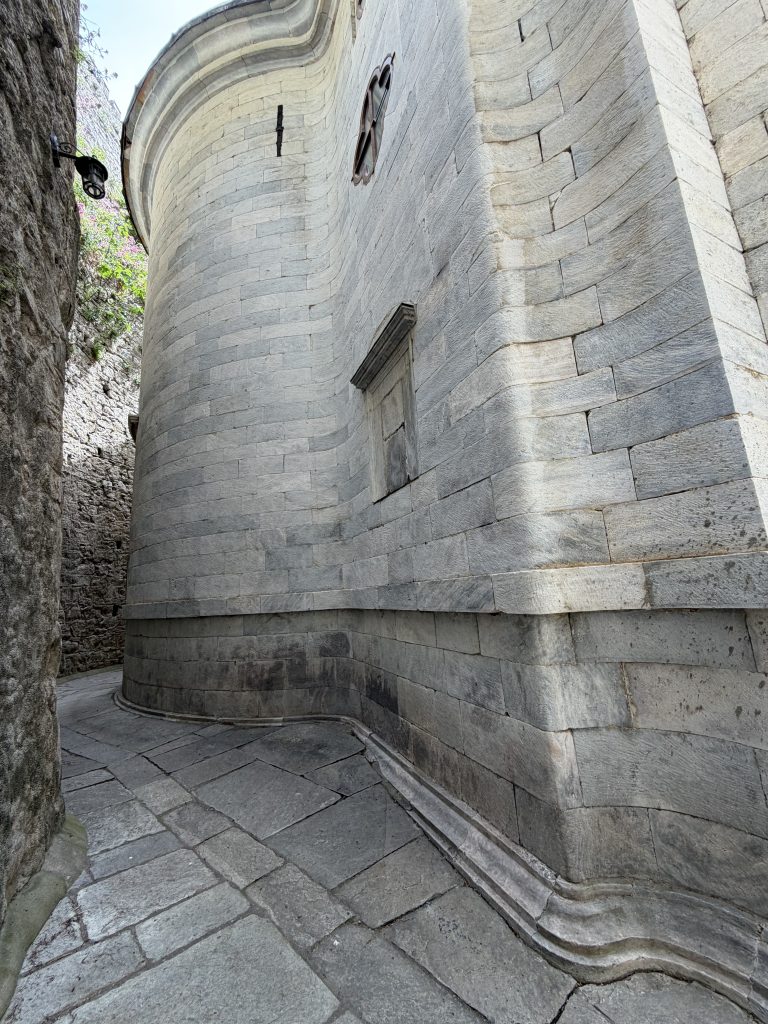
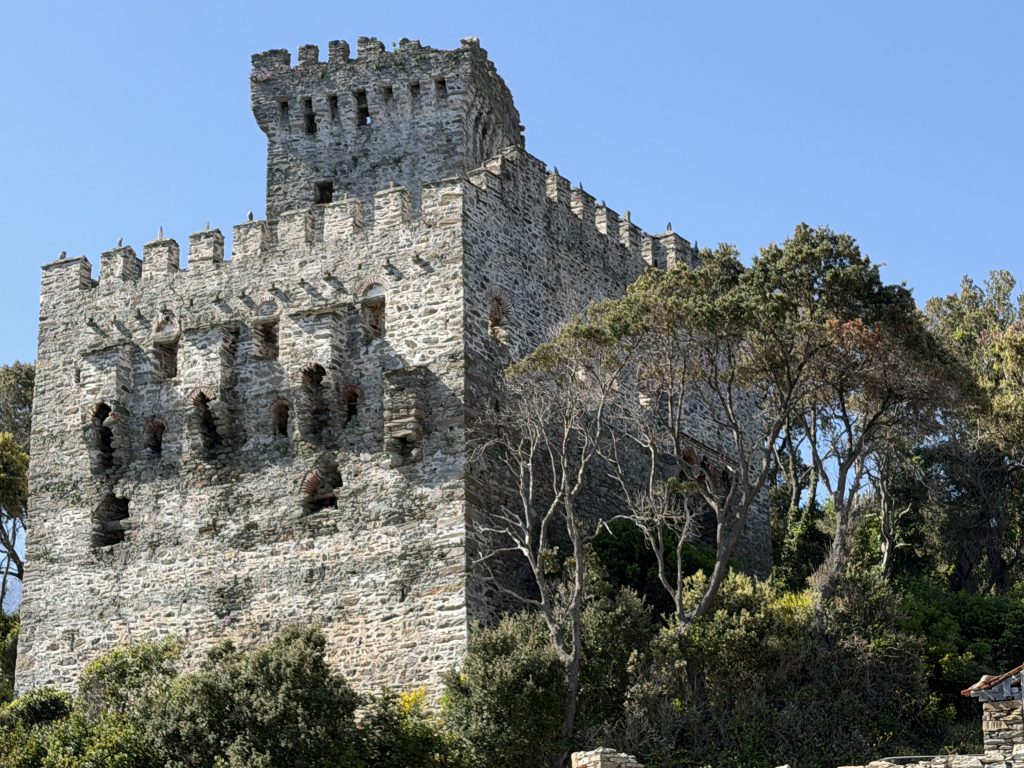
Might notice how it’s built…

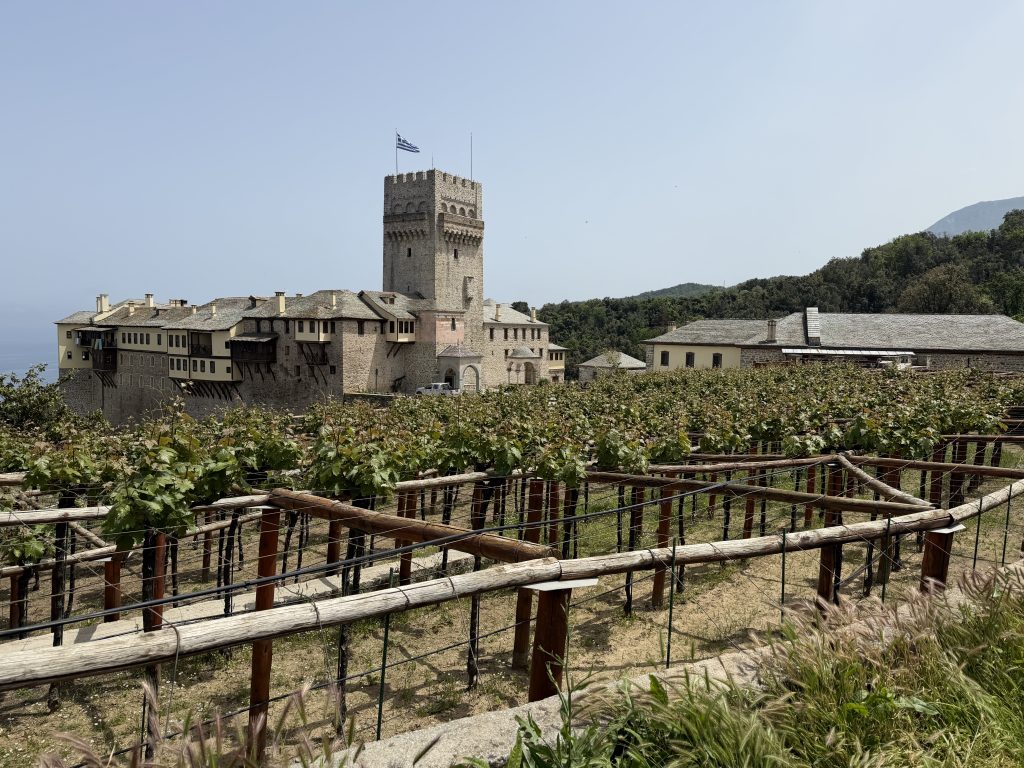
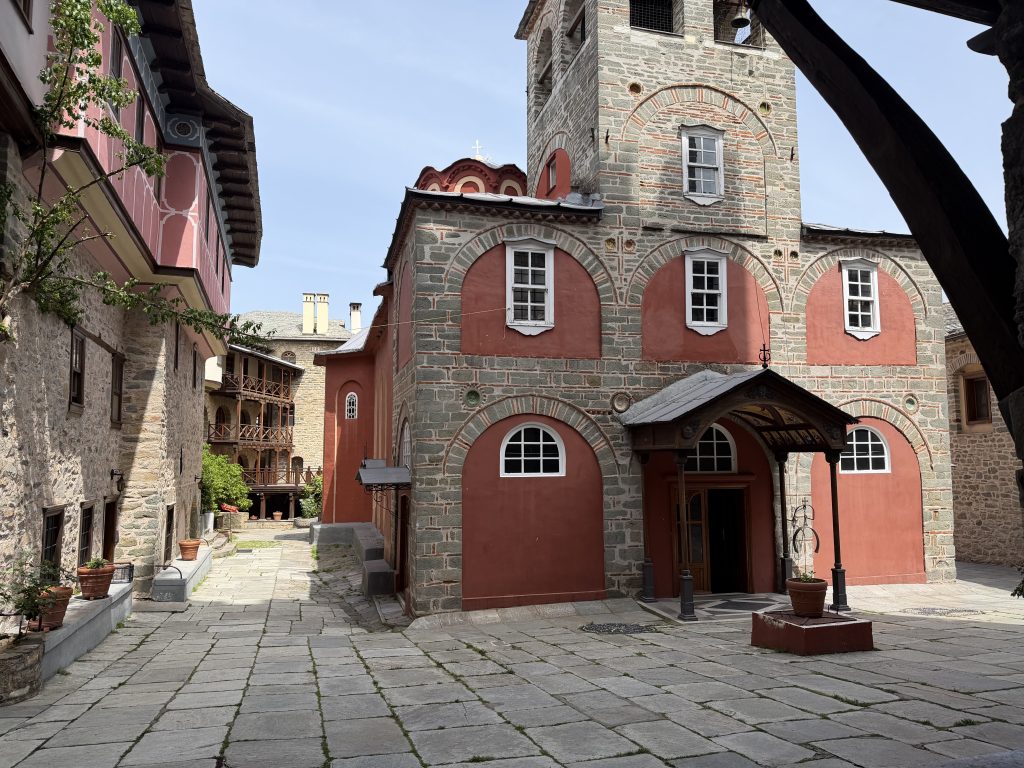
The monastery dates back to the 11th century, and is up a ways from it’s “port.” Something to keep in mind about the monasteries on Mount Athos is that each has (or had) it’s own port down on the coast. In this case, the port is about a mile down the hill from the monastery proper. The monasteries, be they on Mount Athos or elsewhere, strive to be as self-sufficient as possible. A lot of people seem to have the idea that monks are sitting in their cell (room) all day praying, and that’s just not the case. There are often animals for which to care; crops to tend, grapes to pick and wine to make, etc. It is not a sedentary life.

The main entrance, and yes most monasteries are built with pirate and other attacks in mind…

In the case of Karakallou, I would add to that list of chores expanding agricultural activities. While there, work was underway to expand grape and crop growing areas, and to repair and optimize such areas and roads. That was in addition to all the normal work of running a farm. One area next to the monastery had hundreds of onions planted, and we found out why later.

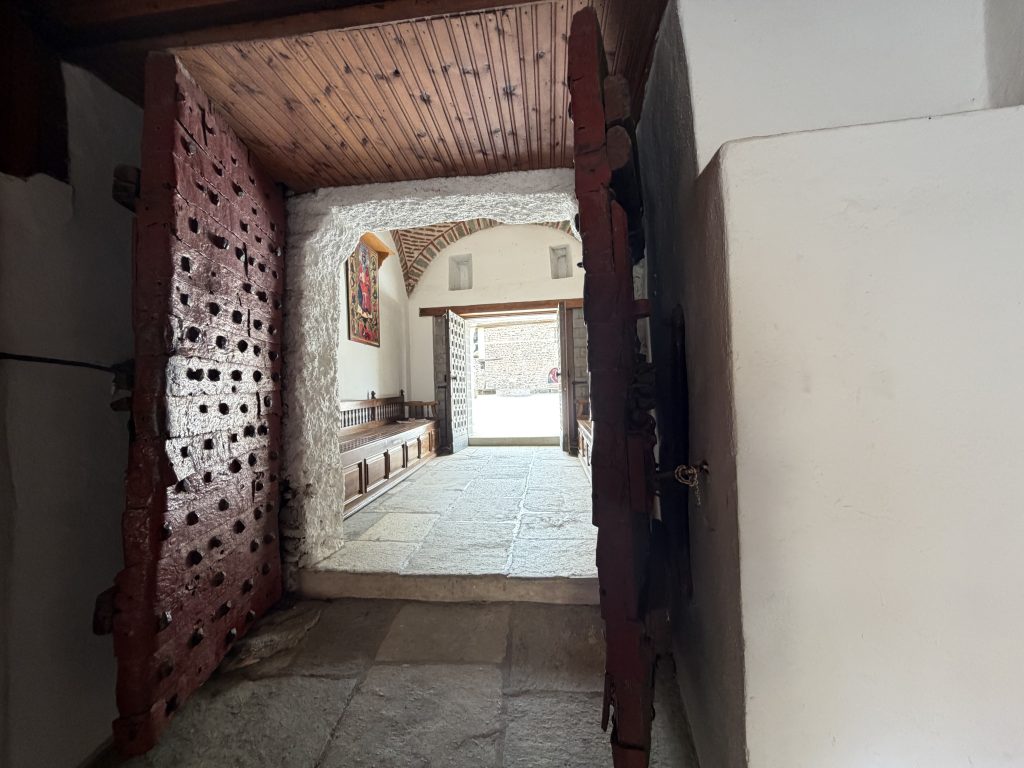
Most monasteries have very serious doors

Karakallu is probably best known for the icon of Saints Peter and Paul (take it as a given that most icons I mention here are miraculous); but, it also houses relics of the True Cross and a number of saints. For most visitors, these will be brought out during a special time after supper to learn about them and have the chance to venerate them.

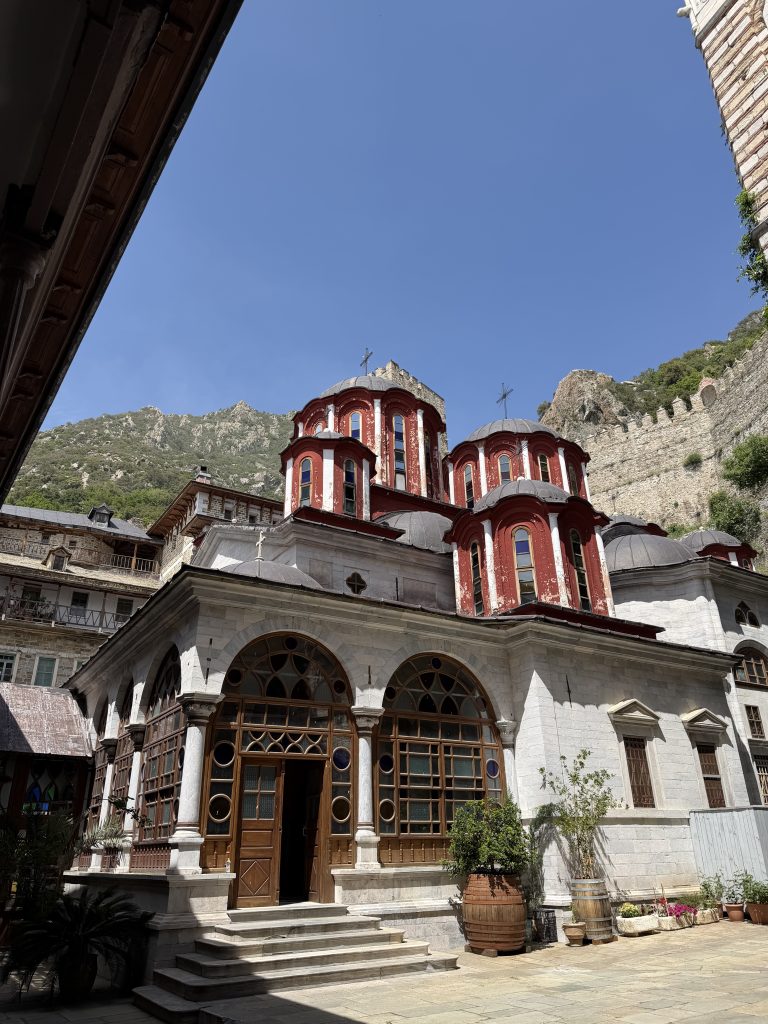
The inner courtyard and church

When I said it was a great place to break into the routine of life on Mount Athos, it truly was such. We were somewhat encouraged to go look around, hike around, and otherwise explore the area. Other than being back in time for evening services and dinner (and not getting underfoot), relax and contemplate. We did walk around a bit, checked out some of the expansion work, and for me at least, to shed the stresses and cares of the world outside. The evening meal also got me back into the monastic meals. There are prayers said beforehand, and one does not eat or drink until the abbot rings his bell. When the bell rings again, you put everything down and stop.

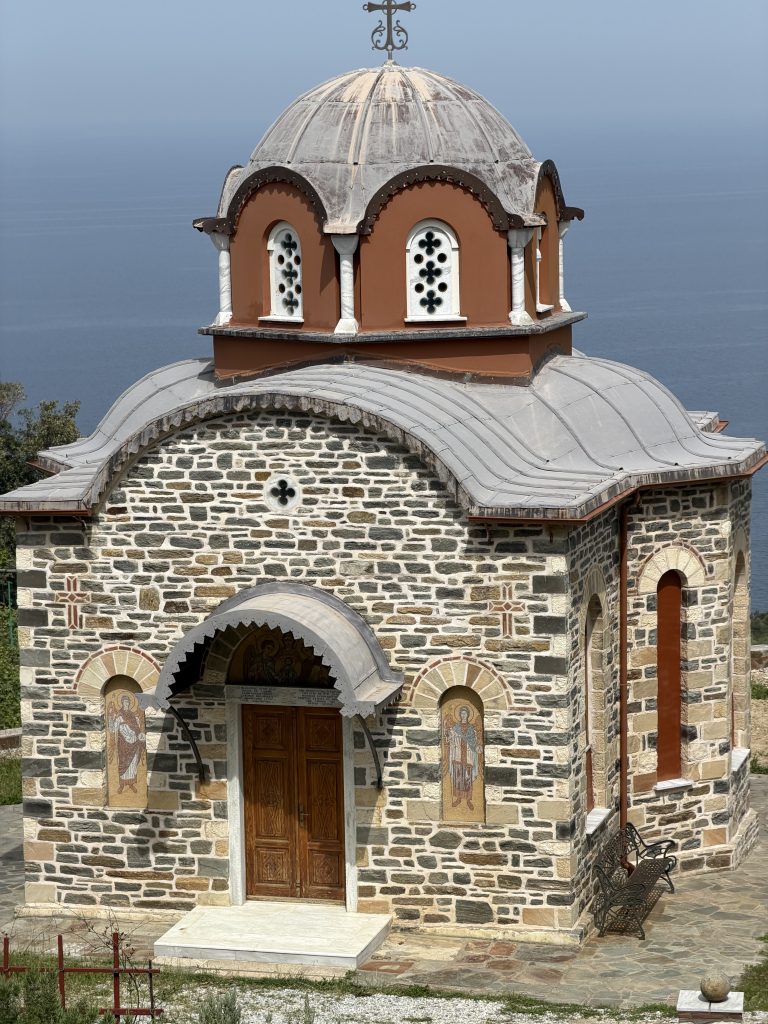
A satellite chapel

I mentioned earlier the onions being grown and at dinner that night we found out why so many are being grown. Dinner was a lentil stew, and it was probably the best such I’ve ever had. I can’t cook lentils all that well, but the monks clearly could. Next to each bowl was a green onion with a small bulb at the end, peeled and with the roots cut off. One ate lentils, took a bite of the onion, and it was delicious.

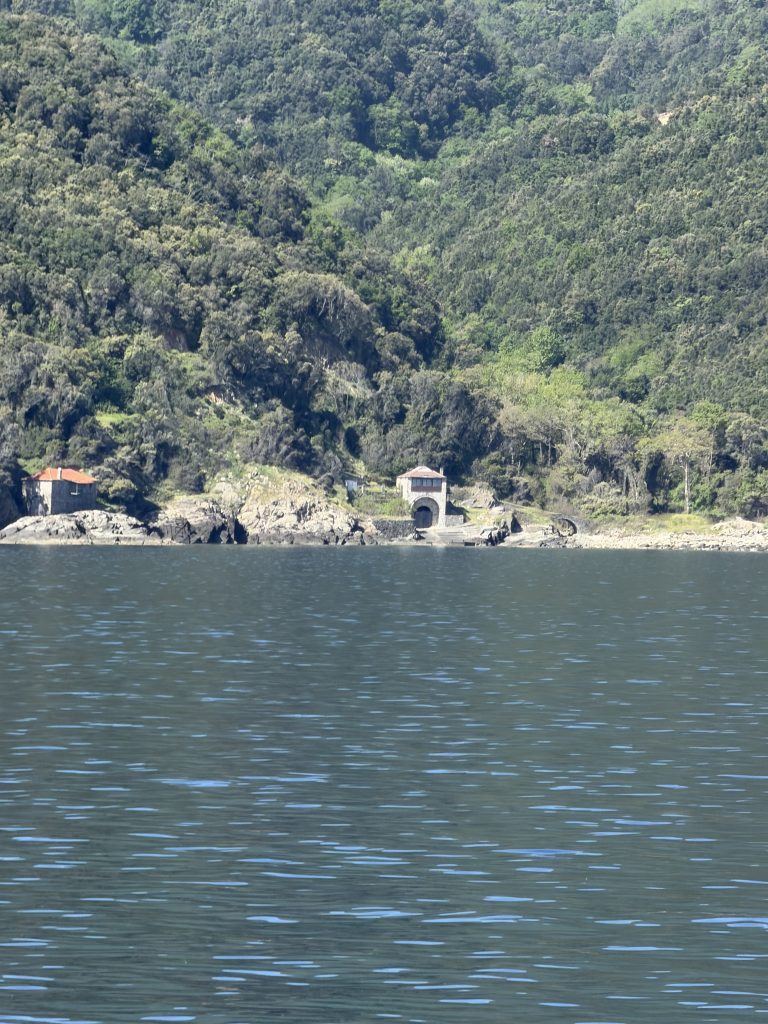
Ruins of the old port

The next morning, we walked about a mile downhill to the old port, and the boat that services those ports came in and picked us up. We did have one small bit of excitement when a wild pig and piglets ran across the trail in front of us. Once we were sure all the piglets were across and they and mom were gone, we continued on.

Karacallou was a good place to shed the world and enjoy some quiet contemplation and prayer. That shift stood me in good stead for my visit to Vatopedi.

Pilgrimage: Kallipetra

We may bounce around a bit over the next couple of weeks, as I am not going to be posting in the order things happened. Instead, I’m going to be trying to pick up the stories I have not yet told and or am still trying to process.

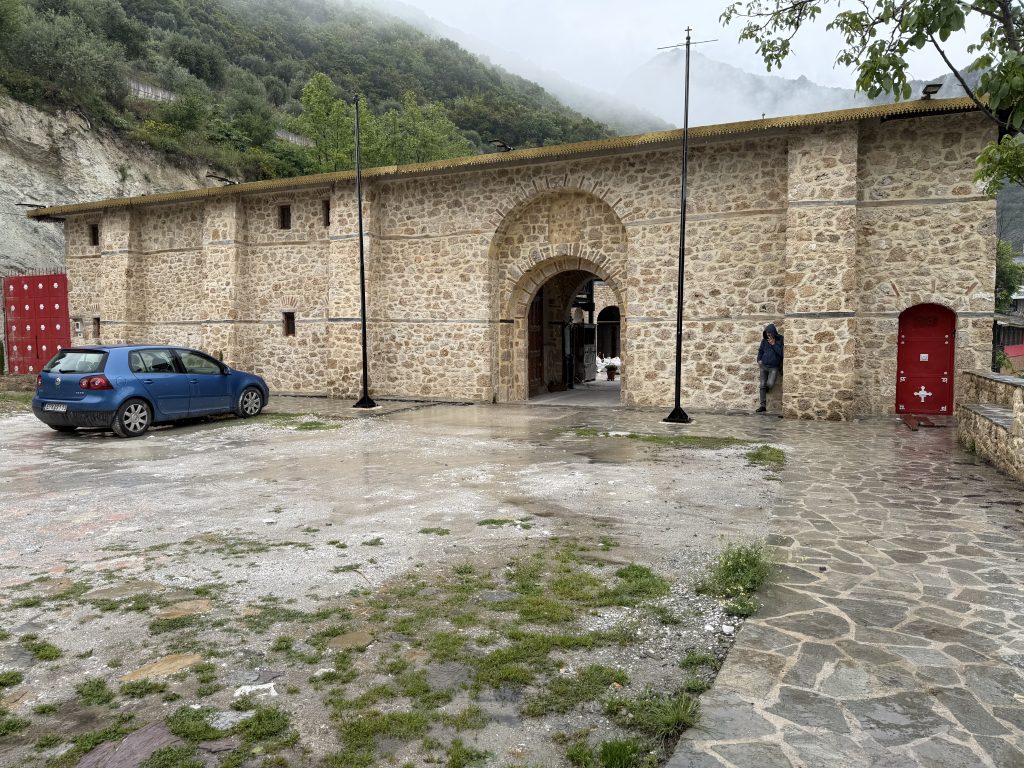
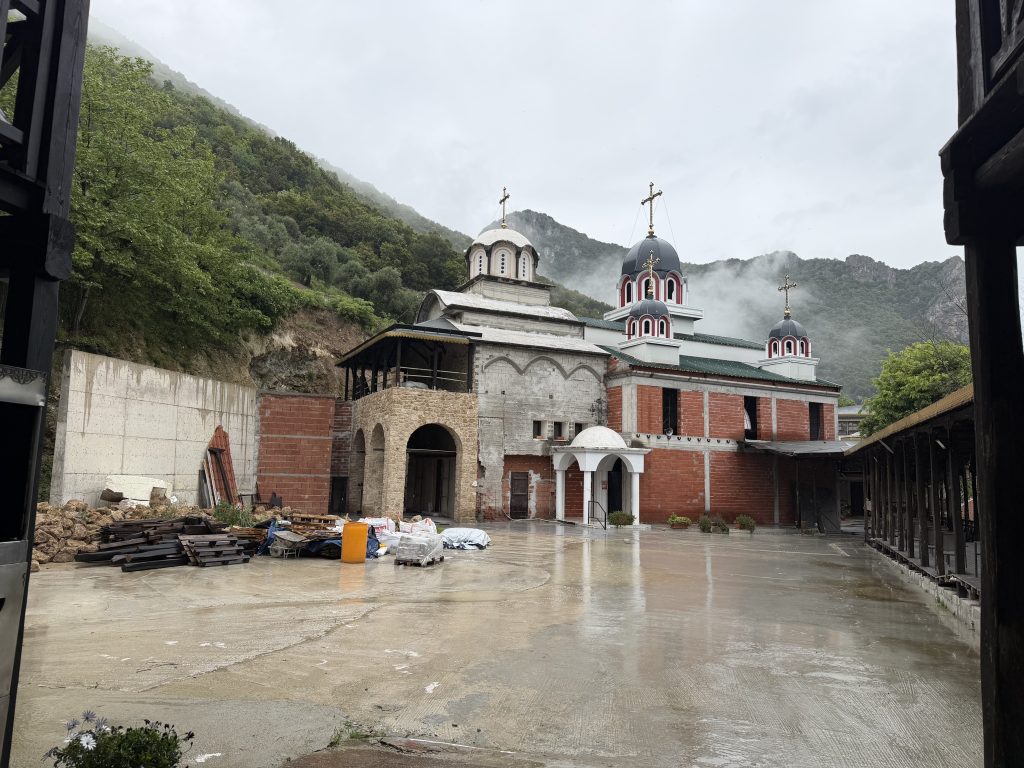
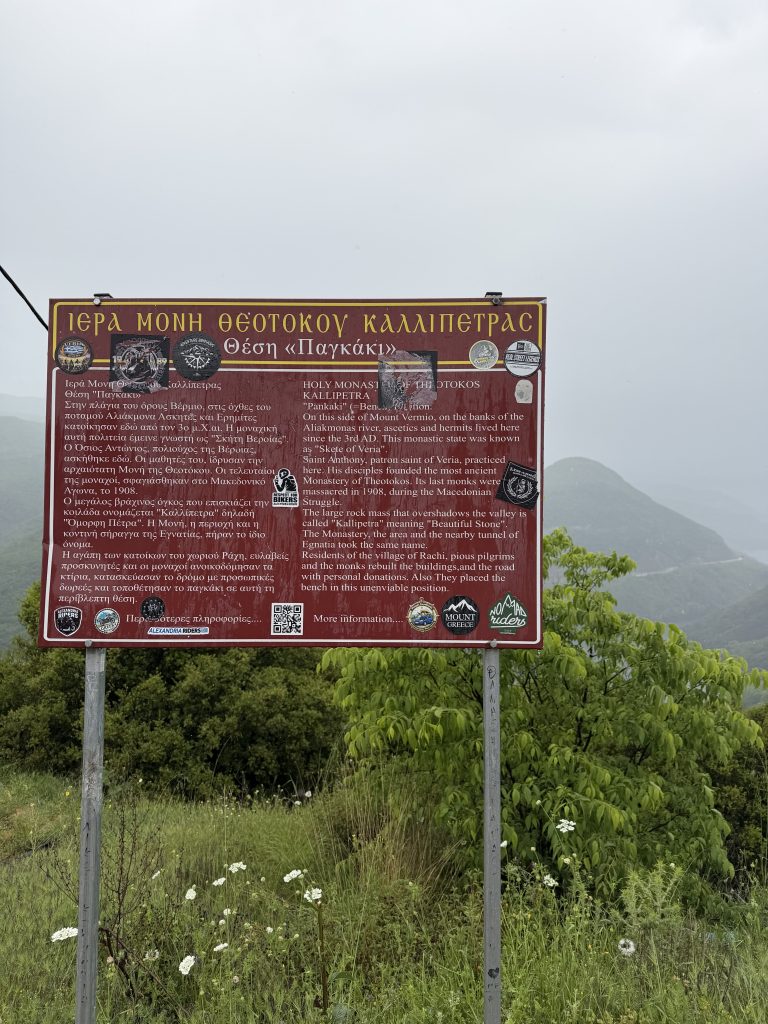
The Monastery of the Theotokos Kallipetra falls into both categories. My friend (and Sub-Deacon) Randy had — for him — strongly recommended I go there. It’s outside Veria (another topic/site we will be exploring some more) and it is, in fact, a work in progress. The monks there were murdered back 1908 and it was abandoned for decades. Locals still snuck down to the site to lite candles and pray, and there is (I’m told) still a foot trail from a nearby village. Local legends talk of hearing monks chanting in the church there while it was deserted.

The main entrance and parking area

A group of monks returned and are working to restore the site and are doing some amazing work. The locals, monks, and pilgrims even raised funds to pave the road to the monastery. Read the first picture for more details.

They have done an amazing amount of work, but there is still a ways to go

I enjoyed meeting the monks, especially the Abbot Father Palamas. He was the first priest I met on this trip who seemed to know more about me that I had shared. Then again, I had been told that might be the case as I am not the first to experience that. During our talk, he invited me to come back for a longer stay — and I would very much like to do that. I would also like to help as much as I can with the work they are doing.

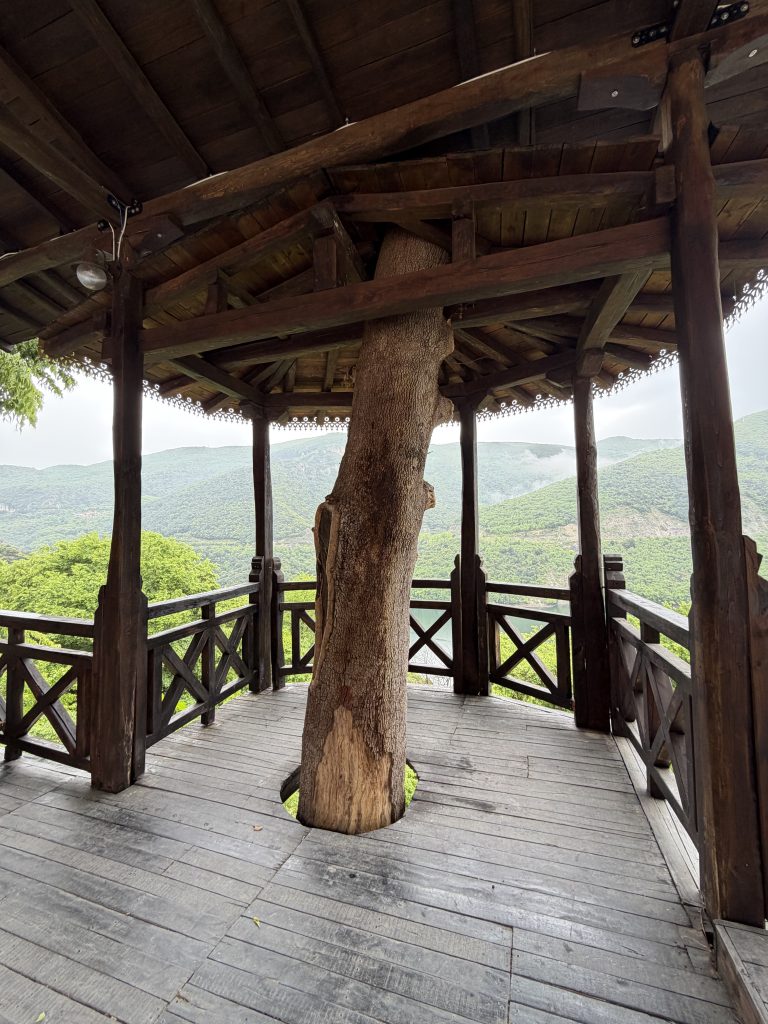
Why cut a tree when you can build around it?

Father Palamas was kind enough to let me stay for evening services and to enter the under-construction/restoration church, where I had the opportunity — among several — to venerate a relic of the Apostle Paul. My visit there was powerful and moving in several ways, and as I said above, I would love to go back for a longer visit as soon as I can.

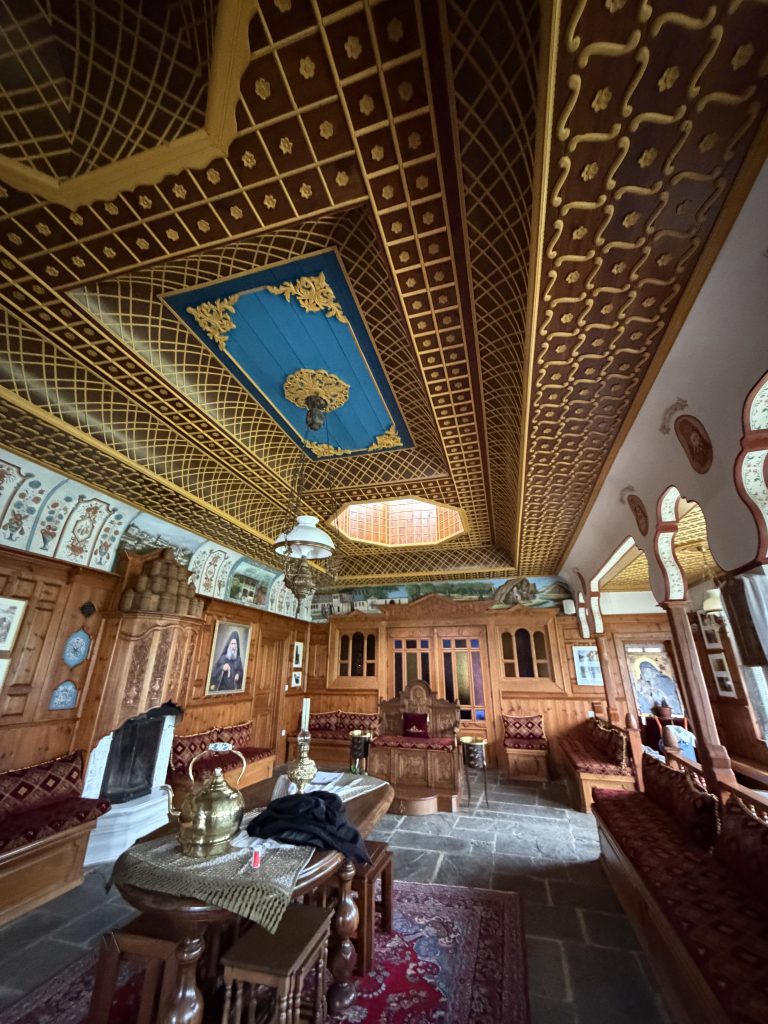
A view of the main hall

If you would like to help me with this trip, seminary courses, and more, feel free to hit the fundraiser at A New Life on GiveSendGo, use the options in the Tip Jar in the upper right, or drop me a line to discuss other methods. I’ve added Cash App ($CliffPow7) and Venmo (@Clifford-Powers-5). There is also the Amazon Wish List in the Bard’s Jar. Getting hit by lightning is not fun! It is thanks to your gifts and prayers that I am still going. Thank you.