Couple Of Quick Thoughts

Sorry for the lack of posting. Things continue to be amost-as-hectic as last week at Church as we celebrate Bright Week, and life has been a bit hectic as well. Good, but hectic.

First, this comment brings up a good discussion. Why not use plastic food jars and such? First, we will be getting into plastic containers here soon, rather into plastic containers that work for Long Term Storage (LTS). As for your usual plastic jars from foods and such, they can be quite useful but NOT for long-term storage.

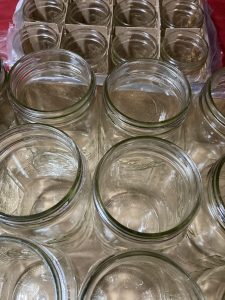
A few quick points. First, the average plastic jar or container often contains interesting compounds that will leach out. That why even with food-safe plastic containers it is advisable to use mylar bags to isolate. Second, the use-life of your average plastic container is often limited. As the chemicals within leach, oxidize, etc., the plastic often turns quite brittle. They may be good for a year or two, but after that all bets are off. There are some that may last longer, but they are a rarity given that they are often more expensive to produce. Third, the porosity of you lower-grade plastics is higher. Keep in mind that even metal is not truly solid. There is a fair bit of space between molecules, and your denser plastics, glass, and metal do a fair job of keeping most things in or out. And I do mean most things: hydrogen is small and slippery and one of the things keeping us from a hydrogen economy is devising a reliable and safe means of storage. Zeolites were investigated for that, not sure where that research is these days. Your cheaper plastics are more porous, which is why good food-safe plastic containers, which are denser, cost more. Also, I focus more on glass than “typical” plastic containers for LTS both for lifespan and for the fact that the glass containers can be re-used for canning multiple times if you have sufficient lids tucked away. Again, we will be getting to food-safe plastic containers here soon.

Second, this comment points out a good option for sewing in the face of emergencies or disasters. I’m sure there are other brands similar, so take a look around. The more you can do for yourself, the better off you will be.

More soon.

Getting hit by lightning is not fun! If you would like to help me in my recovery efforts, which include moving once we have medical issues cleared up, feel free to hit the fundraiser at A New Life on GiveSendGo, use the options in the Tip Jar in the upper right, or drop me a line to discuss other methods. It is thanks to your gifts and prayers that I am still going. Thank you.

Sewing Kits

Yesterday’s post sparked something that deserves it’s own post. Yes, I do recommend having a fair bit of sewing gear tucked away. Aside from fabric, it is fairly inexpensive and in an emergency you will find yourself facing two needs: minor repair and major repair/manufacturing.

First, here’s what I’m talking about when I say inexpensive. Individual packs of hand needles can be found for a couple of bucks, though certain specialty needles can get a bit more expensive. Safety pins and other pins are still at a semi-reasonable price. Thread has gone up since the last time I bought any, but again picking up a spool or two a month is not going to break the bank. What you see above is one kit for minor clothing emergencies, and the start to something more.

The kit on the left is a fairly complete and ready to go minor emergency kit. You have assorted hand needles, pins, safety pins, and a small pre-threaded repair kit. You can add more thread options, which is not a bad idea. Meantime, you have with this the ability to sew on buttons, make minor repairs, and otherwise repair your clothing. You don’t have to be Mr. Baggins running from Gollum and the Goblins to end up losing a button or three, or otherwise doing things that require some repair. Tucking a few of these around is a good investment. Heck, I used to have a slightly larger emergency kit like the one bottom center in each suitcase when I traveled on business. Used them a few times too — my buttons were on, even if not always as pretty as those done by the pros.

The kit on the right is a start to a larger kit. The small rolls of thread are on the bottom, the larger rolls above along with the various needles, pins, and such. My plan is to add more large rolls of thread, a cloth tape measure, some larger specialized needles, and some other basics to it. This will be good for major repairs and a start towards being able to make something at need.

Pro Tip: If your wife/girlfriend/boyfriend/other sews and has good scissors, do not try to use them for anything else, much less add them to a kit. If you have used them to cut paper or anything else, a new pair and dinner is a good start towards making up for that. Find out what they are, where they were obtained, and buy some new to go into a kit. Get their advice on what to tuck away, possibly including some fabric for repairs and more.

One of the things that stuck with me after the first time I read Alas Babylon by Pat Frank was how breaking a needle almost sent some of the survivors into a meltdown. If you are dealing with an emergency or a disaster, you are probably not going to be able to run to the store or shop online. Needles (hand or machine) and other items we take for granted as being cheap and common may well become expensive and scarce. Also, if you have a sewing machine consider getting a Uninterruptible Power Supply (UPS) for it, though it will likely need to be something on the order of what you would get for a sump pump or such. For that matter, having an antique foot-powered sewing machine could provide decoration as well as a functioning machine at need.

Now, I use jars for size and convenience. Pins, needles, and such are not great to put in mylar. For the larger kits you could use gallon or 2.5-gallon buckets, but that is up to you. Also, fabric would work well in mylar and a 5-gallon bucket. Be smart, be flexible, and tuck a few away at need.

Just wanted to sew this up while I could…

Getting hit by lightning is not fun! If you would like to help me in my recovery efforts, which include moving once we have medical issues cleared up, feel free to hit the fundraiser at A New Life on GiveSendGo, use the options in the Tip Jar in the upper right, or drop me a line to discuss other methods. It is thanks to your gifts and prayers that I am still going. Thank you.

Wicks And Lighting

Yesterday’s post brought up questions, so some quick thoughts on wicks and the need for multiple lighting sources. Here we go.

While a lot of my emergency lighting (some of which doubles as my camping lighting) is electric, keep in mind that having multiple sources of lighting is a very good idea for emergencies and disasters. Short version is that even with rechargeable batteries and multiple ways to recharge them (solar, hand crank, etc.) batteries only last so long. There may be times when using electricity is not an option or not a good idea. That’s when having other options is a very good idea.

I use a small oil lamp for religious purposes, and am set to create more at need as sources of light. Regular olive oil or plain vegetable oil work very well in such cases, and you can even use oil that is out of date for lighting when you can’t (or shouldn’t at least) use it for food. As I noted a while back, you can often get expired oil from restaurants or other food service operations for cheap or for free. So long as it is not rancid (smell), you are good.

Oil lamps and such that use liquid paraffin are a good option as well. Again, gives you a different source of fuel, different light, and an additional option to go with electric, lanterns, and candles. Anything open flame is a safety issue, which is why enclosed lamps, lanterns, or using candle lanterns (discussed previously) is a very good idea.

So, to repeat: I plan on flashlights and electric lanterns as my primary at need; name-brand and old fashioned lanterns are a good secondary option; oil and liquid paraffin lamps and candles are another; and, real candles do come in handy. Also decorative and/or scented. No reason things can’t do more than one thing, and most really should…

As to wicks, I have a mix of braided and “adjust-a-size” wicks around. I like to keep some lamp wicks handy (top of photo) and you can get packs with different sizes of them very inexpensively. The ones I use the most are braided wicks in 3mm and 4mm diameter (left in photo). Versatile and you can make lamps or candles out of them quickly at need. The non-braided wicks (right in photo) can be adjusted to whatever size you need. I’m not as fond of them as the other, and find them not to be quite as useful or long-lasting. That said, they come in handy for use in a variety of wick holders of different sizes and they do give you some options. It’s all about having as many options as possible…

So, just a few quick thoughts (and hopefully some answers) before I head out for the day. More to come.

Getting hit by lightning is not fun! If you would like to help me in my recovery efforts, which include moving once we have medical issues cleared up, feel free to hit the fundraiser at A New Life on GiveSendGo, use the options in the Tip Jar in the upper right, or drop me a line to discuss other methods. It is thanks to your gifts and prayers that I am still going. Thank you.

Jar LTS Thought

One thing I think I forgot to mention in the post looking at glass containers is that they can be very useful for storing things that mylar is not going to like. For example, pointy bits of metal that are oddly shaped. In the example above (click to embiggen) are some items for making emergency oil lamps.

These come from a religious book and supply store, and give you options for how to do your lamps. The drawback is that they are oddly shaped, part may be pointy, and otherwise are unsuitable for bag storage since they also need to be protected from crushing. Jelly jar is a perfect home for them and a variety of braided and non-braided wicks. You may notice that I have wicks already threaded through the holders, as if I’m dealing with an emergency the last thing I want to do is to have to spend time threading wicks into place. This way, I have them set to go.

Now, there are good arguments for using oxygen absorbers, but for this jar I opted to go with a vacuum seal. The portable unit I reviewed a while back was sufficient for this task.

With a bit of padding, the jar can go in a bucket or other larger container where it can be protected. Or, it can be stuck in the back of a closet, back of an out-of-the-way shelf, etc. Never a bad idea to have several of these around in different locations so that at least one, if not all, survive for use when and if needed. Same holds true for other supplies as well and one thing I want to do is set-up a sewing jar with a variety of hand sewing needles and other supplies that, again, might not be best to store in mylar or such.

Just a quick thought to share this morning. While I hope to get some more short posts up this week, things are busy down at the Church and my focus is there. Given all, really glad I’m not cooking on top of all else that is going on. Working to be sure my (limited) focus is on what is truly important.

More soon!

Getting hit by lightning is not fun! If you would like to help me in my recovery efforts, which include moving once we have medical issues cleared up, feel free to hit the fundraiser at A New Life on GiveSendGo, use the options in the Tip Jar in the upper right, or drop me a line to discuss other methods. It is thanks to your gifts and prayers that I am still going. Thank you.

Preparedness Pays II: LTS With Glass

Just a heads-up, but posting may be lite this week. I forgot about a surgical follow-up, so have it, a funeral, and a bit more I plan to attend. That said, going to try not to leave you all hanging.

Glass is versatile, affordable, and easy to obtain. Sterilizing it before use is easy, provided you actually can get access to the dishwasher. (long story). Using either a hand-held unit or the jar attachment to a food vacuum seal system, you can quickly prepare items for Long Term Storage (LTS).

Above is what I’ve set up as a “basic” kit. Depending on circumstances and/or rationing, it’s one to four weeks of food at need. There are beans and rice (complete protein), quinoa (complete protein), flour, salt, sugar, and other food basics. Small footprint, and you can put something like this in the back of closets, shelves, etc. and have them in multiple places around the house. This minimizes any one issue taking out all of them at once. Yes, that does mean they can be easy to hide as well.

Glass also comes in handy for storing odd-shaped items and/or items likely to poke holes in mylar bags, which sorta defeats the purpose of using mylar bags. More on this in a future post, but used in conjunction with other storage options, glass can give you a lot of flexibility. I will say right now that using jars to hold needles, thread, and such can be a very good idea. Especially since some of the specialized needles and gear are going to be fun to try to bag…

Again, using smaller glass containers gives you the ability to provide portion control as well as good sizes for trade. Particularly for spices, which in an emergency or disaster could once again be worth many times their weight in gold.

As noted before, the drawback to glass is that it is not going to react well to impacts or shear forces (fragile) and the seals on the lids will eventually go bad. I’ve noticed that many brands seem to be going with an official two year shelf life (or less), though I also suspect that time limit is probably lawyer driven rather than science driven. Corporate risk-mitigation is far more about perception and excessive caution than anything else. Personally I think you should get closer to a decade safely out of them, though replacing and re-sealing every ten years may not be a bad idea. Oh, and keep in mind the lids can corrode if the storage is not dry. Or if the pepper sauce eats through the lid — yes, that did happen and no did not try it.

Oh, keep in mind that even more than bags and such, you can re-use the glass jars almost indefinitely. Having spare lids tucked away means you can even can at need. Again and again, remember that part of the equation is doing things so that you have as much flexibility, and as many options, as possible in an emergency or long-term disaster.

Glass is a good way to start and balance out other options. Lack of expense makes it easy to do smaller amounts of preparations and distribute them around. I know some of you have done this for a while, and have your own basic food and other kits. Feel free to share options in the comments for consideration by others.

More soon. Not sure what I will tackle next, as there are good reasons to look at metal containers next, and equally good reasons to look at plastic containers next. May come down to the flip of a coin. If life keeps me away from the keyboard, I will be back as soon as I can.

Getting hit by lightning is not fun! If you would like to help me in my recovery efforts, which include moving once we have medical issues cleared up, feel free to hit the fundraiser at A New Life on GiveSendGo, use the options in the Tip Jar in the upper right, or drop me a line to discuss other methods. It is thanks to your gifts and prayers that I am still going. Thank you.

Preparedness Pays II: LTS Containers

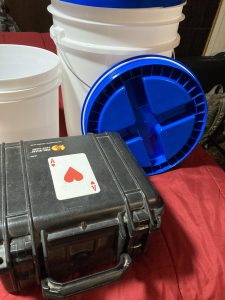
Long Term Storage (LTS) is a different game from storage for general preparedness. For the former, you are talking 20 or more years, while the latter is generally standard shelf life, or about 2-5 years. Yes, I am (over) simplifying things, but…

For me, I have two major reasons for doing LTS work. The first is that I think it a very good idea to have some basic stocks on hand for emergencies and disasters. I know I would like to eat during such, and that there might be others who do as well that I might can assist.

The second reason is that I am a cheap [male offspring of unwed parents — trying to clean up my act a bit as clergy and others may be reading this], er, Scottish, and like buying bulk. Let’s face it, times are tight for us all, and for me having to take early retirement (stupid lightning) puts me on a very tight budget. So, I buy bulk and don’t want to waste any of that food. Bit more on that discussion soon.

There are four major materials used for LTS containers: glass, metal, plastic, and concrete. Yes, I did say concrete. For now, let’s take them in that order and look at some of the pros and cons of each.

Glass, and pottery before it, has been a staple of LTS for literally eons. One still comes across articles detailing how a sealed bit of pottery was found to contain still-edible food (honey turns up fairly frequently) even after a thousand or so years. Glass, and the glass canning jar, really did revolutionize food storage with the advent of more modern types of rubber for sealing.

Glass is durable and has a long shelf-life of its own. Which means the jar you use today could be used by your child or grand-child many years from now. The clarity lets you keep an eye on what’s inside and spot problems before opening. The downside to glass (and pottery) is that it is quite brittle/fragile, which limits emergency utility.

Metal has also been around for a while, and offers great strength and protection to the contents. You have metal boxes and cans available in a wide variety of sizes and shapes. Above is a large can and an ammo box I repurposed as a humidor. Sadly, I am out of good cigars for it.

The drawbacks to metal include bulk/weight, expense, and that coatings are often required as some metals and/or the sealing agents used on them are toxic and/or will corrode easily. Some of the early cans had more than a little bit of lead in them, and poisoned those who ate their contents. Modern cans have little to no lead (depending on where you are in the world) and are often lined to prevent corrosion, especially from acids (think tomatoes for just one example).

Before I forget, I have a larger ammo can that can be used to store electronics and such that I want to shield from radiation of various types and intensities. This includes from sources man-made or from that huge fusion furnace that lights our world — the sun. You don’t have to get to the level of a Carrington Event (or worse) before it becomes good to tuck things away. Given some of the recent strong eruptions from the Sun (so far pointed away from us), might want to think about that.

Plastic is probably the most used modern material for LTS and general storage. It is travel cases, storage cases, coolers, food-safe buckets, mylar bags, and much, much more. There are many different types of plastic out there, and each has advantages and disadvantages.

On the pro side, plastic is relatively inexpensive, depending on formulation quite durable, stronger and more resistant to impact than glass, and lighter than metal or concrete. There are a number of food-safe options available for food and other storage. Just my take, but I tend to use food-safe for as much as possible so I can re-use it at need. For example, in an emergency or disaster, that storage container can be re-used for storage, washing, food prep (soaking, brining, etc), and more. Don’t just think of the initial use, consider that when one moves into disaster territory what you have may well be all you have for some time to come. Make it count.

The con side is that plastic can and and will shatter, often does not take well to sunlight and heat, and is not something you really want to stack, particularly 5-gallon or larger containers. Stacking will result in structural failure, so just don’t do it. Yes, I do speak from experience.

Oh, keep in mind modern coolers/ice chests can be used to store both food and non-food items. I know more than one person who uses them as a humidor for cigars. Load in boxes of cigars, throw in some humidity packs, seal the drain plug, and things are good for months before you have to think about replacing the humidity packs. Add in desiccant packs and you can store books, electronics, and much more in a controlled environment. That way, you not only have the contents, but you have those coolers for use in an emergency or disaster. Just a thought.

Our final category of material is concrete. No, not thinking concrete briefcases or such, but when looking at storage that involves less-than-optimal conditions, certain varieties of disaster, or the need to store things such that they are not obvious, concrete — especially pre-formed concrete products — can be a good way to go.

As I noted here, in the opening of Lucifer’s Hammer Niven and Pournelle had a character loading carefully packaged books into a modified pre-made septic tank. With the normal input/output openings sealed, such makes a very good and durable underground storage unit. I’ve even heard of people using several linked together for shelters. Thing is, with the number of pre-formed concrete pipes, cisterns, etc. you can find something of almost any size for your storage needs. Think also that burglars or other not-nice people are not going to think to check something that has pipes running in and out or appears to be an active septic tank within a basement or pump house, etc. The metal that is in most such pre-formed items is also going to diminish the effectiveness of metal detectors and such when used indoors. Something to think about for outdoor use. Just a thought.

Tomorrow, I hope to take a look at long-term food storage and a bit of my take on the subject. There is no one right way or system, individual tastes vary, but within that one does need to provide for complete and balanced nutrition. For me, I like to survive in style as much as possible, so I may have a few thoughts on how to make friends and have a bit for trade. More soon.

Getting hit by lightning is not fun! If you would like to help me in my recovery efforts, which include moving once we have medical issues cleared up, feel free to hit the fundraiser at A New Life on GiveSendGo, use the options in the Tip Jar in the upper right, or drop me a line to discuss other methods. It is thanks to your gifts and prayers that I am still going. Thank you.

Preparedness Pays II: Slight Change In Plans

Today’s topic was scheduled for later in the series, but when you get someone saying this, and then Sarah says this, and a list like this pops up, it makes a point/makes one wonder.

Preparedness is about much more than basic sustenance and comforts. It is about taking care of the things that truly matter: family, Family, life, and spirit. In the worst case, it is about rebuilding so as to take care of those things and for a better future. It is about helping ensure that the best of our generation and previous generations survives, and that does indeed include philosophy and the far more important Faith.

I think it was at the start of Lucifer’s Hammer by Larry Niven and Jerry Pournelle (stupid lightning), one of the characters is overseeing the final stages of securing a cache of good and important books against what was to come. Plan to revisit this a bit, as how it was being done is a good way to do things. Can’t really remember, but it seems that this character was not the only person/group doing such a thing.

That is a good thing, and I think we need to do it on whatever scale we can. If you think that your books (or anything else) are safe, you are not paying attention. Christianity and Judaism are under attack from multiple quarters. The progressives hate anything that detracts from their control and the supremacy of their deity, the government. When various Muslim groups talk about ‘first the Saturday then the Sunday people’ know they are not joking. I could go on, but if you look, you will find. If you will see and think is the only real question.

In my younger days, I often got into trouble for ‘reading ahead’ on assignments. Today, I’m encouraging you to read ahead in thinking about the need to preserve knowledge, civics, and most of all, Faith. I want you to read this and this, courtesy of my friend Snarksalot, so you can be thinking a bit before we get to the topic of food. Think and read ahead, as I am increasingly worried we are all behind the curve.

Today is one of the few times I will ever tell you to hide what you have done and deny all you have done. I say that because I can see how any number of things can unfold such that large-scale efforts to restrict and censor information, to seize and destroy knowledge, could take place. Not just in limited areas, but large-scale efforts even. I hope we don’t go there, but if you are looking and staying informed on the censorship-industrial complex and more, you should be concerned.

There are three major areas of knowledge to be preserved by everyone.

First, there are the books and more that tell you how to do things like canning, preserving, sewing, knitting, and more. They are the books on survival, on how things used to be done before the advent of modern refrigeration and food preparation/preservation. These are things like the Foxfire books and similar. It’s things like the Ball canning or other food preservation books. It’s the emergency medicine books and guides. It’s the old Boy Scouts Field Guide and similar. Got a favorite or a list to share? Sing out in the comments.

Second, there are the books that shaped our lives and the Great Experiment that was/is the American Republic. It’s books on civics, on discourse, and those that show what can be done by a free people. It’s Paine, it’s L. Neil Smith, and so much more. It is also the books that have shaped us as individuals. In my case, I very much want to preserve the key works of C.S. Lewis, Tolkien, Kipling, Heinlein, and more. Again, if you have a list or suggestions, sing out in the comments.

Third, there are the books of Faith. For me, that would be the Bible as well as some other key works. Heck, I would print out and include a copy of the Didache in that since I don’t have a bound copy (only electronic). BTW, if anyone has any of the other translations they would care to share, I would appreciate it. For you, it may be different. In fact, I would recommend including multiple copies of the Bible, including give-aways if you can get them.

If you belong to a group that can do something on a larger scale, do it. Secure it. Hide it.

Some quick thoughts. First, if you can, go hardcover and/or archival editions of as many books as possible. If needed, they are going to be very much needed and used. Paperbacks and cheap are not going to be up to that type of use. That said, do whatever you can.

Second, particularly on books of Faith, but for as many others as you can, do multiple caches and hide them well. Treat them as the first rule of Preparedness Club, taken up several orders of magnitude and put on steroids. Forget about them, and tell no one about them, until it is time to either keep the knowledge alive or bring it back out.

We will be revisiting this topic, but I just have an odd feeling I need to get this out now. That you need to be thinking and acting now. We are a resilient and inventive species, especially when it comes to hiding and doing things our “betters” don’t want us to do. There is a long history of humans hiding things from rulers, from scrolls of old to history they wish to deny or destroy. Of hiding Faith and knowledge from those in the majority who do not share and want to destroy such. Make our ancestors proud.

Yes, I will be going into a bit on how to prepare and store books and such. This is a huge topic, and there is much to explore. I also hope you have much to share, especially suggestions on the works that are essential in every category.

For now, the word is out and the seed planted. What comes next, on several levels, is quite literally up to you.

Getting hit by lightning is not fun! If you would like to help me in my recovery efforts, which include moving once we have medical issues cleared up, feel free to hit the fundraiser at A New Life on GiveSendGo, use the options in the Tip Jar in the upper right, or drop me a line to discuss other methods. It is thanks to your gifts and prayers that I am still going. Thank you.

Preparedness Pays II:

Intro

Slight Change In Plans

Preparedness Pays: The Longer View

Since there is an interest in longer-term preparedness, I’m going to start a new section (book?) to pick up where Preparedness Pays (the original book in progress) leaves off. There have been requests for discussions on bugging out, with a focus on doing so by foot, and on longer-term planning including how to handle a lack of government (for) response. The need for the latter is one of those things where we do need to look well beyond simple preparedness and survival.

If I had my druthers, and the funds, I would start this with water which is the be-all, end-all, and number-one issue for being prepared. If anyone cares to hit the tip jar, what I would like to do for that is look at and experiment with at least two bulk water purification systems and two to three individual systems. A LOT has changed over the years and one of my favorite systems/companies is no more. Time to do some new reviews with your help.

Instead, I’m going to start with medium- to long-term storage, which is key to the majority of other issues. It’s more than just food, though food justly gets the lion’s share of the discussion. It’s all the things that let you stay as civilized as possible in an otherwise uncivilized situation. It’s about preserving knowledge, thought, and even the spiritual things that are needed for a full life and more.

So, tomorrow we will start looking at some of the different means and options for storage, and how to make use of it as a part of your regular life. Some of what I bring up can and should be used in day-to-day life as a means of rotating stocks while saving on the food budget. And for you to practice certain skills that will add to your everyday menu as well as to longer term preparedness. Also, there are some resources out there that can be used such that you don’t have to reinvent the wheel.

I’m also counting on your good inputs. Some of my knowledge is out of date. Some of mine is flat-out missing (stupid lightning). Some of what I do gets into over-engineering or otherwise going overboard on some things. I’m hoping you, my readers, will offer up suggestions, share things that work for you, or for you to tell me when I am going overboard. Equally, if I’m not taking things far enough, sing out!

If there is a topic you want to see explored in this series, let me know in the comments or via e-mail. There is lots to discuss, and to think about, especially given how the world seems to be going. While Preparedness Pays (original) was aimed at those who have never dealt with preparedness before, and primarily focused on the short-term, I want to use this series to build on it and take people a bit deeper into preparedness — and how it can make day-to-day life a bit smoother.

If all goes to plan (which it seldom does it seems), we will start tomorrow by looking at options for longer-term storage (glass, plastic, metal, and even concrete). I will say up front that some of my “over engineering” may be geared towards providing more than one item at a time for use and re-use later. Onwards!

Getting hit by lightning is not fun! If you would like to help me in my recovery efforts, which include moving once we have medical issues cleared up, feel free to hit the fundraiser at A New Life on GiveSendGo, use the options in the Tip Jar in the upper right, or drop me a line to discuss other methods. It is thanks to your gifts and prayers that I am still going. Thank you.

Your Input Please

I noted before that Preparedness Pays was intended as an introduction to preparedness, and to make the process less intimidating as so many people (and agencies) get waaaay too caught up in the huge number of possible disasters. As noted in previous posts and the book, there really are only about four things that can happen, while the number of possible disasters is an infinity-minus-one situation.

The idea behind the book (which, yes, I do need to get back to work upon) was to focus more on short- to medium-term situations, again so as not to overwhelm people. There are far too many out there, including in positions of authority or pseudo-authority (and I include people in entertainment venues like radio, social media, TV, etc. in this) that will automatically dismiss anything that goes beyond short (very short) term as survivalism/angry militia/crazy talk/etc.

So, would there be an interest in having me talk more about medium- to long-term issues? Things from food storage to keeping the lights and more on? I’ve touched on that in some of the previous posts, but it is an area where many (including myself) are not really as prepared as we should be.

What say you? Also, if we do this, I hope you will join in with your experience, hints, tips, etc. I know a small bit; but, am willing to bet that collectively there is a heck of a lot of knowledge experience that can join in.

Getting hit by lightning is not fun! If you would like to help me in my recovery efforts, which include moving once we have medical issues cleared up, feel free to hit the fundraiser at A New Life on GiveSendGo, use the options in the Tip Jar in the upper right, or drop me a line to discuss other methods. It is thanks to your gifts and prayers that I am still going. Thank you.

Preparedness Club: Reminder

I need to get back to work on the book sometime soon, but for now, some reminders and legal caveats in regards preparedness. Always remember the first rule of Preparedness Club: THERE IS NO PREPAREDNESS CLUB!

That is for your safety. Otherwise, first thing that happens is that ill-intentioned people can and will see you as a target and act accordingly. I will simply say for now be prepared, and that should include mental and spiritual preparations to decide what you are willing and able to do to defend your own against such evil. Only you can make the right decision for you.

Keep in mind also that the good-intentioned may also come to take anything you are known to have in regards food and other supplies. If you don’t believe me, check into your local and state rules, regulations, and laws in regards disasters. It is rare that it is easy to get the information, as for some reason governments don’t really like to talk about it, but most major (and even some minor) cities and even states have regulations and/or laws on the books that allow them to seize food, medicines, and other supplies not only from warehouses and stores, but also from individuals who are “hording” said materials.

You might also want to check the definitions of the terms used in the laws, as they can be most enlightening. That sack of lentils you got the good deal on so your family has food to get by may well be hoarding, a large food stock, or other term that allows it to be seized. Nor would I ever suggest that even if it were not those sent out to do such collecting would disregard the law and take it anyway.

Let me be clear: I do not advocate hiding any preparations or stocks of food from those legally (lawfully is something else) authorized to raid your home, property, or other to seize same. Nor do I advocate passive or active resistance to such. Keep in mind that not only are they likely to be legally armed (and you need to check your local laws as in emergency any weapons of any type you may have may no longer be legal to possess, carry, or use in some jurisdictions) and backed by armed enforcement.

In fact, I would remind you that using jelly jars or smaller to hold any supplies may not be a great idea as they are small and easily misplaced. For all that they are great for holding dried spices, wicks, small but critical hardware, and such — and keep in mind that not all that long ago pepper and other “exotic” spices were worth many times their weight in gold — they also can be easily misplaced or lost. That would deprive you of those necessities (like needles, thread, wicks, etc.) and luxuries that could also be trade goods in small quantities (spices, etc.).

Having your supplies in one central, secure, and known location can be a very good idea. You know where everything is located, what you have, and can easily rotate out stocks at need. Also, if things are seized and you are given a receipt for things taken, it makes quantifying such easier. Dispersing supplies makes it harder to keep up with what you have, rotate stock, and if it is known you disperse supplies could lead to a variety of unpleasantness. DO prepare, but be prepared to Both look after yours and to comply with legal demands.

As for me, I write a good bit but am very limited in what I can put away. Your help and donations allow me to experiment, write, and get by. I thank you very much for them.

Just as there are many good reasons to Be Prepared, there are many reasons to live the first rule of Preparedness Club. Be Safe. Be Smart. Be Prepared. Keep your family and friends close, and your things where you can find them in the dark.

NOTE: This focuses on state and local, you don’t even want to think about what the feds will claim they can do.

Getting hit by lightning is not fun! If you would like to help me in my recovery efforts, which include moving once we have medical issues cleared up, feel free to hit the fundraiser at A New Life on GiveSendGo, use the options in the Tip Jar in the upper right, or drop me a line to discuss other methods. It is thanks to your gifts and prayers that I am still going. Thank you.