
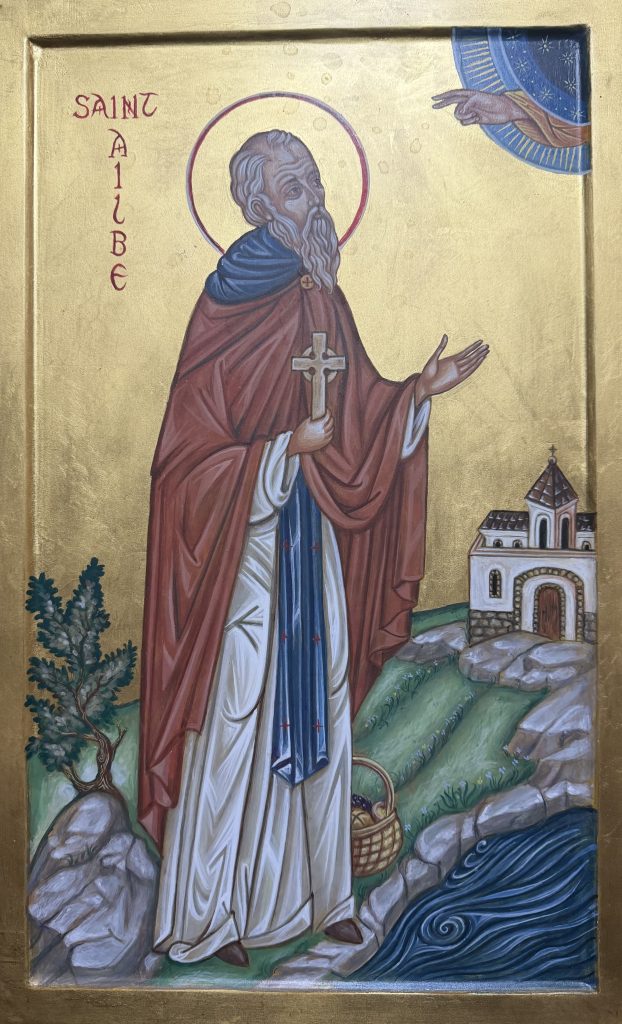
Outside of the deliberate misrepresentation that traditional faiths worship saints, the largest misconception about traditional faith is that we worship icons. And, yes, I do consider it a deliberate and willful misrepresentation of truth, faith, and more. It is a heresy and the last gasp of iconoclasm in the service of the evil one. Too strong for you? Hang on, I will do my best to explain a book’s worth of theology in a single blog post. Can’t be done, but I will at least give you some broad strokes and the grounds for future discussions and explorations.
Fact is, icons have been a part of Christianity. From. The. Start. Just like the veneration of relics, a topic for another day (or year as that too is multiple books). Part comes from the fact that early Christianity (up until well past middle age even) (well, what did you expect, I am a PUNdit after all) was an oral tradition, not a written. As I have discussed before, the early Church (and even unto the 1700s) was based on oral tradition and not literary/written.
Per some previous discussions, go read Matthew, and then read Luke. Two things jump out. First, Matthew was written for an oral tradition including things done to enhance memorization. Luke, in addition to clearly having talked with the Theotokos (Mary, the mother of God), was a literate man who wrote a literary work. It clearly reads as such, and he was one of the few if not the only Apostle who was literate in that he could both read and write. Look at the Epistles and note that in many cases they list who wrote down the words and that they would be sent WITH THE LETTER to verify and explain as needed.
The other thing a lot of other people don’t know or don’t get is that Luke was one of the first (if not the first) iconographers. In fact, of the several with which he is credited, at least four are believed to survive to this day. One of those icons is said to have been painted upon wood from the table where the Holy Family ate. Yes, he is credited with taking the supper table of Christ as a youth and using the wood from it for an icon.
There is a lot that could be said about the seventy or so icons he is said to have created. However, I will simply note that one of the most famous, The Directress, has spawned thousands of copies. It simply depicts Christ the babe in the lap of Mary, with her pointing at him with emphasis indicating HE is the way, the truth and the light. That was the role the Theotokos chose in life, to point to him, to guide people to him. In many respects, it is still her role.
I will again point out an interesting thing I noted a while back. Of the icons attributed to Luke, the Theotokos is almost identical in each, while the figure of Christ can change rather dramatically. To me, it strongly indicates that he did indeed meet and talk with the Theotokos, and that — per scripture — he never met Christ in the flesh. Think about that for a bit, and consider that his icons were accepted not only by the Theotokos, but the fathers of the Church as well. Do you really think that if they were a blasphemy or wrong that no one would have spoken out? Just a thought to consider.
Let’s set aside such things for a moment, and discuss: what is an icon? In the broadest strokes, an icon is a depiction of a person that captures the totality of their work or life and provides a means of two-way communication between the person venerating and the person or persons depicted within the icon. Icons have been described as “windows into Heaven” in that the person or persons being depicted are the only people we know for sure are in Heaven, and the icon offers a path for mutual communication with them.
Now, I’m not saying that the icon comes to life and actually talks with you. It has happened, and I just had the chance to venerate one such icon while in Greece. That icon of the Theotokos (the Virgin Mary) spoke three times to the nuns of a monastery warning them to take everything they could and flee. The third time it spoke they listened, gathered up what they could, and fled. A few hours later a guerilla force sacked the monastery.
Yet another was at the Vatopedi monastery on Mount Athos, and I also had the chance to venerate, study, and pray before it. That icon spoke to warn the abbot not to open the gate one day, as pirates lay in wait for them to do so, so they could sack the monastery. In fact, that icon did in effect come to life, with the infant Jesus trying to stop her from talking, saying the monks deserved what was to come because they were not honoring their vows. She pulled down his hand and repeated the warning, which was heeded. Turns out, when they cautiously checked, the pirates were seen and had large rocks dropped on them, and surprisingly they ran away rather than pressing the sack as was normal. In the aftermath, the icon returned to something close to its original form, save that the infant Jesus’s hand was still in the process of being pulled down and he has a rather angry look on his face. The original fresco was very carefully removed and preserved with those changes; and, a new fresco was put up restoring the happy smiling infant Jesus with his hands where they were originally. The miracle icon is now in a special chapel above the main church, and I found it to be incredibly powerful.
This also brings up the matter of materials. The fact is, there is no limit. Many are painted (written) on wood. Others are done with mosaics, while yet others are done as plaster frescoes. Some more modern ones are copies printed and mounted on wood. I’m looking at one right now that is technically a photograph, but is accepted as an icon. We just had a very interesting discussion in the recent theology class that even something done by AI using prompts from an iconographer who did the prayers and other preparations could be an icon.
Again, the materials don’t matter. According to the seventh ecumenical council (which ended iconoclasm), what matters is: it has to depict a person and not an object; it has to be historical, and not of a dream, legend, etc.; it has to show the totality of a life or event in a life; and, it has to provide two-way communications. There is more, and I’m skipping a lot to keep this a reasonable length, but one final thing is that it has to be able to be venerated by people.
When you go into any number of Greek or Eastern Orthodox churches, you will find saints at ground/eye level, often grouped together by various criteria. The idea is that those icons not only tell the story of the saint(s) in question, but are where the laity can access them. Above them you often find religious art (not icons) depicting the life of Christ. Above that you may have one (or more, Russian Orthodox churches often have five levels I’m told) levels depicting individuals, events, etc. None of the higher levels are considered icons as no one can reach them to venerate them.
A quick aside in regards a lot of the artwork and illustrations seen in traditional churches. As I mentioned above, the early Church was based on an oral tradition not a literary one as few were literate. Instead, the laity and what became the clergy memorized scripture and the books of the Old Testament. The artwork was a memory prompt, as it immediately brought up the scripture associated with the event depicted. When someone wanted to know how many times or in how many places something was discussed, they didn’t have the internet and such. What they did have were people who had memorized content and could think about and then tell you the answer and provide you with the citations as they went.
Now, a couple of other things to share about icons. First up, they have to provide the whole picture as it were. One of the most famous icons, Christ Pantocrator, really threw me the first time I saw it as Christ has two different eyes in historically accurate versions. One eye reflects his divine nature while the other reflects his human nature (two natures separate but united). For those interested, a little tidbit from the recent class. That icon was originally on the walls at a gate into Constantinople and was copied onto the ceiling of a monastery in the Holy Lands. After Constantinople fell, the one in the monastery was copied and spread as the original was lost.
You are going to find a lot of things like that in icons, particularly Byzantine icons. It has to represent the whole, not a snapshot of one brief moment in time. How that was accomplished varied, and for those interested it grew out of the synthesis of Semitic and Hellenistic art in iconography and religious art. Hellenistic artwork tended to be heavily realistic and striving for beauty, while the Semitic was focused less on beauty and more on message. Those “models” if you will, and the synthesis of same, defined much of the iconography and religious art of the early Church.
One other thing you are likely to notice is that perspective is off. Part of that comes from trying to depict the whole rather than a moment; and, part comes from the fact that it is not your viewpoint that drives things, but God’s. The perspective is different because it puts you into the icon as a participant and not a viewer. The world isn’t centered and doesn’t revolve around you, you are a part of the events not separate from them.
Another neat little fact is that indoor scenes always show as outdoor or without a roof/ceiling/etc. This is because nothing is hidden from God. Roof, tent, etc., God sees you as if they are not there. So, they are not present in the icon. Also, the gold background on classical Byzantine icons is intended to represent infinity. It is only in later Byzantine iconography that dark or shaded backgrounds came about, possibly reflecting the darkness as the empire fell.
Now, for the above two paragraphs, you can see what I’m talking about in Byzantine icons of the Annunciation. Though inside, no roof. Perspective on most puts you in the picture and not as a viewer of it. It’s not one brief moment shown; rather, the complete story is depicted using a variety of techniques.
By the way, neither icons or religious art are supposed to depict the Father as a bearded old man, or the Holy Spirit as a dove and the Lord as a lamb. On the former, based on all the Greek Orthodox churches I went into, that has to be the most cheerfully violated bit of canon law out there. On the latter, I can’t count how often that pops up in Protestant art in particular.
There is a lot more that I could say, and I’ve probably not done the best job on what I have said. All errors are mine and mine alone. But, it is a start and hopefully there is fuller discussion of individual points to come. There have literally been books written on these subjects: just the difference in how Orthodoxy depicts the Crucifixion versus the Roman Catholic Church is easily a few thousand words.
Hopefully, however, this gives you a start on understanding icons and iconography. I want to emphasize that per more than one ecumenical council they are not idolatry (and I haven’t yet touched the paganism behind iconoclasm). Rather, they are windows and appeals into heaven which, even unto this day, bring about miracles. There is hopefully a lot more to come on this topic.
If you would like to help me with this trip, seminary courses, and more, feel free to hit the fundraiser at A New Life on GiveSendGo, use the options in the Tip Jar in the upper right, or drop me a line to discuss other methods. I’ve added Cash App ($CliffPow7) and Venmo (@Clifford-Powers-5). There is also the Amazon Wish List in the Bard’s Jar. Getting hit by lightning is not fun! It is thanks to your gifts and prayers that I am still going. Thank you.